China Work Permit (2027): Requirements, Documents and Steps for Foreigners
Quick answer
To work in China, you need three things: a Foreigner’s Work Permit, a Z visa and a work-type residence permit. Your employer applies for the permit; you prepare the documents. Most professionals qualify as Category B: a bachelor’s degree, two years of relevant experience and age 60 or under. Your degree and criminal record must be authenticated (apostille or consular legalisation), then translated into Chinese.
You have accepted a job offer in China, and your new employer’s HR team has just sent you a list: “authenticated degree, criminal record certificate issued within six months, Chinese translations”. This guide explains what each item means, who does what, and in which order, so your work permit is not delayed by a missing stamp.
Written by the HI-COM Asia team.
Updated November 2026 · Valid for 2027
Get your documents ready: free quote
In this guide
- What is a China work permit?
- Who qualifies: Category A, B and C
- How to get a China work permit: 5 steps
- Documents you need to prepare
- How HI-COM prepares your work permit documents
- How long does it take?
- Beyond the work permit: other documents
- Common mistakes that delay a work permit
- What changes in 2027
- FAQ
What is a China work permit?
Since 1 April 2017, China has used a single Foreigner’s Work Permit (外国人工作许可证) for all foreign employees. It replaced the former Employment Permit and Foreign Expert Permit. In practice, working legally in China involves three different documents, and they are often confused:
| Document | Who applies | Where | When |
|---|---|---|---|
| Notification Letter of Foreigner’s Work Permit (外国人工作许可通知) | Your employer | Online, with the local foreign talent bureau | Before you travel |
| Z visa (work visa) | You | Chinese embassy, consulate or visa centre abroad | After receiving the notification letter |
| Foreigner’s Work Permit (外国人工作许可证) | Your employer | Local foreign talent bureau | After you enter China |
| Work-type residence permit (工作类居留许可) | You (often with your employer’s help) | Exit-Entry Administration (public security) | Within 30 days of entry |
In short: the Z visa lets you enter, the work permit lets you work, and the residence permit lets you stay.
Who qualifies for a China work permit? Category A, B and C
The general conditions are the same everywhere: you must be at least 18, in good health, have no criminal record, be employed by an employer in mainland China and have the skills the job requires. Applicants are then classified into three categories.
- Category A, high-level talent: senior experts, scientists, top managers and high earners. Age and experience limits can be relaxed, and some supporting documents can be replaced by a written pledge.
- Category B, professionals: the category of most readers of this guide.
- Category C, other foreign workers: limited places and stricter conditions.
The points system
Cities score applicants on salary, education, work experience, age, Chinese language skills, time spent working in China each year and additional qualifications. According to Shanghai’s guide published in August 2026, Category A requires at least 85 points and Category B 60 to 85 points. As examples from the same guide, a bachelor’s degree is worth 10 points, a master’s 15 and a doctorate 20, and two years of experience give 5 points plus 1 point for each extra year.
Category B in practice
For most professionals, the baseline is: a bachelor’s degree or higher, at least two years of relevant work experience, and age 60 or under (Beijing). Salary also counts, and in Beijing and Shanghai it now matters more than before.
What changed in 2026: higher salary thresholds in Beijing and Shanghai
From 1 January 2026, Beijing and Shanghai raised the salary thresholds for Category A and Category B by about 50%, aligned with the latest local average wages. The change became visible in February 2026, when the online work permit system was updated and started rejecting salaries below the new levels. The new thresholds apply to renewals as well as new applications, and the renewal window was extended from 90 to 120 days before expiry (Morgan Lewis, March 2026). Thresholds differ by city and change over time, so ask your employer which level applies to your position.
How to get a China work permit: 5 steps
This is the usual route for ordinary employment of more than 90 days when you apply from outside China.
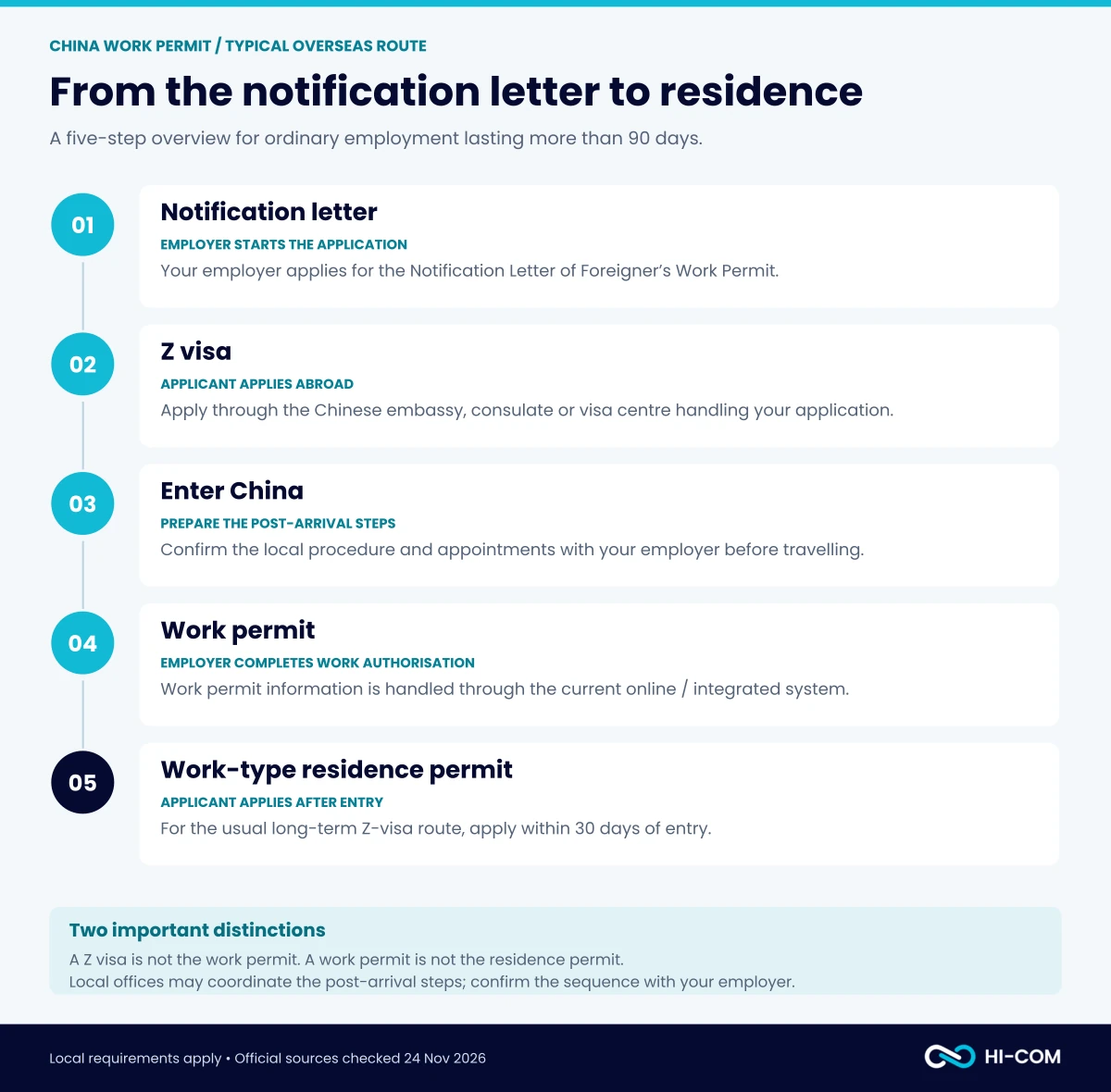
- Your employer applies for the Notification Letter online, using the documents you send.
- You apply for a Z visa at the Chinese embassy, consulate or visa centre, with the notification letter.
- You enter China with the Z visa.
- Your employer applies for the Foreigner’s Work Permit with the local bureau.
- You apply for the work-type residence permit at the Exit-Entry Administration, within 30 days of entry.
Step 1: the Notification Letter of Foreigner’s Work Permit
This is where your documents matter most. The employer uploads your degree, criminal record certificate, proof of experience and their Chinese translations to the online system. If a document is missing an authentication or a translation stamp, the file comes back and the clock restarts.
Step 2: the Z visa
You apply with the notification letter and your passport. Requirements vary by embassy and consulate. If your visa form asks for an inviting organisation, our guide to the inviting entity on a Chinese visa form explains what to write.
Step 3 and 4: entry and the work permit card
After you arrive, your employer completes the work permit application. Local offices may coordinate the post-arrival steps (medical check, work permit, residence permit), so confirm the order and appointments with your HR before you fly.
Step 5: the residence permit, within 30 days of entry
Holders of a Z visa must apply for a residence permit within 30 days of entering China (Shanghai government). Do not let this deadline slip while you settle in: it is one of the most common reasons for fines and stressful extensions.
Documents you need to prepare for a China work permit
This is the part you control. Beijing’s official list includes the application form, proof of work experience, your highest degree, any professional qualification certificate, a no-criminal-record certificate, a health certificate, the employment contract, your passport and a photo. Here is what each one involves.
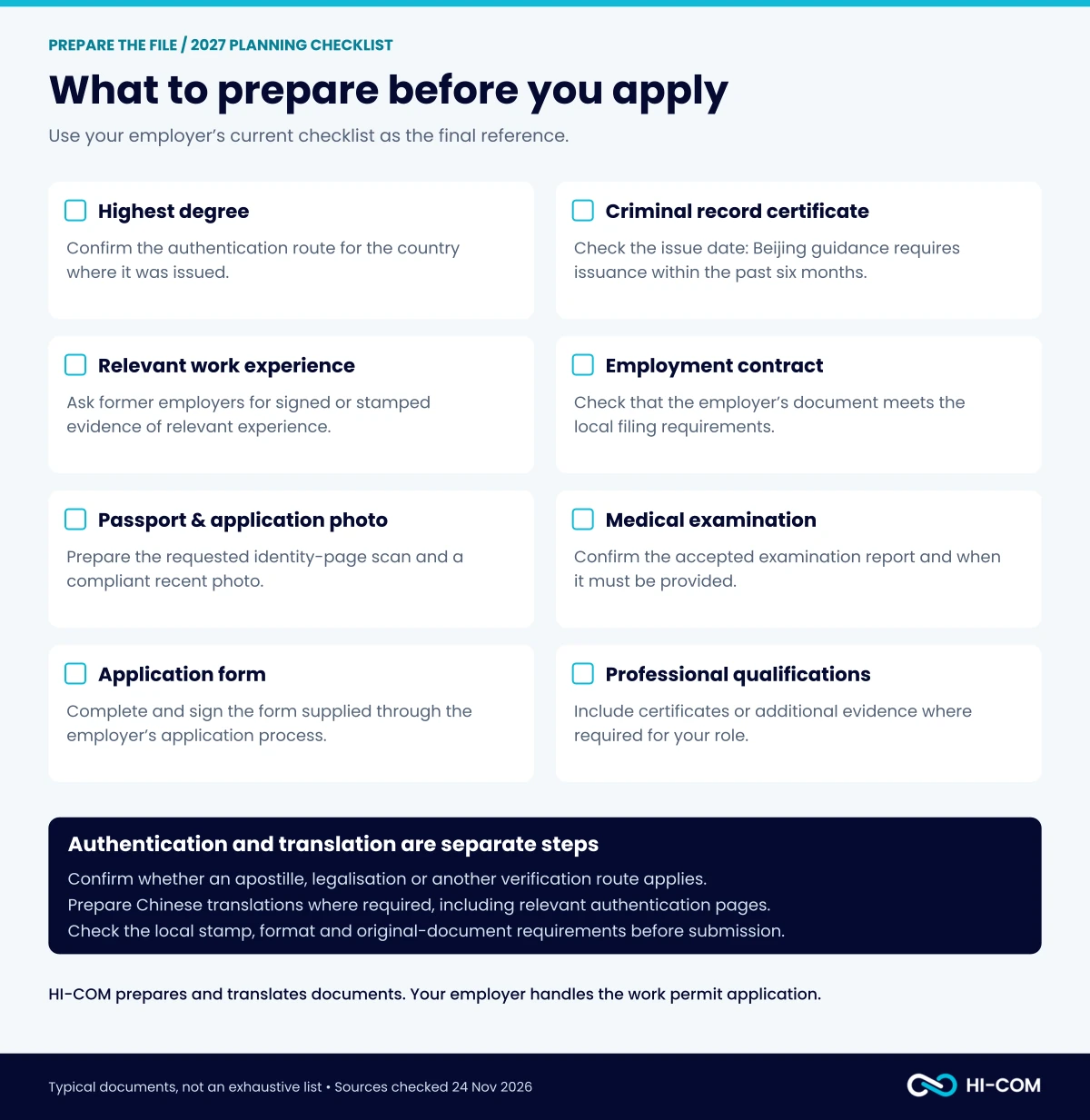
| Document | Requirement | Authentication | Chinese translation |
|---|---|---|---|
| Highest degree | Bachelor’s or higher for Category B | Foreign degree: apostille or Chinese consular legalisation. Chinese degree: original, verified via CHSI | Yes, if not in Chinese |
| Criminal record certificate | Issued within the last 6 months; an affidavit is not accepted | If issued abroad: normally apostille or legalisation | Yes |
| Proof of work experience | Letters from former employers showing position and dates | Ask your employer | Yes |
| Professional qualification | If the job requires one | Often the same route as the degree | Yes |
| Health certificate | Format and timing vary by city | Ask your employer | If issued abroad |
| Passport, photo, form, contract | Valid passport; recent photo; signed form and contract | No | Passport: no |
Degree certificate: apostille or consular legalisation
A degree obtained abroad must be authenticated before China accepts it. Since China joined the Apostille Convention (in force for China on 7 November 2023), degrees from member countries can be authenticated with an apostille issued in the country where the degree was awarded. Degrees from non-member countries go through consular legalisation by a Chinese embassy or consulate. Our China apostille guide explains how the apostille works and which countries are covered.
If you studied in mainland China, you usually only provide the original, and Shenzhen asks for online verification through CHSI (中国高等教育学生信息网, chsi.com.cn). If your Chinese degree must be used abroad later, see how to get a diploma apostilled in China.
Criminal record check: less than 6 months old, no affidavit
Beijing requires a no-criminal-record certificate (无犯罪记录证明) issued within the past six months, from the country where you live or hold citizenship. An affidavit or personal declaration is not accepted. Beijing also accepts certificates issued by an embassy directly. Because of the six-month limit, order this document as soon as you sign the offer, and not before: if your start date slips, it may expire.
If you have already lived in China and need a Chinese certificate for a new job elsewhere, read how to obtain your Chinese non-criminal record.
Proof of work experience
Ask former employers for signed letters that show your position, responsibilities and dates. If one of them is a Chinese company, an employment certificate can be notarised and apostilled in China.
Medical check
Requirements differ by city. Many employers arrange the health check after arrival at a designated centre; others ask for a form completed abroad. Confirm with your HR before booking anything.
Chinese translation: what your local bureau may require
Every document that is not in Chinese must come with a Chinese translation, except the passport. Who may stamp that translation depends on the city:
- Beijing: the translation must carry the employer’s official seal.
- Shenzhen: English documents may be translated by the employer and stamped with its seal; documents in other languages must be translated by a professional translation agency and stamped with the agency’s seal.
So ask your employer which format its local bureau expects before anything is translated. A professional, stamped translation is the safest option when your documents are in French, German, Spanish, Russian or any language other than English, or when your HR team does not want to take responsibility for the translation. If you are unsure of the terms, see the difference between certified, sworn and notarised translation.
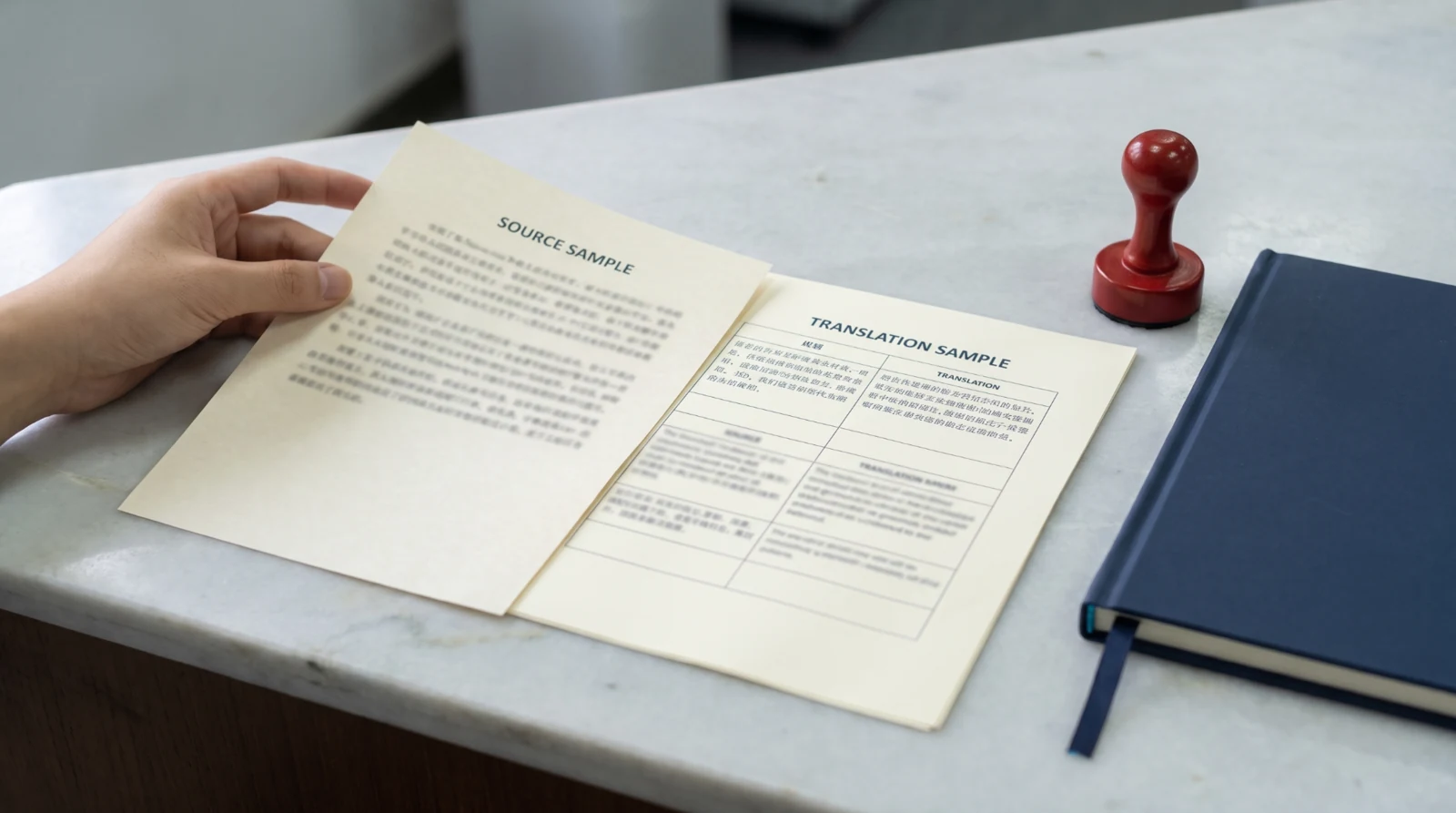
Need your degree or criminal record translated into Chinese?
HI-COM’s ISO 17100-certified team in Shanghai produces stamped certified Chinese translations in the format Chinese authorities expect. Free quote within a few hours, 24 h at the latest.
How HI-COM prepares your work permit documents (A to Z)
Your employer files the application; HI-COM does not. What we do is make sure every document arrives complete, authenticated and translated, so the file goes through the first time.

- Send us your employer’s checklist (or the list from your local bureau).
- We review it document by document and tell you which ones need an apostille, a consular legalisation or nothing at all.
- We tell you which authentication route applies in your country and coordinate the rest. For Chinese documents, we handle notarisation and apostille in China.
- We translate into Chinese with our ISO 17100 team and our registered translation seal, in the format your city expects.
- Scans first, originals after, so your HR can start the online application without waiting for the post.
If the same documents must also be used in Europe, our network of sworn translators in Spain, Germany and Italy can prepare the versions those authorities require.
Hiring several foreign employees?
One contact for every new hire’s documents: work permit files, family visa documents and, later, exit documents. Our Shanghai team can work directly with your HR department in China or abroad. Free quote within a few hours, 24 h at the latest.
How long does a China work permit take?
The official processing is usually the short part. Shenzhen, for example, lists 7 working days for the work permit once the application is accepted. Delays almost always come earlier, while documents are being gathered abroad. Plan backwards from your start date:
- As soon as the offer is signed: order your criminal record certificate and start the degree apostille or legalisation. Authentication times depend on your country.
- When the originals are ready: send scans for Chinese translation and send the full set to your employer.
- Notification letter issued: apply for the Z visa.
- After arrival: medical check if required, work permit, then the residence permit within 30 days.
Short assignments: under 90 days
Short-term work of 90 days or less follows a separate procedure, and a business (M) visa is not a work visa. Read our comparison of the M visa and Z visa before you travel for a project, an installation or a training mission.
Beyond the work permit: other documents you will need translated
A work permit is rarely the last document an expatriate needs. Here is what usually follows.
| When | Typical documents | Read more |
|---|---|---|
| Your family joins you | Marriage certificate, birth certificates for S1/S2 or Q1/Q2 visas | Proof of kinship for a Chinese visa |
| You settle in | Foreign driving licence, children’s school records | Driving in China with a foreign licence (in Shanghai, only two authorised entities may translate licences) |
| During your stay | Contracts, company documents, notarised papers | 20 cases when you need a certified translation in China |
| You leave China | Chinese criminal record, employment or resignation certificate | See the employment certificate and criminal record guides linked above |
Common mistakes that delay a China work permit
- A criminal record certificate that is too old. More than six months at filing, and it is rejected.
- An affidavit instead of an official certificate. It is not accepted.
- A degree without an apostille or legalisation. A notarised copy alone is not enough.
- A translation without the right stamp. Check whether your city wants the employer’s seal or a translation agency’s seal.
- Missing the 30-day residence permit deadline after entering on a Z visa.
What changes in 2027?
What we know: the higher 2026 salary thresholds in Beijing and Shanghai remain in force and apply to renewals, and the online system rejects applications below them. Thresholds are linked to local average wages, so they can move again when those figures are updated. Document rules (authentication, six-month criminal record, Chinese translation) are stable. Before you file in 2027, ask your employer to confirm the current threshold for your category and the translation format of your local bureau.
Young STEM professional? Look at the K visa
Since 1 October 2025, China’s K visa targets young international professionals in science, technology, engineering and mathematics, and it does not require a Chinese employer or inviting organisation. Check the current conditions with the Chinese embassy or consulate in your country.
FAQ
Can I work in China on an M or F visa?
No. M and F visas cover business visits and exchanges, not employment. Long-term work requires a work permit, a Z visa and a residence permit. Short assignments of 90 days or less follow a separate short-term work procedure.
How long is a China work permit valid?
It follows your employment contract and is renewed with it. In Beijing and Shanghai, renewals can be filed up to 120 days before expiry and must meet the 2026 salary thresholds.
Do I need to translate my degree into Chinese?
Yes, if it is not in Chinese. Every non-Chinese document except the passport needs a Chinese translation, stamped with the employer’s seal or, in some cities and for some languages, a professional translation agency’s seal.
Can I apply for a work permit from inside China?
Some people already in China, for example graduates of Chinese universities or holders of certain residence permits, may switch without leaving. The rules depend on your current status and city, so ask your employer and the local bureau.
Does my criminal record need an apostille?
If it was issued abroad, it normally needs an apostille (Apostille Convention countries) or consular legalisation, then a Chinese translation. Certificates issued by an embassy are accepted directly in Beijing. It must be less than six months old.
Is there an age limit for a China work permit?
For Category B, the usual limit is 60. Category A high-level talent can be exempted from age and experience limits.
Send us your employer’s checklist
We’ll tell you what needs an apostille or legalisation and translate the rest into Chinese, with scans first so your HR can file without waiting. Free quote within a few hours, 24 h at the latest.
Rules vary by city and change often. Always confirm requirements with your employer and the local foreign talent bureau.
Official sources: Shanghai: basic procedure; Shanghai: applying for a work visa; Shanghai: points system (August 2026); Beijing: documents to prepare; Beijing: requirements on materials; MOFCOM / Beijing: work permit guide 2024; Shenzhen: list of materials; Shenzhen: Foreigner’s Work Permit; Shanghai: K visa. Analysis: Morgan Lewis, March 2026. Checked 24 November 2026.
HI-COM Asia is a Shanghai-based consulting, marketing and translation company (ISO 17100, TAC member), with offices in Hong Kong and France, that prepares and translates documents for China work permit applications.