





CHINA MARKET CONSULTING · BRAND LOCALIZATION
Brand Naming in China
Choosing/Translating the Right Brand Name
A Key Factor of Your Localization Strategy
Talking about brand name translation, in every brand localisation strategy, also in Chinese brand name localisation or translation, the goals for marketing content are well known: to win the heart of the prospective Chinese customer, but also and above all, to create, maintain and enrich the relationship between the brand and its community.
To reinforce this link over time, personalizing the message of your brand is necessary and can be done in two ways: on the one hand, by listening and getting to know your audience, and on the other hand, by giving your identity a strong presence.

What Is Brand Naming for the China Market?
Brand naming for China is the process of creating or adapting a name so it works in Mandarin, phonetically, visually and in meaning, while staying legally registrable as a trademark. It goes beyond direct translation: a name can sound right and still carry an unlucky, awkward or already-used meaning in Chinese. HI-COM’s naming process combines linguistic evaluation, competitor benchmarking and a trademark uniqueness check before any name reaches a shortlist.
Knowing Your Target Audience: A Key Axis
However, to launch a brand in a foreign country, only by playing on its intrinsic criteria is not enough. Habits and behaviors change from one country to another, which is why a brand that has succeeded in France could be a flop in China.
There is behind all this, a set of values and uses. The target audience remains the most important axis to take into account in any brand localization strategy.
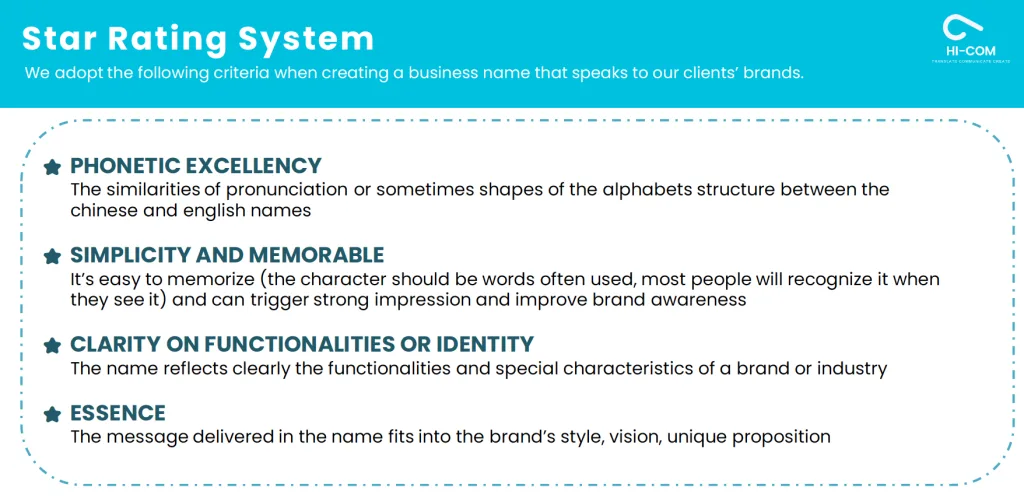
THE STAR RATING SYSTEM
Why Choose HI-COM for Brand Name Translation Service?
When looking for the right translation, HI-COM’s linguistic experts evaluate every candidate name against our Star Rating System, four criteria that assure the Chinese brand name is the perfect match and reflects well the idea behind your brand’s original name:
Want the full breakdown of how this scoring works, with real naming examples like BMW and Coca-Cola? Read our in-depth guide to brand naming in China.
HOW TO GET STARTED
Brand Naming Methodology
We created a systematic product-centric approach to deliver the best suited brand name options for your brand. It’s the same three-step process used on real projects like our work for President Oral Care and COLUN.

Market Analysis
- The Chinese market overview
Benchmarking
- Benchmarking: market leaders
- Brand name benchmarking: leaders in the Chinese market
Proposal
- Brand identity analysis
- Brand name strategy
- 3-5 brand name proposals
- Trademark uniqueness checks
What a Trademark Uniqueness Check Does and Does Not Guarantee
HI-COM’s trademark uniqueness check screens each shortlisted name against existing registrations in the relevant Nice Classification class before it is presented to you, which is what keeps a shortlist realistic. It is not a guarantee of registration: final approval sits with China’s National Intellectual Property Administration (CNIPA), and a name can still be refused for reasons unrelated to prior use, such as descriptiveness. For sectors with a crowded trademark landscape, we recommend running the shortlist past a licensed Chinese IP agent before filing, in addition to our own screening.
HI-COM’s Expertise
Here at HI-COM we have helped hundreds of brands with their brand naming and brand name translation service. With our well established processes, linguistic cross-checks, multilevel benchmarking, and years of experience, we have all the tools you need to make us your number one brand naming service!
Want to learn more about Brand Naming and Brand Name Translation? Read our full guide to brand naming in China, or see common pitfalls to avoid when choosing a Chinese brand name.
Brand Name Translation, What Is Important to Consider?
When it comes to localisation, in China it is not enough just to translate the brand name to Chinese. It is necessary to “re-name” it, making sure that the meaning is retained without bringing any negative meaning into a new location.
It must also stand out and not remind the consumer of the competition. In locations like China, Korea, Japan, and the Middle East, having the right brand naming process is essential to a brand’s success.
Many brands are trying to do brand name translation in-house, which could lead to linguistic misunderstandings, double meanings, as well as resulting in names already taken by other brands in a given category, thus are not available for trademarking.
PROOF, NOT PROMISES
Real Brand Naming Projects
A look at how this process plays out for real clients.
President Oral Care
An Italian oral care brand with 140+ products needed a localized Chinese brand name before entering the China market. HI-COM benchmarked local competitors, ran linguistic and uniqueness analysis, delivered four final name proposals, and registered the chosen name as a trademark in China.
View Case StudyCOLUN
A Chilean dairy cooperative founded by 70 farmers needed a brand name and website that would work across Spanish, English and Chinese as it entered the China market. HI-COM localized the brand name, registered the domain, and delivered a fully translated ES-EN-ZH website.
View Case StudyQUESTIONS, ANSWERED
Frequently Asked Questions
How long does the brand naming process take?
Most projects run through all three steps (market analysis, benchmarking, and proposal) within a few weeks, depending on the complexity of the industry and how many rounds of revisions are needed.
How many brand name options will I receive?
Typically 3-5 final brand name proposals, each scored against our Star Rating System (Phonetic Excellency, Simplicity & Memorability, Clarity, Essence) so you can compare them on the same criteria.
How do you check trademark availability in China?
Every shortlisted name goes through a trademark uniqueness check before it’s presented to you, so you’re only choosing between names that are actually available for registration in your product or service category.
What happens if none of the proposed names feel right?
We go back into the benchmarking and proposal phase with your feedback to refine the direction. The goal is a name you’re confident in, not just the first round of options.
Do you handle the Chinese trademark registration for us?
Yes. As with our President Oral Care project, we can register the selected Chinese brand name as a trademark in China once it’s finalized.
Do you deliver the brand name in both Simplified and Traditional Chinese characters?
By default we deliver Simplified Chinese, since it’s what’s used in mainland China where most of our clients register and operate. If you also need Traditional Chinese, for Hong Kong, Taiwan or Chinese-speaking communities elsewhere, let us know when you brief us and we’ll validate the name in both character sets.
What’s the difference between a brand name translation and a straight transliteration?
A transliteration just maps the sound of your name onto similar-sounding Chinese characters, with no attention to what those characters actually mean together. That’s how some foreign brands end up with names that are confusing or unintentionally negative in Chinese. HI-COM’s naming process scores every candidate on meaning and identity as well as sound, using the four-criteria Star Rating System, so the result works as a real brand name in Chinese, not just as a phonetic label.
Does a positive trademark check guarantee my name will be registered in China?
No. Our uniqueness check tells you whether a name is already registered or in use in your product or service category, which is what most naming conflicts come down to. Final registration, though, is decided by China’s National Intellectual Property Administration (CNIPA), and approval can still be refused for reasons unrelated to prior use. We recommend a licensed Chinese IP agent files the actual application.
Page reviewed and updated August 2026 by HI-COM’s brand naming team.
Brand Naming in Over 40 Languages
Your brand name rarely needs to work in just one market. HI-COM’s linguists cover Chinese and more than 40 source languages, so the same rigorous naming and trademark-clearance process can extend to certified translation and website localization as you expand into new markets.
Ready to Give Your Brand a Name That Works in China?
Send us your brand name, industry and target category, and we’ll tell you what a proper naming process for the China market looks like for your case.