

The China Apostille – How it works since joining the Hague Convention
Since November 7, 2023, China has officially implemented the Apostille system, following its accession to the Hague Convention, which abolishes the requirement to legalize foreign public documents. This major regulatory change has dramatically simplified the use of Chinese documents abroad, replacing the traditional double legalisation process with one single Apostille certificate.
If you need to use Chinese documents overseas, whether it be for business, immigration, education, or legal purposes, this update is essential.
What Is the Hague Apostille Convention?
The Hague Apostille Convention is an international treaty adopted in 1961 to simplify the authentication of public documents exchanged between countries.
So instead of going through both. i.e. authentication by the issuing country, and legalisation by the foreign embassy or consulate, documents now only require one apostille certificate to be legally recognized between member states.
As of October 2023, 125 countries are parties to the Convention, including:
- All EU countries
- United States
- United Kingdom
- Japan
- South Korea
- Australia
- Russia
- Most Belt & Road countries
Since China joined the Convention, public documents exchanged between China and these countries no longer need embassy legalization.
What Is an Apostille?
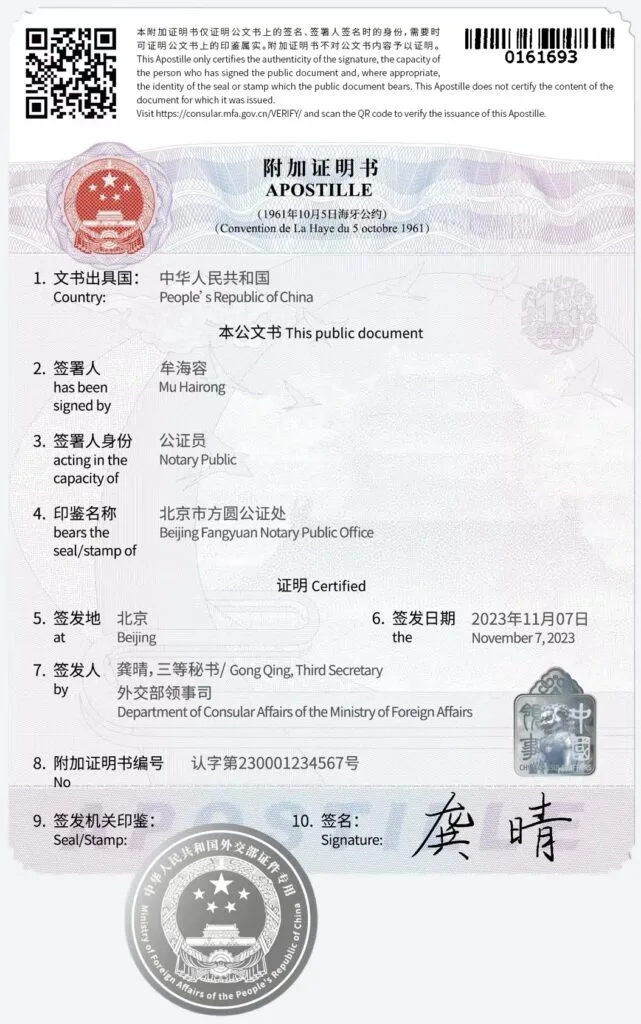
An Apostille is a standardized certificate attached to a public document that confirms:
- The authenticity of the signature
- The official capacity of the signer
- The validity of the seal or stamp
Important! The Apostille does NOT certify the accuracy or legality of the document’s content. It only certifies the authenticity of the issuing authority.
Each Apostille includes:
- Issuing country
- Name and position of the signing party
- Place & date of issue
- Apostille number
- Official seal and signature
All Chinese Apostilles include a QR code for real-time online verification via the Chinese Consular Service system.
What Documents Can Receive an Apostille in China?
Common examples include:
Personal & Legal Documents
- Birth certificates
- Criminal record certificates
- Marriage certificates
- Powers of attorney
- Court documents
- Academic records
Commercial & Trade Documents
- Certificates of origin
- Commercial invoices
- Packing lists
- Inspection & quarantine certificates
- CCPIT-issued documents
The exact requirement depends on the foreign authority requesting the document.
Which Documents Cannot Receive an Apostille?
An Apostille cannot be issued if:
- The signature or seal is not genuine
- The signature does not match official records
- The document format is incorrect
- National or public interests could be harmed
- The destination country is not a Hague Convention member
In non-member countries, traditional consular legalisation still applies.
Key Benefits of the Apostille System in China
-
Much Faster Processing
Average processing time reduced from 20 working days to just a few days — a 90% time saving.
-
Major Cost Reduction
Applicants no longer need to pay embassy legalisation fees. Annual nationwide savings are estimated at over RMB 300 million.
-
Improved Business Environment
Over 70% of China’s export-related commercial documents now benefit from direct certification, making cross-border business faster and more competitive.
Where Can You Apply for an Apostille in China?
Apostilles are issued by:
- The Ministry of Foreign Affairs (MFA)
- Local Foreign Affairs Offices authorized by the MFA
Example: In Shanghai, Apostilles are handled by the Shanghai Foreign Affairs Service Center for documents issued by:
- Shanghai notarial offices
- Shanghai Customs
- Shanghai CCPIT branches
Important:
- Documents must be submitted in sealed envelopes from the notarial office
- No courier submission is accepted
- Apostilles cannot be issued by Chinese embassies abroad
- Documents must be processed in the same region where they were issued
Special Rules for Hong Kong & Macau
- Hong Kong: Requires MFA confirmation, not Apostille
- Macau: Apostille Convention does not apply
Standard procedures remain unchanged
Do You Need an Apostille or Traditional Legalisation?
- ✅ If your destination country is a Hague Convention member → Apostille only
- ❌ If your destination country is not a member → Consular legalisation required
A full list of member countries is available on the Chinese Consular Service website.
In summary, China’s adoption of the Apostille system marks a major improvement for international document use. Whether for business, study, immigration, or legal purposes, the Apostille:
✔ Saves time
✔ Reduces costs
✔ Eliminates embassy legalisation for 100+ countries
✔ Streamlines global mobility
If you regularly use Chinese documents abroad, understanding Apostilles is now essential.