

Inviting Entity in China: Who to List on Your Visa Form (2026)
Last checked: 16 October 2026. Prepared by HI-COM Asia’s translation team.
Quick answer
Your inviting entity or inviter in China is the organisation or person inviting or hosting you for your visit: a business partner, trade fair organiser, school, employer, relative or friend. If nobody in China is inviting you, for example on a self-organised tourist trip, answer No, or the no-inviter option your form offers. A hotel reservation does not make the hotel your inviter.
The question looks harder than it is. You are not looking for “an entity” to fill a field: you are naming the party connected with your visit. This guide shows how to answer it, which documents to check for each visa type, what a China visa invitation letter must include, and when you need a translation.
What Does “Inviting Entity or Inviter in China” Mean?
An inviting entity is an organisation, such as a Chinese business partner, university or trade fair organiser. An inviter is an individual, such as a relative or friend living in China.
When the online application asks, “Do you have any inviting entities or inviters in China?”, base your answer on your actual visit and your supporting documents. Do not pick a company just because the form uses the word “entity”.
Use the application system linked by the Chinese embassy, consulate or visa centre handling your application. Wording and layout differ from one country to another, so a screenshot from another country’s form may not match yours. [1]
“Do You Have Any Inviting Entities or Inviters in China?”: Yes or No?
Answer Yes if you have a genuine host or inviter
For example, you are visiting a Chinese supplier, attending a trade fair or hosted exchange, starting a job or a study programme, or joining a family member.
Enter the host’s correct name and contact details, and keep them identical to your supporting documents. If the form asks for a contact person, distinguish that person from the company or institution they represent.
An employer or school is your host even when the required evidence is a work-permit notice or an admission document rather than an ordinary invitation letter.
Answer No if nobody is inviting you (tourist visa, no inviter)
If you organised an independent tourist trip, select the no-inviter option, usually “No”. Use “Not applicable” only if your form offers it.
Do not invent a Chinese contact to fill a field. If the form blocks you, ask your visa centre how to complete it.
Accommodation is a separate question: enter your hotel where accommodation details are requested.
Who Is the Inviter for Each Chinese Visa Category?
This overview shows the usual host and the documents to check. It is not a complete checklist: always follow the instructions of your place of application. [1][2]
| Visa | Typical host or inviter | Supporting documents to check |
|---|---|---|
| L Tourism | Often none for independent trips; otherwise a travel agency, organisation, friend or relative | Local checklist: itinerary or accommodation evidence, or an invitation, may be requested |
| M Business and trade | Chinese trade partner or trade fair organiser | Commercial-activity documents or an invitation letter |
| F Exchanges and visits | Host institution, organisation or individual | Invitation letter suited to the activity |
| Z Work | Employer in China | Notice for the Work Permit for Foreigners. A company letter alone does not replace it |
| X1 Long-term study | School or university | Admission documents and JW201/JW202 study confirmation (higher education) |
| X2 Short-term study | School or university | Admission notice, plus Form DQ where applicable |
| Q1 / Q2 Family | Chinese citizen or foreign permanent resident living in China | Invitation, host’s ID or residence status documents, and kinship evidence where required |
| S1 / S2 Family of foreigners in China | Foreign national working or studying in China | Invitation, host’s passport and residence permit, and kinship evidence for family visits |
Q and S visas are not interchangeable: the host’s status decides. S1 also covers fewer family relationships than S2. [2]
Tourist requirements vary by country. For example, the Chicago consulate no longer requires flight bookings, hotel reservations, an itinerary or an invitation letter from tourist applicants in the United States. That rule is local: other visa centres may still ask for them. [1]
China Visa Invitation Letter Requirements
Check first whether your visa centre publishes a template. An invitation letter generally covers three areas: [3]
- You: full name, date of birth, passport details and any other identification requested.
- The visit: purpose, dates, places to visit or stay, your relationship with the host and who pays for the trip.
- The inviter: name, address, contact details, and a signature (individuals) or the company seal and legal representative’s signature (organisations).
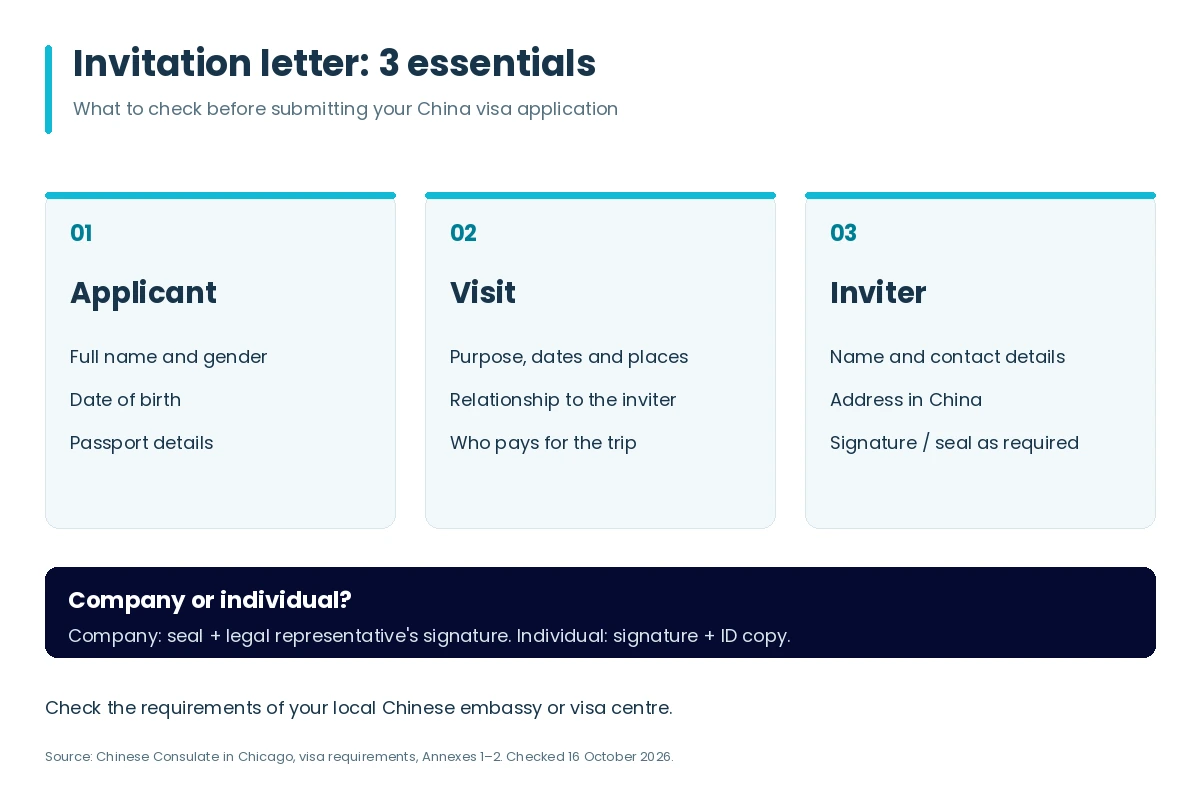
An individual inviter also attaches identity documents: a Chinese ID card for a Chinese citizen, or a passport and residence permit for a foreign resident.
Many visa centres accept a scan or printout but may ask for the original. A nickname instead of the passport name, a missing signature or incomplete company details can delay your application. [2][3]
An invitation letter is not a Verification Letter of Invitation
A Verification Letter of Invitation (邀请核实单), or an Invitation Letter TE, is a separate official document issued by authorised bodies in China. Only some embassies require it, for certain applications. Ask your host to follow the procedure your embassy specifies. [4]
Does a China Visa Invitation Letter Need a Certified Translation?
Not automatically. A letter already written in a language your visa centre accepts may not need translation.
When translation is needed, confirm the target language and the certification format required: wording, signature, seal and any agency documents. A translation does not replace a missing invitation, signature or work-permit document.
HI-COM’s certified Chinese translation service covers invitation letters and other official documents, with our registered translation seal. Send us the receiving authority’s instructions so the translation matches its intended use.
Visiting Family? Check Proof of Kinship Separately
The invitation explains the visit. A birth or marriage certificate proves the relationship.
Q1 family reunion and S1/S2 family visits usually require kinship evidence. For Q2, check your local checklist rather than copying Q1 requirements. [2]
Visa application and residence permit are two different stages
Documents accepted by a Chinese consulate abroad do not settle every requirement for a later residence permit in China.
For example, Shanghai’s immigration authorities require a Chinese translation from a qualified translation agency in China for a foreign-language marriage certificate submitted for a residence permit. The same guidance says an applicant who entered on an S1 visa may be exempt from resubmitting proof of the relationship. [5]
When is an apostille needed?
China has applied the Apostille Convention since 7 November 2023. When a foreign public document must be authenticated and both countries apply the Convention, an apostille from the issuing country generally replaces consular legalisation. [6][7]
An apostille and a translation do different jobs: the apostille authenticates the document’s origin, the translation makes its content readable. You may need both. Shanghai has accepted a printed e-Apostille with a QR code in a residence-permit case; confirm the format with your own office. [5][7]
For document preparation, see HI-COM’s apostille and notarisation support in China.
Do You Need a Visa for Your Trip at All?
Many ordinary passport holders can now visit China visa-free for up to 30 days, for business, tourism, family visits, exchanges or transit. Citizens of France, Germany and most EU countries qualify until 31 December 2026, as do UK and Canadian citizens. Check the current rule for your own passport before applying. [8][9]
The 240-hour visa-free transit is a different policy. It requires an eligible passport (57 countries since 20 August 2026), an onward journey to a third country or region, and staying within the permitted ports and areas. [10]
Visa-free entry does not authorise work. If your trip qualifies, there is no visa form to fill in, but you still complete the normal arrival formalities.
Planning a business trip? Read our China business trip preparation guide.
Checklist Before You Submit
Need Your Supporting Documents Translated?
HI-COM is a China-based translation and localisation company with more than 10 years of experience. Our certified translations carry a registered translation seal. We translate invitation letters, birth and marriage certificates, employment records, diplomas and other documents for visa and residence permit applications.
We pay particular attention to consistency: names, dates, document numbers, stamps and annotations must match across your file. Send us your passport spelling and any previous official translations.
Urgent requests can be prioritised. Tell us the document type, languages, receiving authority and deadline, and we will confirm the turnaround with your quote. Prefer WeChat? Use the WeChat contact on our contact page.
REQUEST A DOCUMENT TRANSLATION QUOTE
Frequently Asked Questions
Is a hotel an inviting entity?
No. A hotel reservation does not make the hotel your inviter. Only if the hotel genuinely invites you, for example to a business event, can it be the inviting organisation. Otherwise, enter it only where accommodation details are requested.
What should a tourist answer to “Do you have any inviting entities or inviters in China?”
If you organised your own trip and nobody in China is inviting you, answer No, or the no-inviter option your form offers. Never invent an inviter.
Can a friend in China be my inviter?
Yes. A friend can invite you with a signed invitation letter and a copy of their ID or residence documents. Check your visa centre’s checklist for the exact documents required.
Must the inviter’s details match the invitation letter?
Yes. Names, contact details, addresses and visit dates should be identical on the form and in the letter. Ask your inviter to correct any discrepancy before you submit.
Do I need a visa for a short business trip to China?
Not if your passport qualifies for China’s 30-day visa-free entry, as French, German, UK and Canadian passports do until 31 December 2026. Otherwise, apply for an M (business) visa. Business visits and employment are different activities.
Can HI-COM translate my invitation letter urgently?
Yes. Urgent requests can be prioritised. Send us the document, the required languages, the receiving authority and your deadline, and we will confirm the turnaround with your quote.
This guide covers mainland China. Requirements vary by place of application: confirm the latest checklist with the Chinese embassy, consulate or visa centre handling your application. Visa and residence decisions rest with the authorities.
Sources
- Chinese Consulate-General in Chicago: visa requirements and new online application system, updated September 2025.
- Chinese Visa Application Service Center, Macao: Chinese Visa Application Materials, 24 August 2026 (category reference, not a universal checklist).
- Chinese Visa Application Service Center, Prague: F visa invitation contents and submission notes, 26 August 2026.
- Chinese Embassy in Iran: Apply for Ordinary Visas, 21 December 2025 (example of embassy-specific TE / Verification Letter rules).
- Shanghai Exit-Entry Administration: marriage certificates for a private-affairs residence permit, 3 September 2026.
- Chinese Consulate-General in Adelaide: Apostille Convention notice, 25 October 2023.
- HCCH: Apostille Section, competent authorities, status table and electronic Apostilles.
- Fujian Provincial Government: extension of China’s unilateral visa-free policy to 31 December 2026, November 2025.
- Ministry of Foreign Affairs of China: UK and Canada visa-free announcement, 15 February 2026.
- National Immigration Administration: Kyrgyzstan and Vietnam added to the 240-hour visa-free transit, 20 August 2026.