





TRANSLATION SERVICES · FINANCIAL & CORPORATE
Financial & Corporate Translation Services in China
Financial and corporate documents carry legal and financial consequences that depend on getting more than the words right — on China’s specific chop-and-seal requirements, its own accounting conventions, and certification rules that vary by which authority is receiving the document. HI-COM provides certified financial and corporate translation for companies operating between China and international markets, from routine statement and registration-document translation to time-pressured due diligence work.

 ISO 17100 certified
 TAC member
 40+ languages
 Financial & corporate specialists
WHO THIS PAGE IS FOR
CFOs & Finance Directors
General Counsel & Legal Teams
M&A & Due Diligence Advisors
Company Secretaries & Compliance Officers
What Happens If Financial or Corporate Documents Aren’t Properly Translated and Certified in China
Financial and corporate documents submitted to Chinese authorities, banks, or courts without the correct certification, chop, or notarization generally aren’t accepted, and in some cases the underlying transaction or filing itself is delayed or rejected as a result. Getting the certification and translation right the first time — including which seal applies to which document, and whether notarization or further legalization is required — is a compliance question as much as a language one.
This is operational guidance based on general practice, not legal or accounting advice. Requirements vary by document, authority and jurisdiction — confirm specifics for your situation with HI-COM or your own counsel before relying on them.
Financial Document Translation
HI-COM translates financial statements, audit reports, bank statements, tax filings, and board resolutions approving annual financial statements — with attention to the details that generic translation misses.
Chinese vs. international accounting standards. China’s Accounting Standards for Business Enterprises (ASBE) have converged substantially with IFRS but still differ in specific, material ways. A translator who doesn’t know the difference will translate the numbers correctly and still mislead the reader.

Fixed-Asset Valuation
IFRS allows a revaluation option for certain fixed-asset classes; ASBE permits historical-cost valuation only — a Chinese subsidiary’s statements won’t reflect asset revaluations an IFRS-reporting parent company might expect to see.
Common-Control Business Combinations
ASBE requires restated comparative figures for entities merged under common control; IFRS has no equivalent specific rule — worth flagging when comparing periods across the two standards.
Employee Benefits
ASBE doesn’t specifically address some benefit types IFRS covers, such as deferred compensation or certain pension arrangements — these may be recorded differently, or not separately itemized, in a Chinese-standard statement.
Adoption Lag
ASBE updates that track new IFRS standards are often delayed, and sometimes not adopted at all — a Chinese subsidiary’s statements may reflect an older treatment than an IFRS-reporting parent uses in the same reporting period.
These are general standards differences, not accounting advice for your specific statements — consult your accountant for how they apply to your filings.
Daxie (大写) capitalized numerals. Formal Chinese financial documents — checks, contracts, official statements — commonly require amounts written in daxie, a set of complex character forms for numerals, distinct from everyday numerals, specifically because they’re far harder to alter fraudulently. A translation that renders these as ordinary Arabic numerals loses this anti-fraud function entirely; HI-COM’s process preserves and explains the daxie figures rather than silently converting them.
The Finance Chop (财务专用章). Financial documents in China are authenticated by a specific seal, separate from the general Official Company Chop (公章): the Finance Chop is used for opening and closing bank accounts and authenticating the finance department’s own statutory documents, including accounting records and tax filings. Banking authorizations commonly also require the Legal Representative Chop (法定代表人章) alongside it — the same chop used for corporate document execution, covered in detail in the section below. Knowing which chop belongs on which document is itself part of getting a financial-document translation and certification right.
Financial documents used outside China often require notarization or further legalization before they’re accepted by the receiving authority. Requirements vary by document and destination — HI-COM can confirm exactly what’s needed for your specific case.
Corporate Document Translation
HI-COM translates business licenses, articles of association, board resolutions, certificates of incumbency, representative attestation and authorization letters, and Foreign-Invested Enterprise (FIE) establishment documents.


Where a corporate document also touches banking or finance matters, see the Finance Chop distinction above.
See Certified Chinese Translation for the certification mechanism itself, and Legal & Contract Translation for bilingual-contract enforceability questions — this section focuses on the corporate documents themselves.
Due Diligence & M&A Translation
Due diligence and M&A translation runs on a different clock and a different risk profile than routine document translation — multiple document types (legal, financial, tax, employment, IP) often need to move in parallel, under real deal pressure, with confidentiality as a first-order requirement rather than an afterthought.
HI-COM is ISO 17100 certified — a concrete, checkable credential rather than an unverifiable security claim — and we scope every due-diligence and M&A project around the specific confidentiality and coordination requirements you set, rather than a one-size-fits-all workflow. Tell us your document volume, languages and timeline, and we’ll confirm exactly how we’ll handle it before work begins.
Discuss a Due Diligence ProjectConfidential intake, no obligation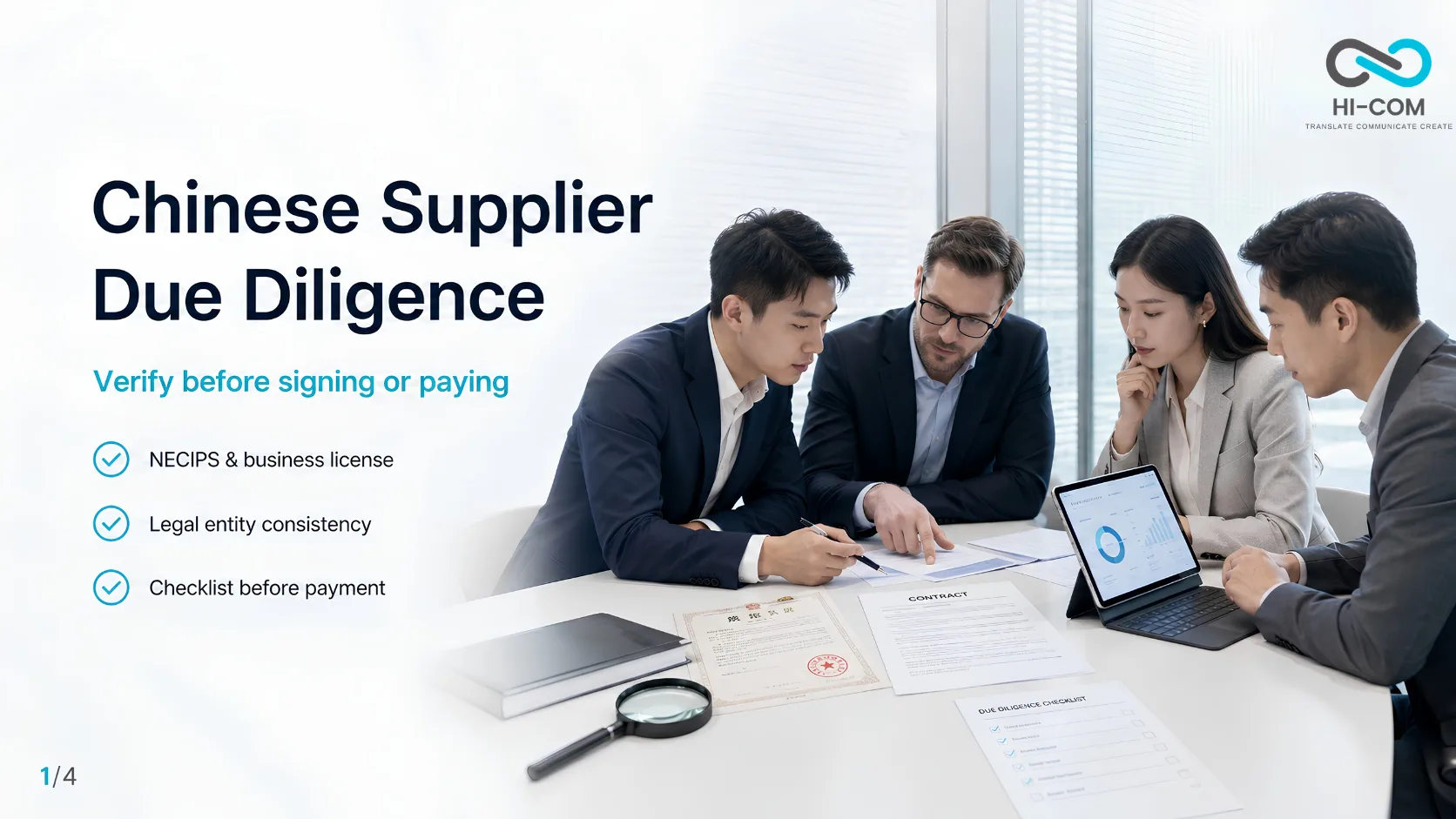
Credentials
HI-COM is ISO 17100 certified and a member of the Translators Association of China (TAC).
Financial & Corporate Document Compliance Checklist for China
A short, practical checklist covering chop requirements, certification, and notarization for financial and corporate documents used in China. Request a copy and we’ll send it to your inbox.
Individual Financial Declarations
Do you translate financial support declarations for student visa applications?
Yes. HI-COM translates and certifies financial support declarations, financial standing declarations, and spousal financial declarations for visa and immigration purposes.
Does a financial declaration for a visa application need to be certified?
Requirements vary by the receiving visa authority; HI-COM can confirm what’s needed for your specific application.
Frequently Asked Questions
What’s the difference between the Official Company Chop and the Finance Chop?
The Official Company Chop (公章) is used for general corporate documents and contracts; the Finance Chop (财务专用章) is a separate seal specifically for banking and the finance department’s own statutory documents. Both may be required depending on the document.
Do you translate financial statements prepared under Chinese Accounting Standards (ASBE) for an IFRS-reporting parent company?
Yes, and HI-COM’s translators flag the specific points — asset valuation, common-control restatement, benefit treatment, and standard-adoption timing — where ASBE and IFRS presentation differs, rather than translating the numbers without noting what they represent.
How much does financial or corporate document translation cost?
Pricing depends on the document type, length, language pair and turnaround required. Contact us for a same-day quote tailored to your documents.
How fast can you turn around due diligence or M&A documents?
Turnaround depends on document volume and complexity — due diligence and M&A projects are prioritized and staffed accordingly. Contact us with your timeline and document volume for a specific turnaround estimate.
Related Services
Ready to Discuss Your Financial or Corporate Translation?
Whether it’s a routine statement or a time-pressured due-diligence project, tell us what you need and we’ll confirm the right approach.

Scan to contact us on WeChat