

EU Machinery Regulation 2027: User Manual Requirements for Machinery Made in China
The EU Machinery Regulation (EU) 2023/1230 applies from 20 January 2027 and replaces the Machinery Directive 2006/42/EC. For user manuals, it sets clear rules on four points: when instructions can be digital, when a paper copy is still owed, which safety information must stay on paper, and which languages each market requires.
If your machines are built in China and sold in Europe, the hard part is rarely the law itself. It is getting a manual that matches the exact machine you ship, written from real engineering information, in the languages of every country where you sell. A good translation cannot fix a manual that is missing a maintenance procedure, and it does not make a machine compliant. This guide shows what to check, and in what order.
Sources checked: 14 October 2026. General information, not legal advice. Product classification, risk assessment and conformity decisions belong to your engineering and compliance team and, where required, a notified body.
Key takeaways
- The main application date is 20 January 2027. Some administrative provisions already apply.
- Digital instructions are allowed, but they must be printable, downloadable and saveable, and stay online for the machine’s expected lifetime and at least ten years.
- A buyer who asks for paper instructions at purchase must receive them free of charge within one month.
- Essential safety information stays on paper when non-professional use is intended or reasonably foreseeable.
- Each Member State decides the language. Do not assume English is enough.
- The manufacturer is responsible for conformity. The EU importer has its own checks to make before placing the machine on the market.
What Changes on 20 January 2027?
The European Commission confirms that the Regulation applies on a mandatory basis from 20 January 2027, and that machinery placed on the EU market before that date must comply with the Directive. Because it is a regulation, the same text applies in every Member State, with no national transposition.
The date that matters is when each individual machine is placed on the EU market, not when the model was designed, ordered or shipped from China. The Commission’s Blue Guide is clear that placing on the market concerns individual products, not product models. Two identical machines can therefore fall under different rules if one reaches the market in December 2026 and the other in February 2027. Plan your documentation around your real delivery schedule.
EC type-examination certificates issued under the Directive remain valid until they expire (Article 52(2)). That does not exempt newly placed machines from the Regulation, so check with your notified body how your certificate fits your conformity route.
Who Is Affected When Machinery Is Made in China?
The rules follow the product and your role in the supply chain, not the country of manufacture.
- Chinese manufacturers exporting to the EU are responsible for the design, risk assessment, technical documentation, instructions and conformity procedure.
- EU importers must check that the manufacturer has done its part before placing the machine on the market: conformity procedure, CE marking, documentation and instructions.
- Importers or distributors selling under their own name or trademark take on the manufacturer’s obligations (Article 17). In private-label projects, settle who owns the manual before production starts.
The volumes are large. In 2025, the EU imported €106.5 billion of “machinery, mechanical appliances and parts” from China, 19.0% of all EU imports from China, according to Eurostat. That is a trade category, not a count of products covered by the Regulation, but it shows how many manuals are about to be reviewed.
One caution on scope: partly completed machinery follows its own route, with assembly instructions and a declaration of incorporation. Confirm the classification of your product before you use a finished-machinery checklist.
Machinery Directive vs Regulation: What Changes for Instructions?
| Topic | Machinery Directive 2006/42/EC | Machinery Regulation (EU) 2023/1230 |
|---|---|---|
| Legal form | Directive, implemented through national law | Directly applicable Regulation, mainly from 20 January 2027 |
| Instruction format | Paper, with digital material as a supplement | Digital instructions explicitly allowed, under conditions |
| Paper on request | No equivalent mechanism | Free of charge within one month when requested at purchase |
| Non-professional use | Instructions and safety requirements already applied | Essential safety information explicitly required on paper |
| Online access | No general retention rule | Expected lifetime, and at least ten years after placing on the market |
| Declaration of conformity | Accompanies the machine | Accompanies the machine, or accessible through an internet address or machine-readable code |
| Languages | Destination-language rules already existed | A language easily understood by users, as determined by the Member State |
Sources: Regulation (EU) 2023/1230, in particular Article 10, and the Commission’s machinery guidance.

Machinery Regulation Digital Instructions: the Three Conditions
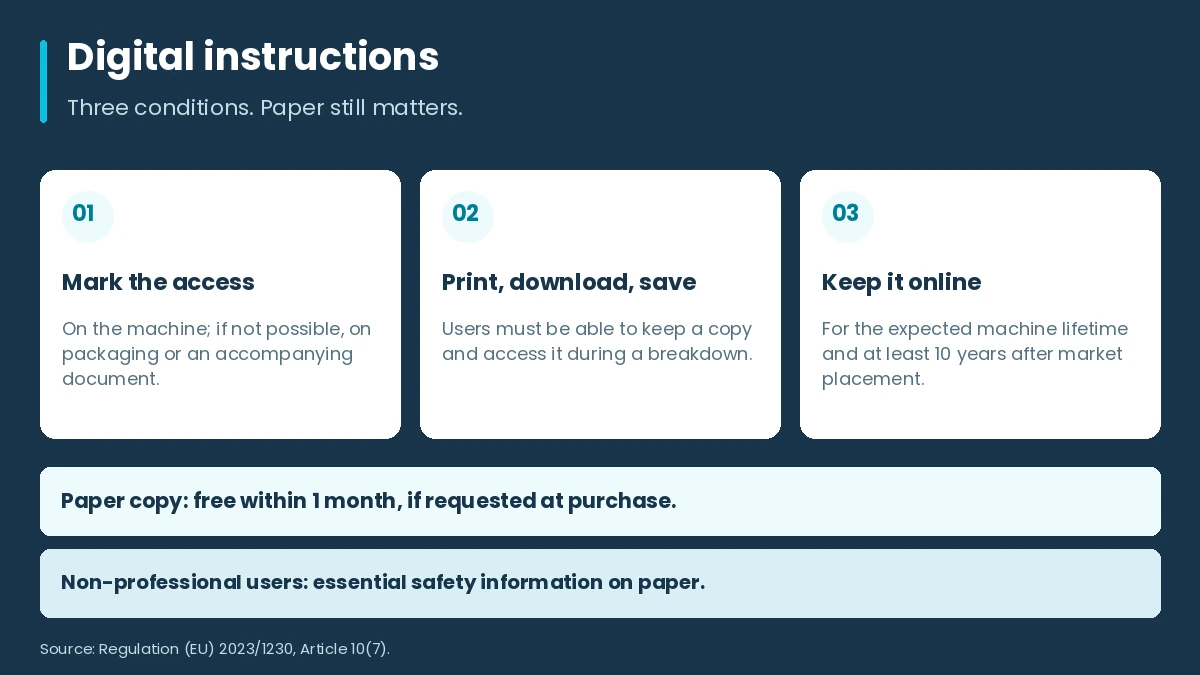
Article 10(7) allows digital instructions only if all three conditions are met:
- Access is marked. The machine, its packaging or an accompanying document tells the user how to reach the instructions.
- The user can keep them. The format can be printed, downloaded and saved, so the manual is still readable when the machine has broken down.
- They stay online. The instructions remain available for the machine’s expected lifetime and at least ten years after it is placed on the market.
A QR code is a way in, not the manual itself. A video, or instructions shown only on the machine’s screen, will not meet the requirement on its own. If you supply the declaration of conformity through a link or code, Article 10(8) sets the same lifetime and ten-year availability, so plan both together.
In practice: use a stable link that will survive a website redesign, make the language choice obvious, keep the exact version that matches each delivered model and configuration, and name the person responsible for keeping it online if your supplier relationship ends.
Paper Copies and Essential Safety Information
Digital does not mean paperless. When a buyer asks for paper instructions at the time of purchase, the manufacturer must provide them free of charge within one month. When non-professional use is intended or reasonably foreseeable, the safety information needed to put the machine into service and use it safely must be on paper.
Keep print-ready files for every language and agree who handles paper requests. If paper will travel with the machine, plan print production in China alongside manufacturing. A request received after the shipment has left needs a separate fulfilment plan.
Machinery Regulation Language Requirements: Is English Enough?
Usually not. Article 10(7) requires instructions and safety information in a language easily understood by users, as determined by the Member State concerned, and Article 21(2) requires the declaration of conformity in the language or languages that Member State requires.
Before you order any translation, build a simple matrix: one row per country of sale, with the languages needed for the operating instructions, the safety information, the digital-access note and the declaration. If someone tells you specialist maintenance instructions can stay in one language, check that exception narrowly. It does not cover the whole manual.
When the engineering source is in Chinese, a reviewed English master version is often a sensible step, but it is a workflow choice, not a legal requirement. We translate user manuals into target-market languages from approved Chinese or English source content.
Manual Content: Check the List, Not Just the Regulation Number
Use Annex III, section 1.7.4.2 as your review list. Check installation, intended use, foreseeable misuse, residual risks, protective measures, training, adjustment, maintenance and emissions against the machine’s own risk assessment.
Not everything on that list is new. Training, maintenance and non-ionising radiation were already in the Directive. The Regulation revises or extends other items, such as rescue information and hazardous-substance emissions. Review the whole list systematically rather than hunting only for 2027 changes.
Most importantly, approve the engineering content before translation starts. If a maintenance procedure is missing from the source, no linguist can invent it. That decision belongs to the manufacturer.
Need approved product information turned into a clear multilingual manual? See our user manual and technical documentation services.
High-Risk Machinery, AI Safety Functions and Software Updates
Annex I splits high-risk machinery into Part A and Part B, each with its own conformity routes. Part A always involves a notified body. It covers removable mechanical transmission devices and their guards, vehicle servicing lifts, portable cartridge-operated fixing and other impact machinery, and safety components or machinery with fully or partially self-evolving behaviour that ensure safety functions. The Commission’s notice C/2024/6142 lists the categories.
Using AI does not put a machine in Part A by itself: the category depends on the function. And Part B machinery cannot always be self-assessed either.
For connected machinery, the Regulation also covers the protection of safety-related software and data, and autonomous operation. For your manual, that means recording the configuration, operating limits and approved updates so the documentation stays consistent with the machine. Ask your conformity specialist whether a later hardware or software change counts as a substantial modification. Always work from the current consolidated text, which includes later amendments.
EU Importer Checklist Before Placing Machinery on the Market
Use these eight checks alongside your full conformity review:
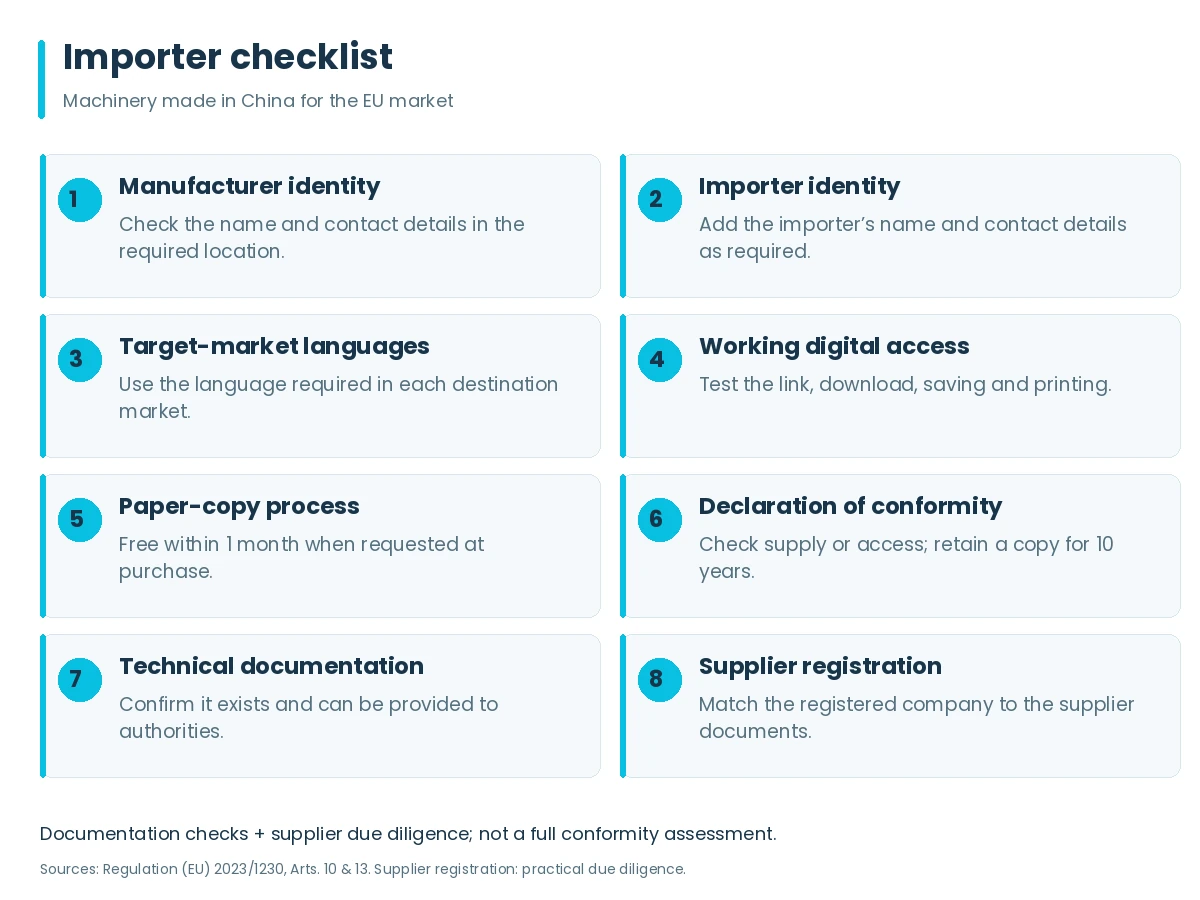
This is not every importer obligation. Article 13 also covers what to do when a product is non-compliant and how to cooperate with authorities.
Beyond Machinery: Other EU User Manual Requirements
Electrical equipment, radio equipment, PPE, toys, construction products and medical devices each have their own instruction rules. Do not reuse a machinery checklist unchanged for them.
For consumer products, the General Product Safety Regulation has applied since 13 December 2024. How it interacts with sector rules depends on the product and the risks those rules already cover. The new Toy Safety Regulation (EU) 2025/2509 applies generally from 1 August 2030, with some provisions earlier, and the construction-products rules are also phased in. The lesson is the same everywhere: check the rules for your exact product.
Our technical translation team supports approved documentation across product categories.
Five Questions to Ask Your Chinese Supplier Before Translation
Before you send anything to translation, ask the supplier:
- Does this manual describe the exact machine and configuration we are buying?
- Have your engineers approved the safety and maintenance content?
- Are component names and terms consistent, and can you send the editable source files and diagrams?
- What is the version number, and who is the technical approver?
- Who answers our technical questions after the order is paid?
If the answers are vague, fix the source first. Agreeing a master version with the supplier costs far less than correcting the same error in six languages.
A Practical Transition Plan for January 2027
| Stage | What to do |
|---|---|
| Now | List the products, your role for each, the target countries and the likely placing-on-the-market dates. |
| Source review | Collect manuals, engineering content and conformity documents. List the open technical questions. |
| Content approval | Close the gaps with the manufacturer and compliance team. Approve the master content and the digital or paper delivery model. |
| Language and layout | Translate, check terminology and warnings, integrate diagrams, and prepare digital and print files. |
| Release check | Match each document set to the shipped configuration, test access, and assign responsibility for versions and hosting. |
Start well before your shipping deadline. Engineering clarification, approval and multilingual layout usually take longer than the translation itself.
How HI-COM Supports Machinery Documentation From China
HI-COM is a Shanghai-based business consulting and localization firm. We combine technical writing, translation and layout in a China-based workflow, working with your product and compliance teams:
- Source development: technical writing with on-site observation in China when the product needs to be documented first-hand.
- Multilingual delivery: translation of approved content, terminology management and linguistic review.
- Layout: text and diagrams integrated into usable digital and print-ready manuals.
- China-side coordination: clarifying source information with your supplier, within the agreed project scope. If you are still choosing a manufacturer, our partner search can extend to supplier sourcing.
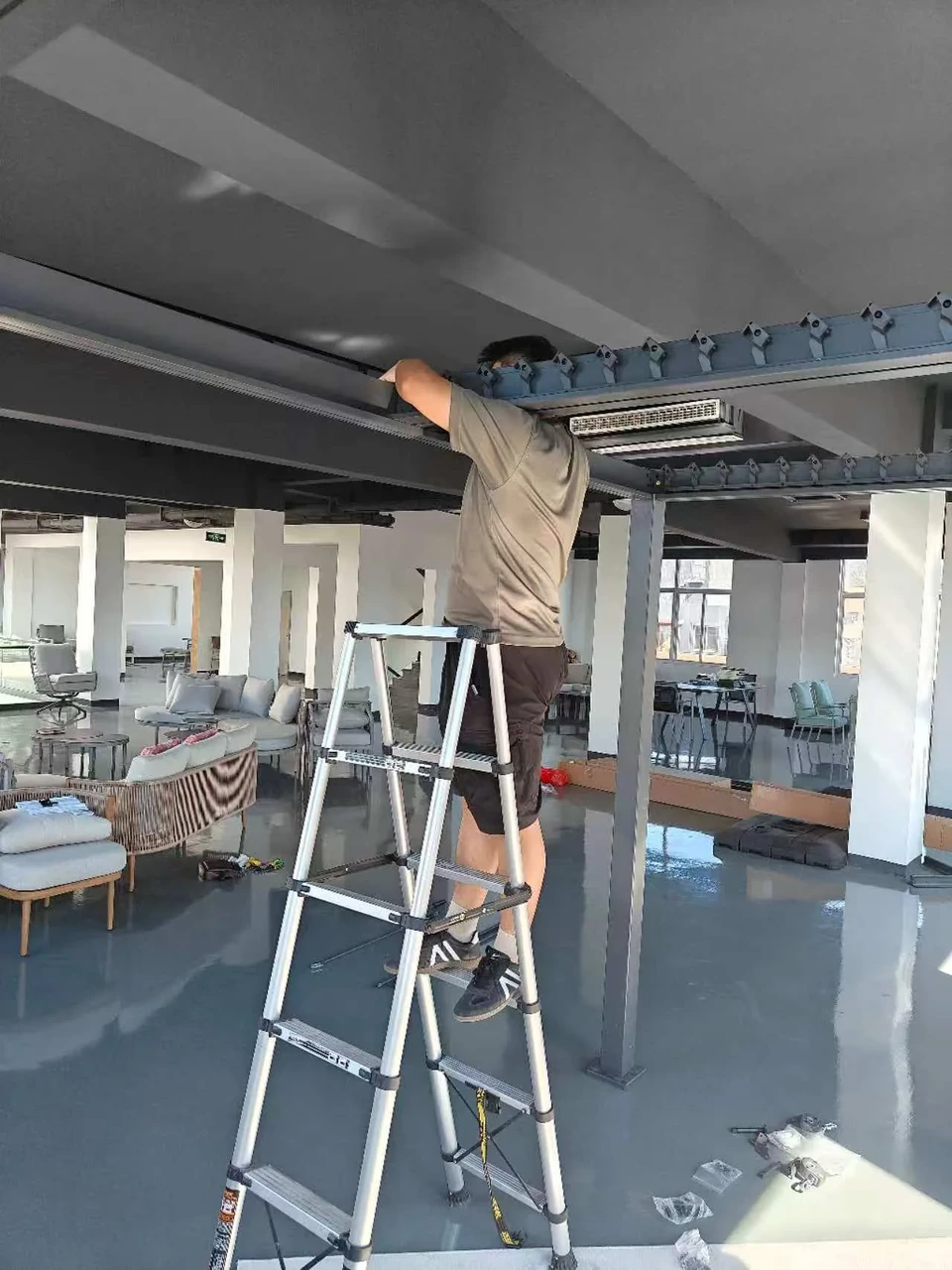
In one published case study, a machine bought from China arrived without a usable manual, and we created one from scratch. It shows the source work a missing manual can require.
Conformity assessment and engineering approval stay with the responsible parties. Our role is documentation, language and presentation, not CE approval or notified-body certification.
Send us a sample manual, the machine type and model, your target countries and your expected placing-on-the-market date, plus any comments from your engineer or conformity specialist. We will scope the writing, translation and layout, and list the source questions for your technical approver.
DISCUSS YOUR MACHINERY MANUAL PROJECT
Frequently Asked Questions
When does the EU Machinery Regulation apply?
Its main application date is 20 January 2027. Some administrative provisions apply earlier. Machinery placed on the EU market before that date must comply with the Machinery Directive 2006/42/EC.
Can a QR code replace a paper machinery manual?
A QR code can lead to digital instructions, but all the Article 10(7) conditions still apply: printable, downloadable and saveable instructions, long-term online availability, free paper copies on request at purchase, and paper safety information where non-professional use is foreseeable.
Is an English manual enough for machinery sold in the EU?
Not automatically. Each Member State decides which language users can easily understand. Build your language scope around the actual countries of sale.
Do I need a digital product passport for machinery under this Regulation?
No. Digital instructions are not a digital product passport. Check separately whether another rule that applies to your product introduces a passport obligation.
Can HI-COM certify that my machine complies with EU rules?
No. HI-COM supports technical writing, translation and layout. Conformity, risk assessment and any third-party assessment remain with the manufacturer and the relevant conformity professionals.
What if my Chinese supplier has no usable manual?
Start with source development: collect the engineering information, document the actual machine and get technical approval. Translation comes once that content exists.
Does January 2027 mean every existing machine must be recertified?
No. There is no blanket recertification just because the date arrives. Machines placed on the market before it stay under the Directive. Later modifications can create separate obligations and should be assessed case by case.
Conclusion
The Machinery Regulation does not ask for more paperwork for its own sake. It asks for a manual that matches the machine, reaches the user in their language, and stays available for as long as the machine is in use. If your machines come from China, start with the source content and the supplier, then translate. That order saves time, money and a difficult conversation with a market surveillance authority.
Prepared by Saveli Yakhnenko, HI-COM Asia, Shanghai. Sources checked on 14 October 2026. This article is general information about EU product rules and is not legal advice.