

Launching an App in China in 2026: App Stores, ICP Filing and Compliance
Published by HI-COM | Prepared 15 September 2026
Launching an app in China is not simply a matter of adding Simplified Chinese and uploading the same build to another store. The market has a distinct distribution structure, its own filing and platform-verification processes, China-specific privacy and data requirements, and a digital ecosystem in which familiar Western services may not be the right technical choice.
For international teams, the practical challenge is coordination. Product, legal, infrastructure, localisation, testing and marketing decisions affect one another. A beautifully localised app can still fail store review. A compliant submission can still perform poorly if its login, maps, payments, notifications or support journey do not work naturally for users in China.
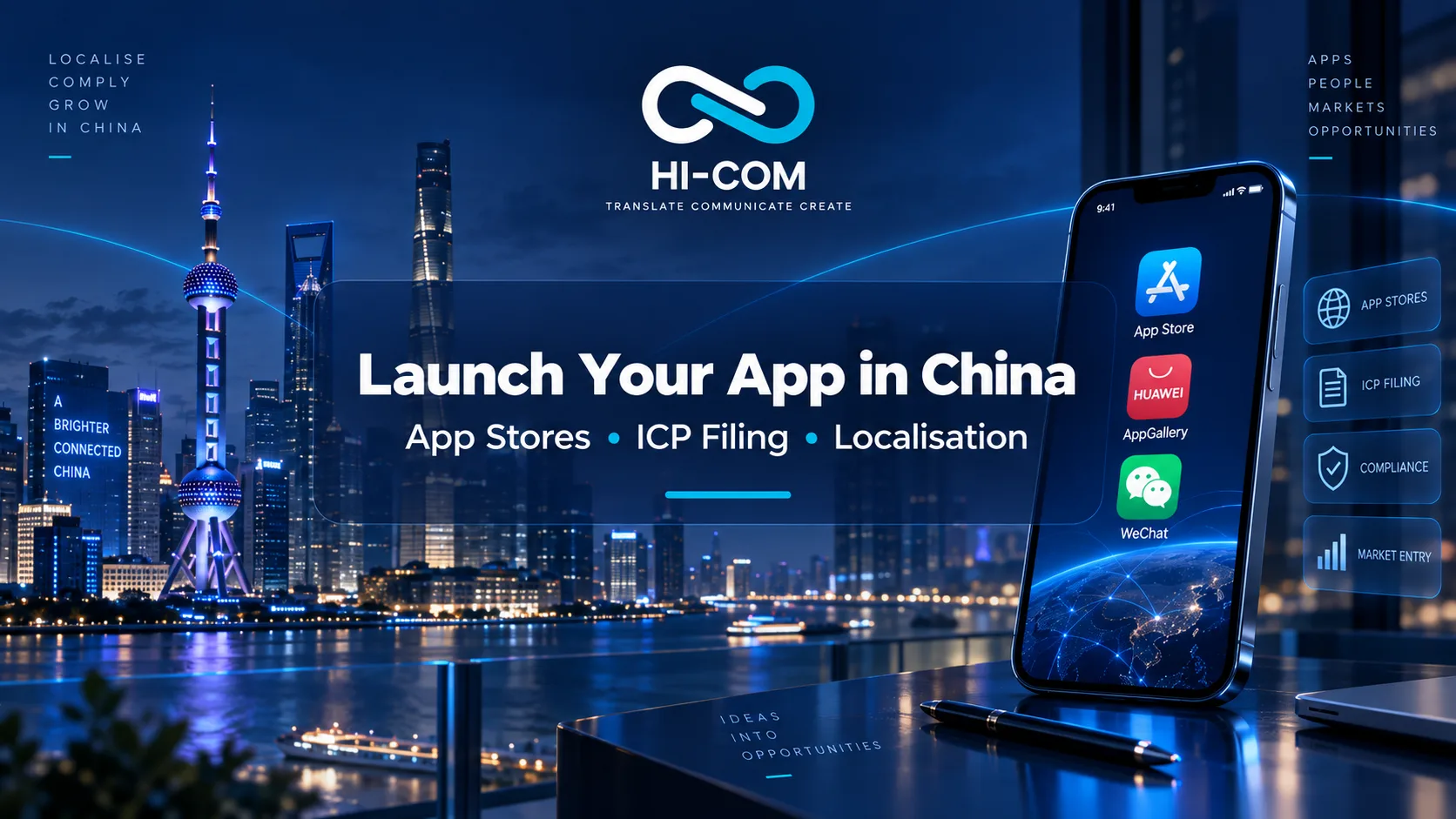
This guide explains the main differences, the leading app stores, the compliance questions to examine and a practical sequence for planning a China launch.
Important: this article provides general business information, not legal advice. Requirements depend on the app’s functions, operator, data flows, sector and distribution model. Confirm the current position with qualified legal and technical advisers before launch.
The short answer: what is different about launching an app in China?
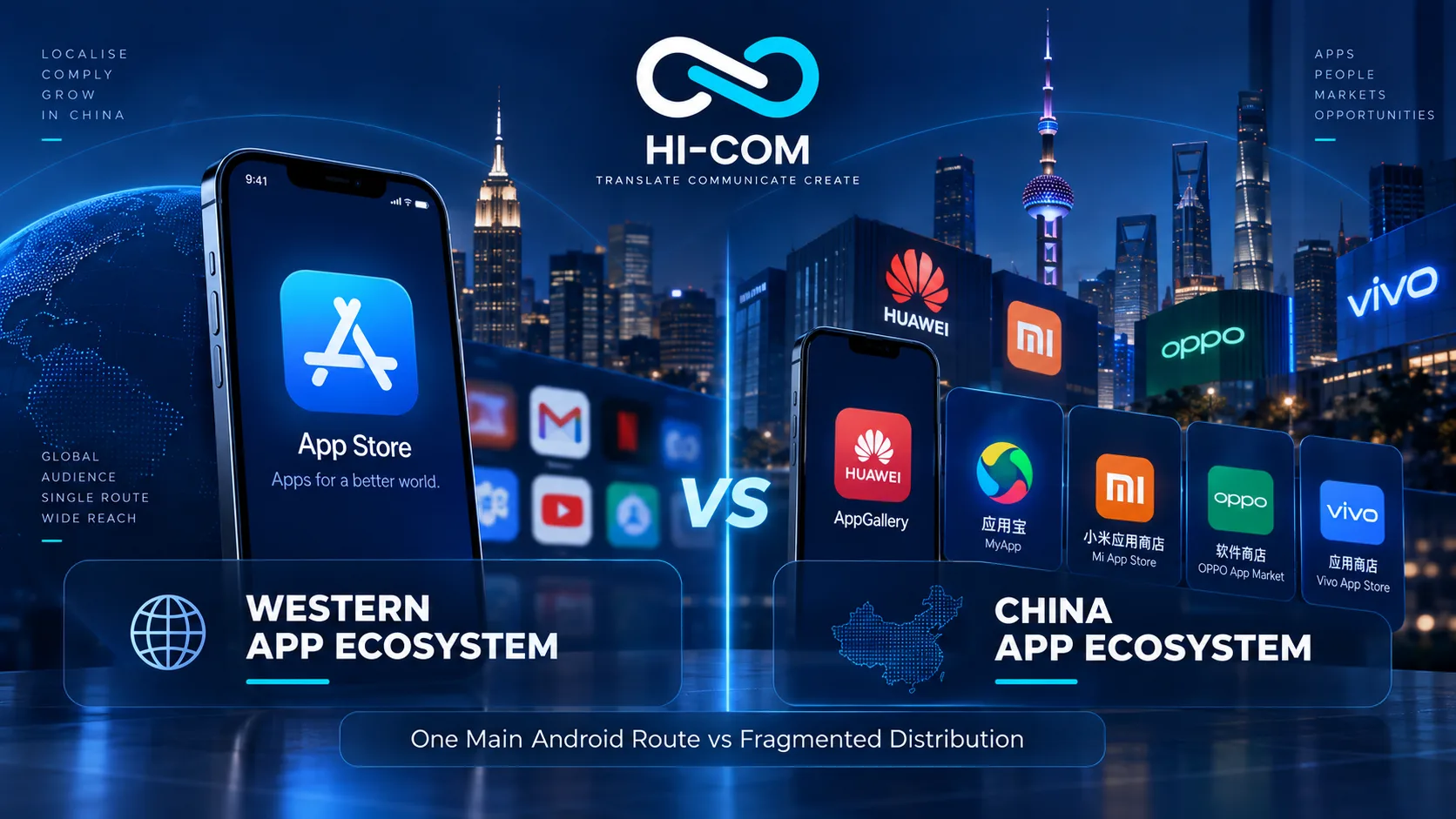
In many Western markets, consumer distribution is concentrated around Apple’s App Store and Google Play. In China, iOS distribution still runs through Apple’s China storefront, while Android distribution is divided among several handset-maker and third-party stores. Google Play should not be treated as a dependable mass-market distribution route for users in China.
At the same time, an app may need an internet information service filing—commonly called APP filing or mobile-app ICP filing—plus platform verification and, for certain categories, additional permits or approvals. The app’s privacy notices, permissions, third-party SDKs, data transfers and technical dependencies also need a China-specific review.
China launch essentials at a glance
- Classify the app’s functions and regulated features.
- Confirm the responsible operating entity and distribution model.
- Assess APP/ICP filing and any sector-specific approvals.
- Map personal information, SDKs and cross-border data flows.
- Decide which iOS and Android stores actually reach the target users.
- Adapt the product, metadata, visuals and support journey for China.
- Test on local devices, networks and third-party services.
- Plan ongoing store updates, compliance reviews and user acquisition.
Western and Chinese app stores: the practical differences
The most visible difference is fragmentation, but the operational effect goes much further.
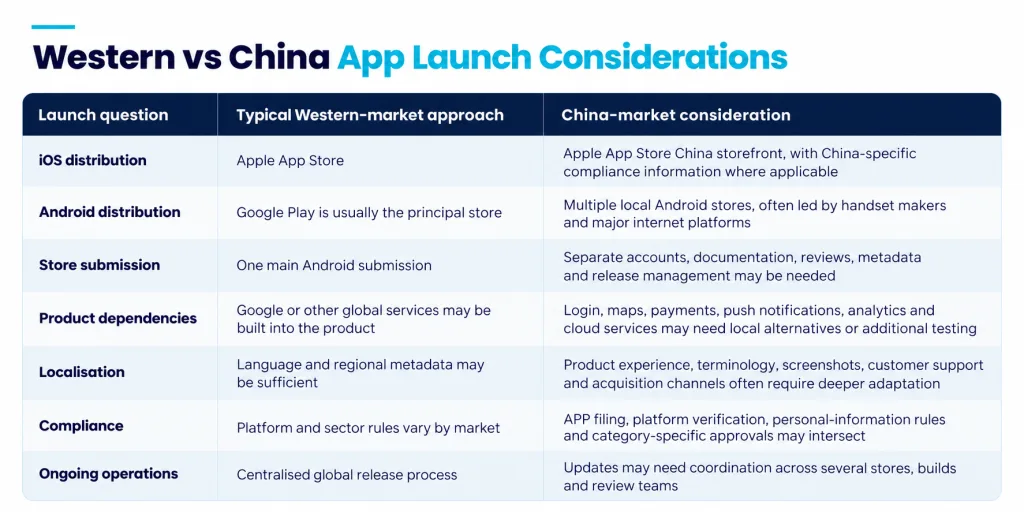
The consequence is simple: distribution strategy should be designed before final development and localisation, not added at the end.
Apple, Google Play and local Chinese app stores
Apple App Store in China
Apple provides a comparatively centralised route to iPhone and iPad users through its China storefront. However, a global App Store listing does not remove China-specific obligations.
Apple’s App Store Connect documentation states that additional documentation is required for some apps offered in China. Where applicable, an ICP filing number must match the information filed with the Ministry of Industry and Information Technology (MIIT). Apple also identifies additional approval requirements for categories including games, news, books and magazines, and religious content.
The operational lesson is to complete the app classification and filing analysis before selecting the China territory in App Store Connect. Store metadata, the operating entity and regulatory records must be consistent.
Source: Apple, “App information,” App Store Connect Help: developer.apple.com
Why Google Play is not a complete China strategy
Publishing an Android app only on Google Play does not provide dependable mainstream reach in China. Android users commonly discover and update apps through local handset-maker stores and other domestic platforms.
This affects more than acquisition. An Android launch may require:
- Several developer-account registrations
- Store-specific identity and compliance documents
- Different review conversations and timelines
- Separate screenshots, descriptions and promotional materials
- Compatibility testing across devices and operating-system variants
- Coordinated version releases and update monitoring
The right question is therefore not “What is the Chinese Google Play?” There is no single equivalent with universal reach. The better question is: “Which combination of stores reaches our intended users and can our team maintain it properly?”
The 2026 operating reality: fragmentation, new filing standards and active enforcement
The gap between a technically functional China build and a store-approved, publicly available release is where most international launches stall. Three operational realities define this gap in 2026.
First, China’s Android store landscape is not merely fragmented—it operates across three distinct operating systems: Android, iOS, and HarmonyOS NEXT, which Huawei launched in October 2024 as an independent platform. Third-party Android stores account for approximately 79% of the market, with Apple’s China App Store at around 20%; HarmonyOS NEXT’s share has not yet been officially reported.
Second, APP filing is no longer a single submission event. The Ministry of Industry and Information Technology issued two industry standards effective 1 August 2026—YD/T 6794-2026 (filing information display requirements) and YD/T 6795-2026 (service category classification requirements), that specify exactly where and how filing information must appear within the app, on distribution platforms, and on smart terminals, and clarify which service categories require pre-approval documents from sector regulators.
Third, enforcement has become quantitative. As of 30 June 2026, 988 generative AI services had completed filing and 598 had completed registration, while the “Qinglang · AI Application Chaos Rectification” campaign disposed of more than 14,000 non-compliant AI products. In the personal information domain, the 2026 special campaign inspected over 20,000 App and SDK implementations, ordered over 4,000 to complete compliance remediation, publicly named over 1,100 with violations, and imposed takedown or other penalties on over 400.
For international teams, these numbers translate into a single operational takeaway: store publication and regulatory filing are not parallel workstreams to be sequenced at the end of the project. They are constraints that shape product architecture, data flows, SDK selection and release planning from the first sprint.
The local Android ecosystem
China’s Android ecosystem includes stores operated by device manufacturers and major technology platforms. Huawei, Vivo, Xiaomi, OPPO and Honor are important because their stores are integrated into their device ecosystems. Tencent, 360, Baidu and other platforms can add reach depending on the app category and audience.
Huawei also deserves separate technical attention. The growth of the HarmonyOS ecosystem means that compatibility assumptions made for a conventional global Android build should be tested rather than taken for granted. The necessary development route depends on the intended devices, audience and current platform requirements.
What are the top 10 Android app stores in China?
The following ranking is based on AppInChina’s September 2026 Android app-store index. It is a third-party market estimate—not an official government ranking—and market shares can change. Apple is not inserted into this table because its iOS storefront and Android-store estimates are not directly comparable.
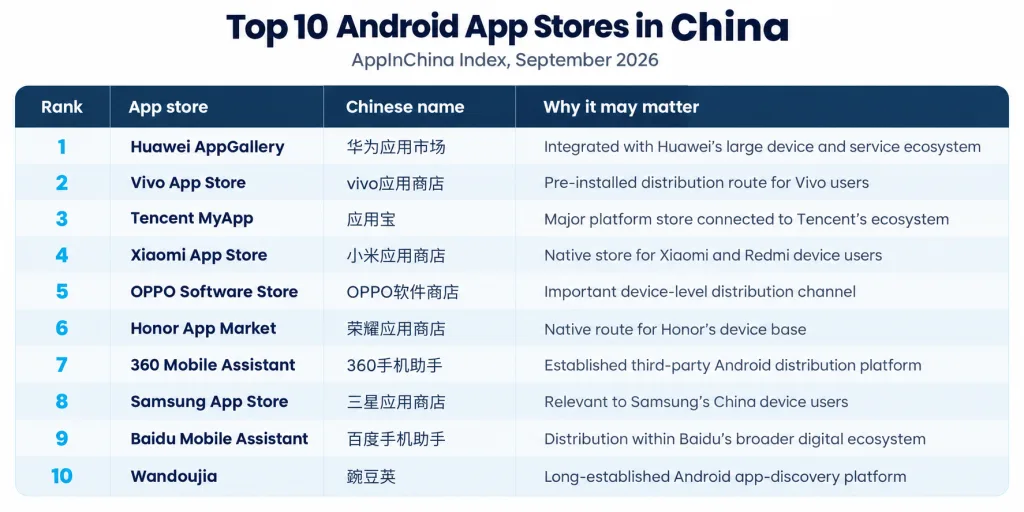
Source and methodology note: AppInChina App Store Index, accessed 15 September 2026: appinchina.co
Do you need to publish in every store?
Usually, no. Maximum theoretical coverage can create unnecessary submission and maintenance work.
A better store-selection model considers:
- The target audience’s device mix
- Consumer versus enterprise use
- App category and monetisation model
- Store eligibility and documentation requirements
- Technical compatibility
- Acquisition opportunities inside each ecosystem
- The team’s ability to maintain releases and respond to reviews
A focused first release may be more effective than publishing everywhere at once. Store coverage can then expand using real download, activation and retention data.
Planning the China version of an existing app? HI-COM’s Software and App Translation & Localisation service can support the linguistic, content and market-adaptation work around the product and its store presence.
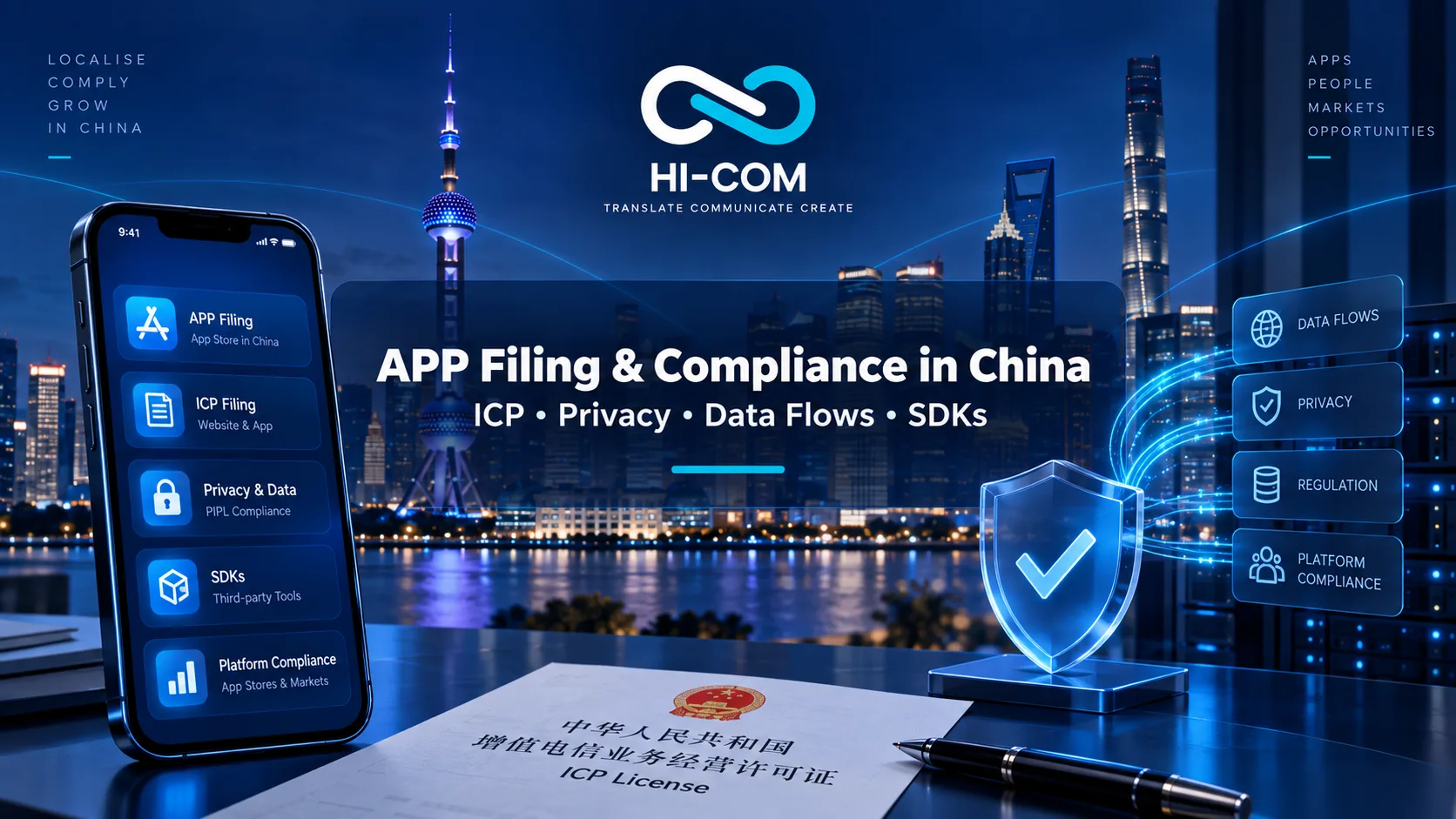
APP filing, ICP and other compliance questions
There is no single “China app licence” that resolves every compliance issue. The correct route depends on what the app does, who operates it, where its infrastructure sits, which data it processes and how it is distributed.
What is APP or mobile-app ICP filing?
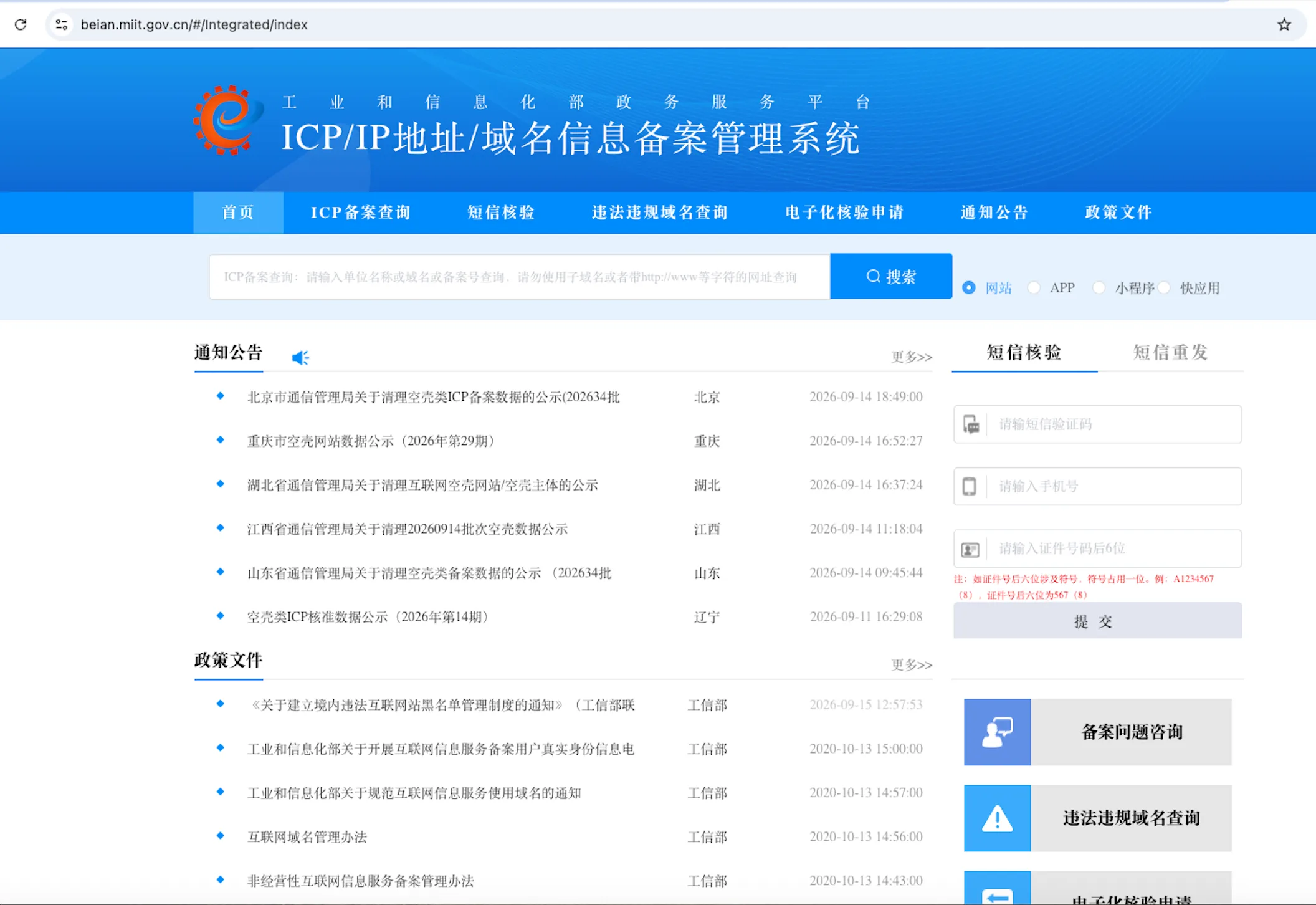
MIIT introduced a filing framework for mobile internet applications that provide internet information services in China. The official notice explains that app operators complete filing procedures through their network-access provider or distribution platform, which submits the information to the relevant provincial communications administration.
The filing commonly associates the app with its responsible entity and basic service information. Platform and infrastructure partners may request materials as part of the process.
APP filing is not the same as an ICP Commercial Licence
These terms are often confused:
- An ICP filing is a registration or record-filing process. It should not be described as a commercial licence.
- An ICP Commercial Licence concerns certain value-added telecommunications activities and is a different regulatory question.
- Sector-specific approvals may still be required even where an APP filing has been completed.
The app’s business model and functions should be reviewed before deciding which requirements apply.

Primary source: MIIT notice on mobile internet application filing, official text reproduced by the Hunan Provincial Government: hunan.gov.cn
Does an overseas developer need a Chinese company?
There is no responsible one-line answer for every app. An overseas-only structure can create limitations around filing, store verification, payments, sector approvals and regulated operations, but the correct structure depends on the service and launch model.
Where APP filing or ICP registration is required, a foreign company cannot complete it in its own name. Both the basic and commercial tiers of filing require a Mainland-registered entity—typically a wholly foreign-owned enterprise (WFOE), a joint venture, or a domestic sponsor—before the filing system will accept the application. A WFOE can generally obtain a basic ICP filing for a non-commercial presence, but commercial activity such as e-commerce, paid subscriptions or advertising generally calls for an ICP Commercial Licence, which carries stricter capitalisation, staffing and business-scope requirements. In practice, this entity requirement is often the single longest lead-time item in the whole launch: teams that begin incorporation only after the product is finished can see a filing they expected to take two weeks stretch into a six-month project. The structure that fits varies by service and operator—but wherever filing applies, the requirement for a qualifying Mainland entity does not.
Before development is finalised, clarify:
- Which entity will be identified as the app operator
- Whether that entity is eligible for the required filing and store accounts
- Who contracts with users and processes payments
- Who controls the servers, SDKs and user data
- Whether a local partner is involved and what authority it receives
- How intellectual property and future updates will be controlled
These are corporate, contractual and regulatory questions. They should be assessed with qualified advisers—not improvised during store submission.
Must the app use servers in China?
Not every China-facing app is automatically required to host every server in China. The answer depends on the service, filing route, data, sector and architecture.
However, China-based infrastructure may offer substantial practical benefits:
- Lower latency for users in China
- More reliable access to APIs and media
- Easier integration with some domestic services
- Alignment with certain hosting and filing arrangements
- Better control over the local user experience
Overseas hosting does not remove Chinese privacy, cybersecurity or sector obligations. Conversely, hosting in China does not make an app compliant by itself.
Test the complete dependency chain
An app may load successfully while critical features do not. Review every dependency, including:
- Authentication and SMS verification
- Email delivery
- Maps and geolocation
- Push notifications
- Payments and subscriptions
- Analytics and crash reporting
- Cloud storage and content delivery
- Customer-service tools
- Embedded web pages
- Third-party login and sharing
Common local integrations can include mobile-number login, WeChat, Alipay, domestic map services and locally effective push-notification solutions. They are product choices, not universal legal requirements.
Privacy, personal information and third-party SDKs
China’s app rules place responsibility on app providers and distribution platforms. Before launch, teams should map the personal information collected directly by the app and indirectly through every SDK.
The review should cover:
- A clear Chinese-language privacy policy
- The purpose and necessity of each data field
- When and how permissions are requested
- Separate consent where required
- Sensitive personal information
- Children’s or minors’ data where relevant
- Account cancellation and data-deletion routes
- Third-party SDK names, functions and data access
- Data retention and access controls
- Cross-border transfers and overseas support access
Do not copy a global privacy policy and change only the country name. The text must correspond to the app’s actual behaviour. Store reviewers and users can compare what the policy says with the permissions and network activity of the product.
Primary source: Cyberspace Administration of China, Provisions on the Administration of Mobile Internet Application Information Services: cac.gov.cn
Cross-border data needs its own decision
If user information is accessed, stored or analysed outside China, map the flow before launch. Relevant requirements may depend on the type and volume of information, the operator and the transfer mechanism. Avoid assuming that a global analytics, support or cloud configuration can be reused unchanged.
Which apps may need additional approvals?
APP filing does not replace category-specific requirements. Additional review or approval may apply to functions or content involving areas such as:
- Games
- News and publishing
- Audiovisual content and live streaming
- Maps and location services
- Finance, payments or investment
- Healthcare, medicine and medical devices
- Education
- E-commerce
- Religious information
- Algorithmic recommendation
- Deep synthesis
- Generative artificial intelligence
The wording “may apply” is important. Requirements turn on the actual product, not only the category selected in an app store.
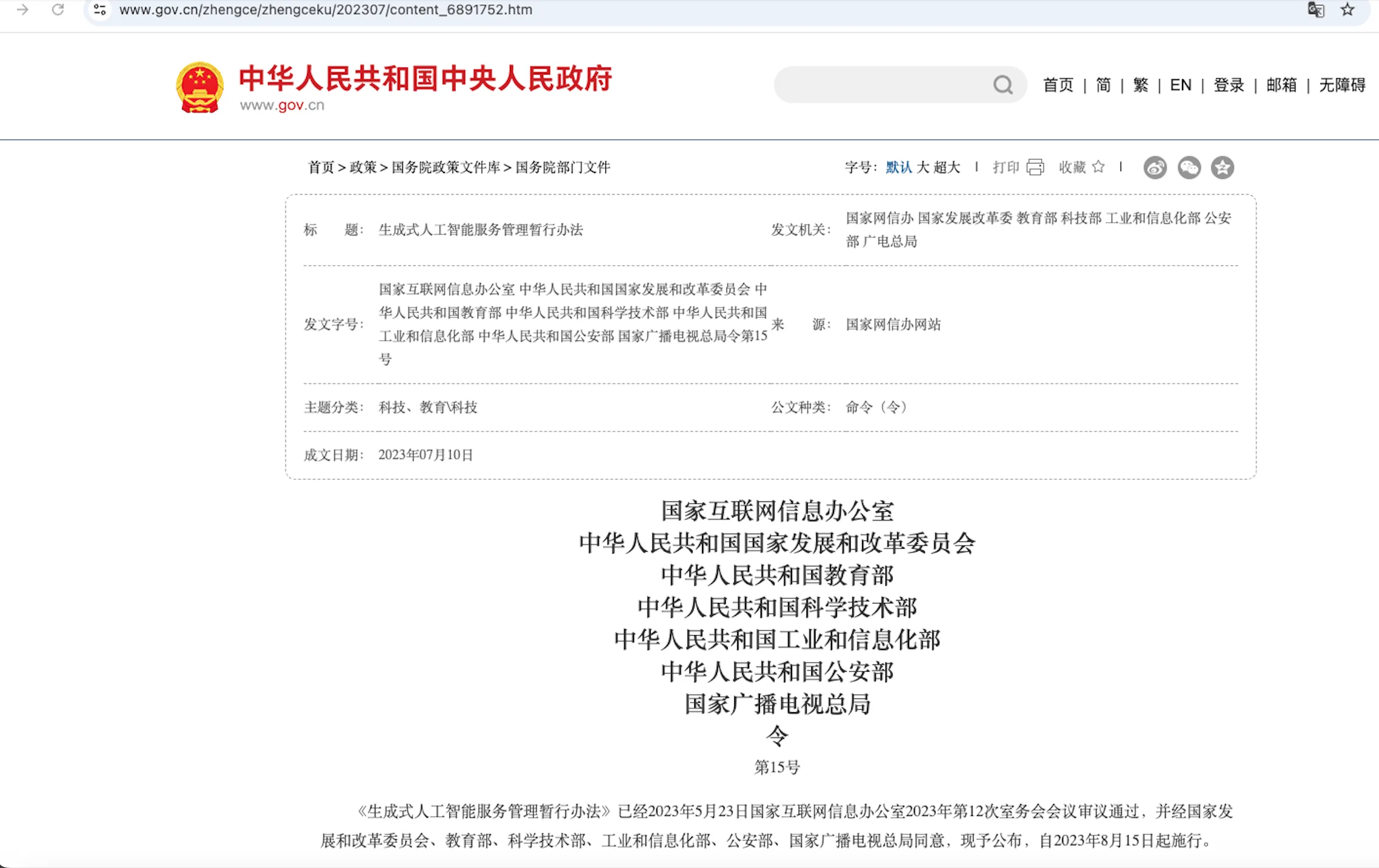
AI-enabled apps in China: compliance starts with the feature map
Adding an AI assistant, generative search function, image generator or automated recommendation layer can change the compliance analysis. “AI-powered” is not merely a marketing label when the product processes user prompts, generates public-facing content, profiles behaviour or provides a regulated service.
Questions to answer before launching an AI feature
- Is the AI function available to the public or only to internal enterprise users?
- Does it generate text, images, audio, video or synthetic identities?
- Can users publish or share generated content?
- Does it use recommendation algorithms to shape what users see?
- What personal or sensitive information enters prompts, logs or model-improvement workflows?
- Is data sent to a model or infrastructure outside China?
- How are prohibited, unsafe or misleading outputs handled?
- Are generated or synthetic outputs labelled where required?
- Does the feature operate in finance, medicine, education or another regulated field?
- Which entity is accountable for the service and user complaints?
An AI feature should therefore be included in the initial product classification, privacy mapping, content-governance and infrastructure review. Adding it just before submission can force costly changes to notices, consent flows, moderation, architecture and store materials.
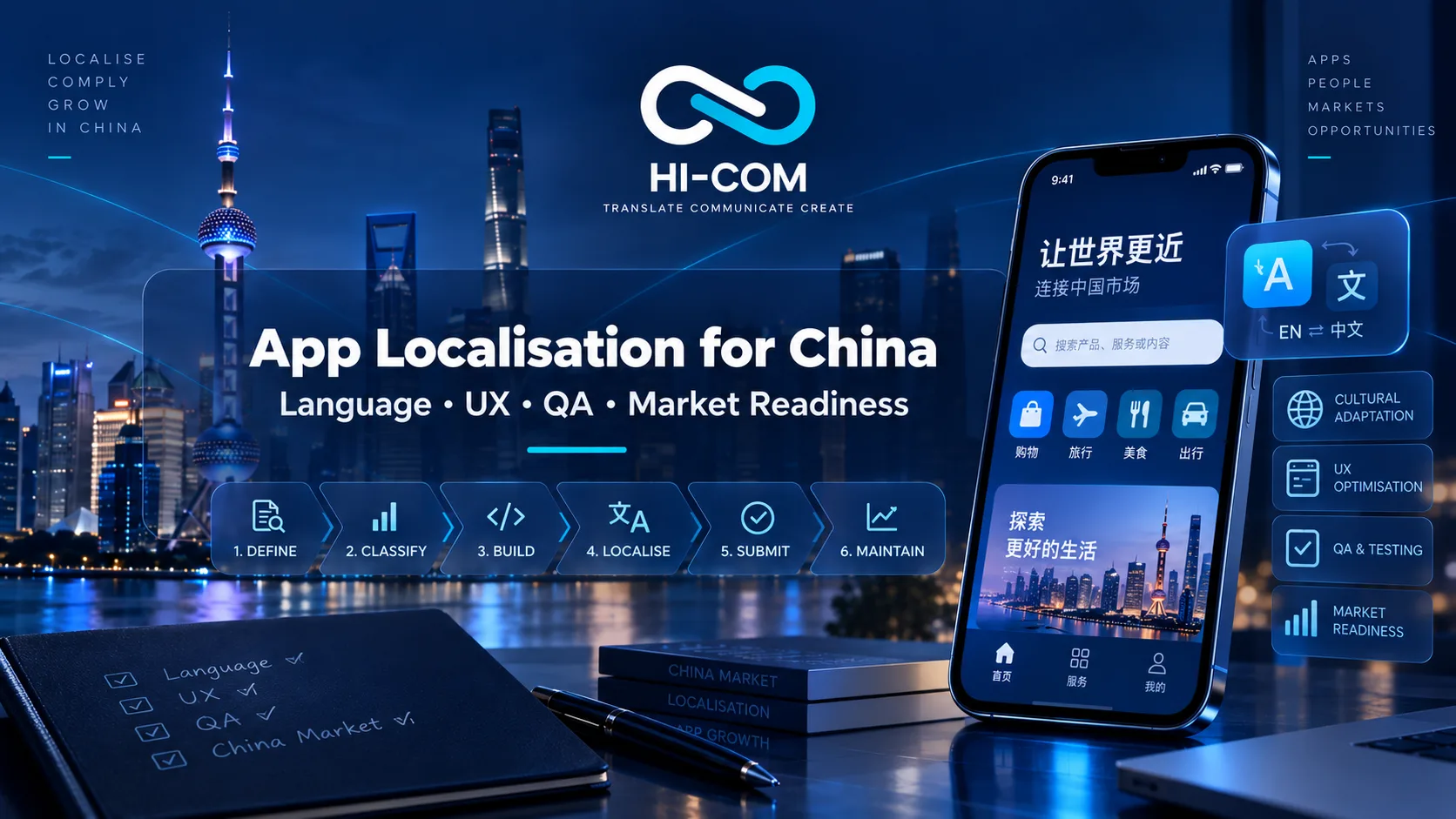
A practical China app launch framework
The following six-stage framework is designed to prevent late surprises. It is not a substitute for a legal assessment; it is a project-management tool for bringing the relevant teams together.
Stage 1 — Define the China product
Commercial scope
- Who are the target users?
- What problem does the app solve for them?
- Is the model B2C, B2B, employee-only or partner-only?
- Which functions will be available at launch?
- How will the app acquire users and generate revenue?
Product scope
- iOS, Android or both?
- Smartphone, tablet, mini-program or another format?
- Separate China build or shared global codebase?
- Which global features may be removed, replaced or adapted?
Output: a one-page China product and feature map.
Stage 2 — Classify compliance and ownership
Responsible-party review
- Identify the proposed app operator.
- Confirm the developer-account owner.
- Review APP/ICP filing eligibility.
- Identify regulated content or services.
- Map contracts, payments and customer responsibility.
Data review
- Inventory all personal-information fields.
- List every SDK and permission.
- Draw local and cross-border data flows.
- Identify AI inputs, outputs and logging.
Output: a responsibility matrix showing who owns each decision and approval.
Stage 3 — Design the technical architecture
Infrastructure
- Compare local, overseas and hybrid hosting options.
- Test latency and service availability from China.
- Review APIs, content-delivery networks and embedded web pages.
- Select workable login, maps, payment, analytics and notification services.
Compatibility
- Define the priority device matrix.
- Review Android-store and Huawei/HarmonyOS requirements.
- Plan build signing, version control and update delivery.
Output: a validated architecture and dependency register.
Stage 4 — Localise the complete experience
Product language
- Localise the interface in context, not from isolated strings.
- Build a terminology glossary for product and support teams.
- Check text expansion, truncation, placeholders and error messages.
- Adapt dates, units, currencies, address fields and forms.
Trust and discovery content
- Prepare Chinese store titles, descriptions and keywords.
- Adapt screenshots and preview videos to real user priorities.
- Align privacy notices, permission prompts and help content.
- Prepare customer-service and review-response language.
Output: a linguistically tested China release candidate and store-content kit.
Stage 5 — Submit strategically
Store plan
- Select stores using audience and device evidence.
- Confirm each store’s current document list.
- Prepare test accounts and review instructions.
- Coordinate iOS and Android release timing.
- Record credentials, account ownership and renewal obligations securely.
Output: a submission tracker with status, reviewer feedback and actions.
Stage 6 — Launch, learn and maintain
Post-launch control
- Monitor crashes, failed integrations and network performance.
- Track downloads, activation, retention and acquisition source.
- Respond to Chinese-language reviews and support enquiries.
- Maintain consistent releases across stores.
- Recheck filings, permissions, SDKs and policies when features change.
Output: a monthly product, store and compliance review.
App localisation in China is market engineering, not word replacement
A product can be accurate in Chinese and still feel foreign, confusing or unreliable. Effective localisation connects language with interface behaviour, digital conventions and the user’s expectations.
Interface and terminology
Translators need context: screen captures, character limits, variables, user journeys and feature definitions. A shared glossary is especially important when the same terms appear in the app, store page, privacy policy, website, support centre and advertising.
Store listing and app-store optimisation
Chinese store content should be written for local discovery and conversion. This includes the app name, subtitle, descriptions, screenshots, benefit sequence, update notes and support responses. Literal reuse of an English listing often misses the questions Chinese users ask before downloading.
Linguistic and functional quality assurance
Testing should occur on real target devices and networks. Reviewers should check:
- Truncated or overlapping text
- Wrong variables and untranslated strings
- Inconsistent terminology
- Input methods and form validation
- Broken local integrations
- Permission timing and wording
- Error messages and recovery paths
- Screenshot-to-product consistency
China-market communication after launch
Store publication is not the same as market entry. User acquisition may involve Chinese search, social and content platforms, partnerships, communities, media relations or sector-specific channels. The right mix depends on whether the app serves consumers, professionals, enterprise buyers or an existing customer base.
How HI-COM supports China app localisation and market readiness
HI-COM combines language expertise with practical knowledge of China’s business and digital environment. This matters because the interface, store content, privacy wording, technical documentation, launch communication and user support must tell one coherent story.
Depending on the project, HI-COM can support:
- Simplified Chinese app and software localisation
- Product terminology and multilingual glossaries
- App-store descriptions, screenshots and promotional content
- Linguistic adaptation of privacy, help and user-agreement content supplied or approved by the appropriate advisers
- Website and launch-content localisation
- In-context linguistic quality assurance and user testing
- China-market messaging and digital communication
- Coordination across international and Chinese-speaking stakeholders
HI-COM does not replace the legal, cybersecurity, hosting or sector specialists responsible for formal advice and approvals. Our role is to help international teams identify the China-specific communication and localisation questions early, prepare market-ready content and reduce the gaps that appear when product, language and launch teams work separately.
A practical first conversation
If you are evaluating a China launch, share:
- The app category and main functions
- Intended users in China
- Current platforms and languages
- Whether the app uses AI, payments, maps or regulated content
- Current hosting and major third-party SDKs
- Preferred launch date
- Existing source files, screenshots and store content
HI-COM can then help scope the localisation, content and China-market communication work, while flagging questions that should be directed to the relevant legal or technical advisers.
Discuss your app localisation project with HI-COM
Frequently asked questions about launching an app in China
Is Google Play enough to launch an Android app in China?
No. Google Play should not be treated as a dependable mass-market route for China. Android distribution is fragmented across several local stores, including device-maker platforms. Store selection should reflect the target audience, app category, device mix and maintenance capacity.
Does China have one main Android app store?
No single Android store provides universal reach. Huawei, Vivo, Tencent MyApp, Xiaomi, OPPO and Honor are among the leading platforms in a September 2026 third-party market index, alongside several other stores. Rankings change, so confirm current audience and device data before submission.
Does an app need an ICP filing in China?
Apps providing internet information services in China may fall within MIIT’s APP-filing framework. The answer depends on the service and operating arrangement. APP filing is a record-filing process and should not be confused with an ICP Commercial Licence or sector-specific approval.
Must the app’s servers be located in China?
There is no universal rule that every China-facing app must place every server in China. Hosting decisions depend on the app, data, sector, filing route and architecture. China-based infrastructure can improve performance and support some operating arrangements, but it does not create compliance automatically.
Does a foreign app developer always need a Chinese company?
Not in every situation. However, the operator’s identity and eligibility affect filing, store accounts, payments and regulated services. Determine the appropriate entity or partner structure for the specific product before submission.
Is app translation the same as app localisation?
No. Translation changes language. Localisation adapts the complete experience: interface terminology, layouts, forms, store metadata, screenshots, local integrations, help content, quality assurance and market communication.
Are AI apps subject to additional requirements in China?
They can be. Public generative AI, deep-synthesis and algorithmic-recommendation functions may raise additional filing, content, labelling, data and security questions. The assessment depends on the actual function, audience and deployment model—not simply the use of the word “AI.”
How long does a China app launch take?
There is no reliable universal timeline. Entity setup, filing, sector approvals, architecture changes, localisation, testing and multiple store reviews can all affect timing. A function-level assessment is needed before promising a launch date.
Build the China launch plan before building the final release
The strongest China app launches begin with the ecosystem, not the upload button. They define the intended users, operator, data flows, store mix and technical dependencies before finalising development and marketing.
That preparation does not make the project needlessly complex. It prevents the expensive version of complexity: discovering late that a critical service does not work, a store needs different documentation, the privacy text does not match the product or the interface was localised without understanding Chinese users.
Planning to adapt an app for the Chinese market? Share your app type, target users, current languages, platforms and intended launch model with HI-COM. We can help assess the localisation, content and China-market communication requirements and build a practical scope for the next stage.