

Before You Sign a Distributor in China: 8 Terms to Agree First
Before signing a distributor in China, agree in writing who owns and registers your trademark, how far exclusivity reaches, who controls your online stores and social accounts, what sales targets apply, how pricing works, who pays for marketing, and what happens to stock, stores and brand assets if the relationship ends. These points are far easier to settle before the first order than after it.
A distribution partner is often the fastest route into China. You do not need your own entity, and a good distributor brings warehouses, retail relationships and online sales channels you would otherwise spend years building. If you are still weighing this route against a company of your own, start with deciding between a distributor and your own entity in China.
The timing matters too. Official commentary on China’s 15th Five-Year Plan (2026–2030) points to stronger domestic consumption and more imports of premium consumer goods and advanced equipment. That is a policy signal, not a sales guarantee, but it explains why many international brands are revisiting the distribution question this year.
A distributor also brings leverage. Once your products, your Chinese brand name and your online stores sit inside someone else’s business, changing course becomes slow and expensive. The eight terms below are where that leverage is decided.
Quick takeaway
- Register your trademarks in China, in your own company’s name, before you share brand plans.
- Grant exclusivity in exchange for results, not in advance.
- Keep online stores and social media accounts under your control, or make handover a written obligation.
- Plan the exit before you sign the entry.
First, Check Who You Are Actually Signing With
Before negotiating terms, confirm that the company across the table is the company that will sign. Ask for the full Chinese legal name and the Unified Social Credit Code, then check them against the official registry. Look at the operating status and the business scope, and make sure the signing entity is the one that actually runs the stores, warehouses and sales team you were shown.
Our guide on how to check a Chinese company with NECIPS walks through this step by step. A registry check confirms legal existence, not commercial quality, so combine it with references from brands the distributor already carries and a close look at its real sales channels.

The 8 Terms to Agree Before You Sign a Distributor in China
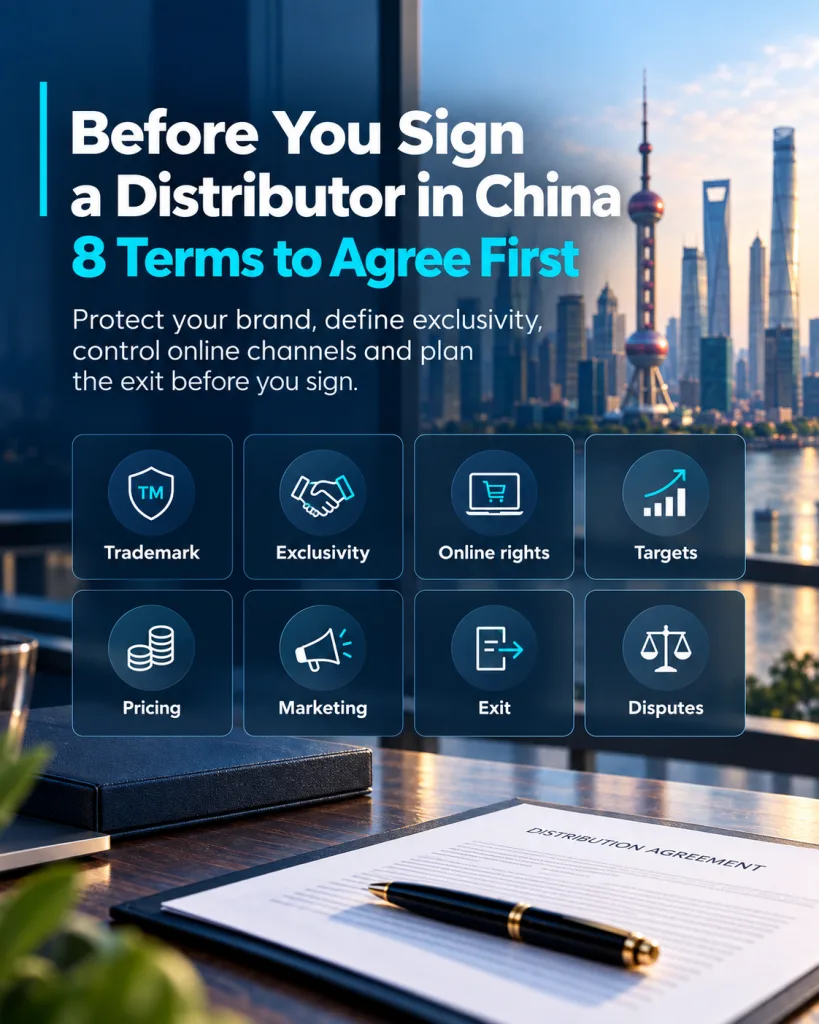
Use this list as a quick reference during negotiations. Each term is explained in more detail below.
1. Trademark ownership
2. Scope of exclusivity
3. Online stores and social accounts
4. Sales targets
5. Pricing
6. Marketing
7. Termination and exit
8. Language, law and disputes
1. Trademark Ownership: Register First, Negotiate Second
China works on a first-to-file basis: in practice, whoever registers a trademark first usually holds the rights, whether or not they created the brand. A distributor or local partner filing a foreign brand’s mark in its own name is one of the best-known risks for companies entering China, and it becomes very hard to change distributor once that distributor owns your trademark.
Chinese trademark law does address this. The current law allows a brand owner to oppose a registration filed by its agent or representative without authorisation, and this has been applied to distributors. China’s revised Trademark Law, adopted in June 2026 and in force from 1 January 2027, keeps this protection and adds fines for bad-faith filings. But these remedies take time, evidence and legal fees. Prevention is far cheaper:
- Register your Latin-script mark and your Chinese brand name, in the relevant classes, in your own company’s name before discussions become detailed.
- Write into the agreement that the distributor acknowledges your ownership, will not file identical or similar marks, domain names or account names, and will transfer anything filed in breach.
- Choose the Chinese name deliberately. It is the name customers will search for and remember, as explained in our article on how brand naming in China shapes consumer perception.
2. Scope of Exclusivity: Define It in Four Dimensions
“Exclusive distributor for China” is one of the most expensive phrases a brand can sign. China is not one market. A distributor that is strong in East China may have little reach in Chengdu or Guangzhou, and one that dominates department stores may have no e-commerce team at all.
Define exclusivity along four separate lines:
- Products: which product lines, and whether new launches are included automatically.
- Territory: named provinces or cities, rather than “China”.
- Channels: offline retail, B2B or professional channels, specific e-commerce platforms, cross-border e-commerce.
- Duration: a first term short enough to review, with renewal tied to performance.
A common approach is to start with limited or non-exclusive rights and let exclusivity expand as the distributor proves it can sell.
3. Online Stores and Social Accounts: Control the Keys
In China, much of a brand’s visibility lives on platforms such as Tmall, JD.com, Douyin and Xiaohongshu. Clarify from day one who opens each store and account, in whose name, and who operates it day to day.
Platform rules connect store types to trademark rights. On Tmall, a brand flagship store is tied to the trademark owner or a company holding the owner’s exclusive authorisation, which makes the authorisation letter you sign a very valuable document. Grant it for a defined store and period, keep a copy of everything submitted to the platform, and make sure the agreement requires the distributor to cooperate in transferring or closing the store if the relationship ends.
The same applies to your WeChat Official Account, Xiaohongshu profile and Douyin account. Where possible, register brand accounts under your own control and give the distributor operating access, rather than the other way around. Platform requirements change regularly, so check the current rules for each platform before signing.
4. Sales Targets: Measure Sell-Out, Not Only Orders
Minimum purchase commitments protect you from a distributor who signs an exclusive deal and then does little with it. They work best when they are realistic for year one and rise as the brand becomes known. Agree on:
- Annual minimum purchase volumes or values, with a ramp-up in the first year.
- Regular reporting on sell-out, not only purchase orders: which stores and channels, which products, which regions.
- The consequence of a missed target. Losing exclusivity is often a more practical first step than immediate termination.
Sell-out reporting also gives you the market information you need to plan your next move, whatever happens with this partner.
5. Pricing: Suggest, Don’t Dictate
Many brands want to control the price their products are sold at in China, to protect their positioning and avoid price wars between channels. Be careful how you do it. Under China’s Anti-Monopoly Law, agreements that fix a distributor’s resale price or set a minimum resale price are restricted. The safe harbour applied by the market regulator since 1 February 2026 is narrow for this type of clause: it covers only companies with a market share below 5% and turnover below RMB 100 million, and even then the authorities can still act if they find anticompetitive effects.
A suggested retail price is generally treated differently from a fixed one. But a “suggestion” backed by penalties for non-compliance can be treated as price fixing. Channel strategy, product ranges by channel and clear brand guidelines are safer tools than hard price clauses. Ask a China-qualified competition lawyer to review any pricing provisions.
6. Marketing: Who Pays, Who Approves, Who Owns
Distributors increasingly expect brands to invest in building awareness in China, and brands expect distributors to activate their own networks. Leave this vague and each side will assume the other is paying. Put in writing:
- The marketing budget from each side, and how it is split between online and offline activity.
- Who approves campaigns, Chinese copy, product claims and influencer (KOL) content before publication.
- Who owns the content, visuals and customer data created during the partnership.
- How your Chinese brand name, product names and key messages are used consistently across every channel.
If you plan to run campaigns alongside the distributor, or want an independent view of what the distributor proposes, China digital marketing support from a team that works directly on WeChat, Douyin, Xiaohongshu and KOL campaigns helps keep brand building in your hands.
7. Termination and Exit: Plan It Before You Enter
Nobody wants to talk about separation in a first meeting, but this is where the most expensive disputes happen. Agree on:
- Notice periods, and the specific grounds for early termination, such as missed targets or a breach of the trademark terms.
- What happens to remaining stock: a sell-off period, a buy-back at an agreed price, or a combination of both.
- The withdrawal of all authorisation letters, and the transfer or closure of online stores and brand accounts.
- The return of marketing materials, and an end to the use of your brand name, logos and product images.
8. Language, Law and Disputes: Decide Which Version Counts
Distribution agreements in China are often signed in two languages. That is sensible, but the two versions must say the same thing, and the contract must state which version prevails in case of conflict. Technical terms, product names and target definitions should be translated consistently throughout.
Decide on the governing law and on how disputes will be resolved. Many foreign companies choose arbitration, partly because China is a party to the New York Convention on the recognition and enforcement of foreign arbitral awards. The right choice depends on your situation, and it is a decision to take with a lawyer who practises Chinese law.
Want to share the eight terms with your team? Here they are on one page.
Red Flags in a Distributor Proposal
Most distributors act in good faith, but some proposals should slow you down:
- The distributor offers to register your trademark “for you”, in its own name.
- It asks for nationwide exclusivity across all channels, with no minimum targets.
- It wants to open and own your Tmall store or social media accounts, with no handover clause.
- It will not share sell-out or store-level information.
- The contract exists only in Chinese, and you are asked to sign before an independent review.
- Its volume promises seem far above what its current brand portfolio suggests it can deliver.
None of these automatically means bad faith. Each one is a reason to ask more questions before you sign.
Where HI-COM Fits
HI-COM’s China-based consulting team identifies and vets distributors, importers and channel partners, makes the introduction through chamber-network and trade-show relationships, and supports you through the first conversations and early-stage negotiation, including bilingual communication with the candidate. A qualified lawyer should draft and review the agreement itself. Our role is to help you reach the right partner and arrive at that negotiation well prepared.

Learn more about HI-COM’s partner search and distribution support in China.
Looking for the Right Distributor in China?
Tell HI-COM about your product, your target regions and the channels you want to reach. Our consulting team will help you define the right partner profile and find candidates who are actually reachable.
DISCUSS YOUR PARTNER SEARCH
Prefer WeChat? Scan to contact HI-COM
Frequently Asked Questions
Should I give my distributor exclusivity in China?
Only within a defined scope. Limit exclusivity by product, territory, channel and time, and link its renewal or expansion to agreed sales results. Many brands start with limited rights and extend them as the distributor performs.
Can my Chinese distributor register my trademark?
It should not, and Chinese law lets a brand owner oppose a registration filed by its agent or representative without authorisation. These procedures take time and evidence, however. The safest approach is to register your own Latin-script and Chinese marks in China before sharing detailed brand plans, and to prohibit any filing by the distributor in the agreement.
Who should own my Tmall store?
Ideally, the store is opened on the basis of an authorisation you control, for a defined period, with a written obligation to transfer or close it when the relationship ends. On Tmall, flagship stores are linked to the trademark owner or a company holding its exclusive authorisation, so your trademark position and your authorisation letters matter.
Can I set the retail price my distributor charges?
Fixing a distributor’s resale price or setting a minimum resale price is restricted under China’s Anti-Monopoly Law, with only a narrow safe harbour for small companies. Suggested retail prices are generally treated differently, but a China-qualified lawyer should review any pricing clause.
Do I need a lawyer for a distribution agreement in China?
Yes. A distribution agreement involves trademark, competition, contract and dispute-resolution questions that should be reviewed by a lawyer who practises Chinese law. Commercial preparation, partner vetting and bilingual communication can run alongside that legal work.
This article provides general commercial information and is not legal advice. Prepared by HI-COM’s China consulting team, September 2026.