


How to Sign a Contract with a Chinese Company: Chops, Signatures and Authority
When you sign a contract with a Chinese company, the safest practice is to have the document stamped with the company chop or contract chop of the exact entity named in the contract, and signed by its legal representative or by a person holding a written authorisation. Under the Chinese Civil Code, a written contract is formed once the parties have signed, sealed or fingerprinted it. Since December 2023, China’s Supreme People’s Court has also made clear that what matters most is whether the person signing had the authority to do so, not only whether the chop is genuine.
For foreign companies, the red stamp is often the most confusing part of the process. Which chop is the right one? Is a signature enough? What if the sales manager signs? Can you sign by scan or online? This guide answers those questions and ends with a checklist you can use on the day you sign.
Last verified: October 2026. This guide is general information, not legal advice. For a significant contract, ask a lawyer qualified in Chinese law to review it.
Key takeaways
- A written contract in China is formed when the parties sign, seal or fingerprint it (Civil Code, Article 490).
- For contracts, the right chops are the company chop (公章) or the contract chop (合同专用章). The finance chop and the invoice chop are not meant for contracts.
- The legal representative (法定代表人) can sign for the company. Anyone else should show a written authorisation (授权委托书) stamped by the company.
- Since 5 December 2023, Chinese courts focus on the signer’s authority: a forged or unregistered chop does not automatically void a contract, and a missing chop does not either. In the words of a Shanghai court, companies should move from “recognising the seal” to “recognising the person”.
- Best practice is still chop plus signature, a cross-page seal (骑缝章) on multi-page contracts, and an entity name that matches the registered Chinese name character for character.
What Makes a Contract Binding on a Chinese Company?
Article 490 of the Civil Code of the People’s Republic of China says that when a contract is concluded in written form, it is formed at the moment all parties sign, seal or put their fingerprints on it. Signature and seal are alternatives in the law, not cumulative requirements: the Code links the three methods with “or” (或者), so any one of them is enough and none ranks above the others. The same chapter also fixes where the contract is formed. Under Article 493, it is the place of the last signature, seal or fingerprint, unless the parties agree otherwise.
In practice, though, Chinese companies expect a chop. A company acts through its legal representative and through its authorised staff, and the chop is the visible proof that the document is a company act rather than a personal one. That is why a Chinese counterpart will almost always stamp the contract, and why a foreign company should ask for the stamp even when a signature is also present.
The real question for a foreign buyer or partner is therefore threefold: is it the right entity, is it the right chop, and does the signer have authority? The rest of this guide takes them in that order.
Which Chop Should Be on Your Contract?
A Chinese company usually holds several chops, each with its own purpose. In most cities, official chops are carved by licensed engravers and filed (备案) with the local public security bureau. Only two of them belong on a commercial contract.
| Chop | Chinese | Used for | On your contract? |
|---|---|---|---|
| Company chop | 公章 | The company’s general seal: contracts, letters, official documents | Yes |
| Contract chop | 合同专用章 | Contracts only | Yes |
| Finance chop | 财务专用章 | Banking and payments | No |
| Invoice chop | 发票专用章 | Official invoices (fapiao) | No |
| Legal representative’s name chop | 法定代表人名章 | Banking and some registrations, usually with the finance chop | No, it does not replace a signature |
| Department or project chop | 部门章 / 项目章 | Internal use | Avoid: it may not bind the company |

Two practical checks make the difference. First, read the name engraved around the chop: it must be the full registered Chinese name of the company you are contracting with, character for character. Second, make sure the chop belongs to the entity that will invoice you and receive your payment. A branch (分公司), a sister company or a Hong Kong entity has a different chop, and possibly a different liability.
In judicial practice, the company chop and the contract chop carry the same legal effect on a contract. Department and project chops are different: they bind the company only if the person who used them had authority, which is exactly the uncertainty you want to avoid on signing day.
Who Can Sign for a Chinese Company?
The legal representative is the person who can act for the company by law. Their name appears on the business licence and on the company’s record in the National Enterprise Credit Information Publicity System (NECIPS), so you can check it before the meeting.
Under Article 61 of the Civil Code, the legal representative’s power to act for the company comes from the law itself, so no separate authorisation letter is needed when they sign. Internal limits on that power, for example in the articles of association, cannot be used against a counterparty acting in good faith. Your job is simply to confirm that the person signing really is the legal representative shown on the record.
In daily business, the person across the table is often a general manager, a sales director or a project lead. That is normal, but that person should show a written authorisation (授权委托书) issued and stamped by the company. Article 165 of the Civil Code lists what a written authorisation must state: the agent’s name, the matters authorised, the scope of authority and the period, signed or sealed by the company. In practice, a useful authorisation names:
- the company, with its full Chinese name and Unified Social Credit Code;
- the authorised person, with their name and ID number;
- what they may sign (this contract, or a defined type of contract);
- how long the authorisation is valid;
- the company chop and the legal representative’s signature or name chop.
Keep a copy of the authorisation with your signed contract. If a dispute ever arises, it is the simplest evidence that the person had authority.
Chinese law also recognises position-based authority (职务代理, Civil Code Article 170): an employee can act within the normal scope of their job, such as a purchasing manager placing routine orders. For anything beyond routine business, such as a distribution agreement, a large order or an exclusivity clause, ask for a specific written authorisation.
If you have not yet checked the company’s details, our free Chinese company check compares the credit code, registered name, bank account holder and SWIFT code from the documents you have received, before you get to the signing stage.
Does a Fake or Missing Chop Make the Contract Invalid?
Not automatically. In its interpretation of the contract part of the Civil Code, in force since 5 December 2023, the Supreme People’s Court set out four rules in Article 22:
- If the legal representative or an employee signed within their authority, the company cannot escape the contract only because the chop is forged or not the registered one.
- A contract with signatures but no company chop can bind the company if the signer acted within their authority, unless the parties agreed that a chop was required for the contract to take effect.
- A contract with a company chop but no signature can bind the company if it was concluded within the signer’s authority.
- Even when the signer exceeded their authority, the contract can still bind the company if the other side reasonably believed the signer had authority (apparent representation under Article 504, or apparent agency under Article 172 of the Civil Code).
The two fallback rules work differently. Article 504 starts from the principle that a contract signed by the legal representative binds the company, unless the counterparty knew or should have known they were exceeding their powers. Apparent agency is harder to claim: you must show that the signer looked authorised and that you relied on it in good faith and without negligence. A written authorisation in your file is the easiest way to show both.
The lesson for foreign companies is practical. A perfect-looking chop is not a guarantee, and an imperfect one is not always fatal. What protects you is evidence of authority: the legal representative’s signature, or a written authorisation, together with the company chop.
“When signing, companies should shift their focus from recognising the seal to recognising the person (从‘认章’向‘认人’转变): check whether the signer has the power to represent the company or act for it.”
Minhang District People’s Court, Shanghai, September 2024
In a dispute, the question is rarely “is the stamp red enough?” It is “did this person have the right to commit the company?” Collect the proof of that on the day you sign.
What Is a Cross-Page Seal (骑缝章) and Should You Ask for One?
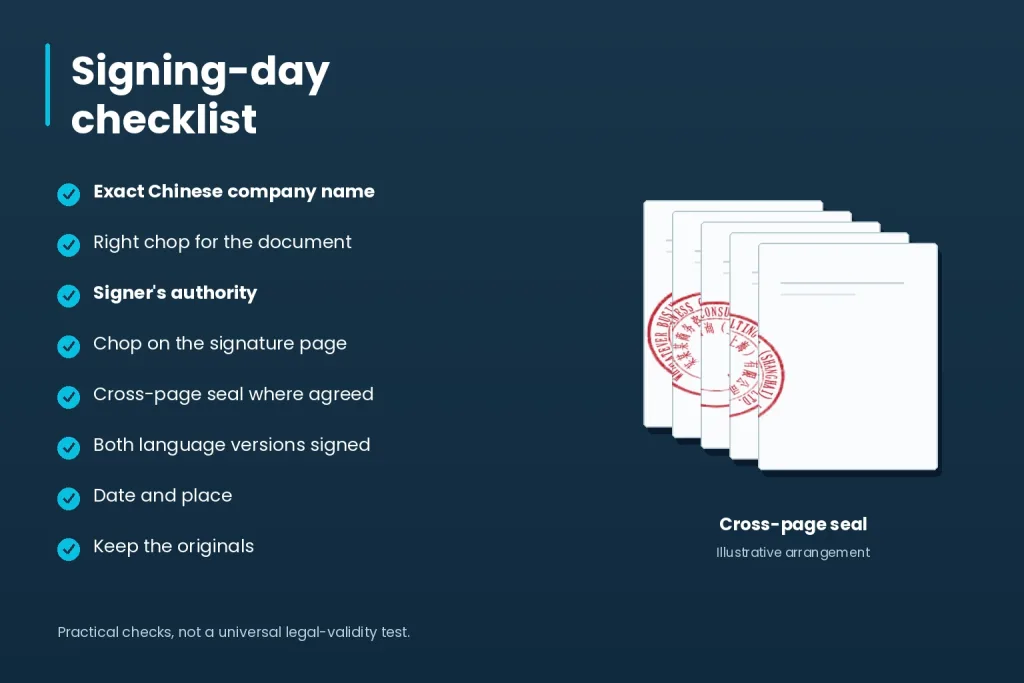
A cross-page seal is a chop applied across the edge of all pages of a document at once, so that each page carries part of the impression. It shows that no page was swapped after signing. Chinese law does not require it, but it is standard practice for multi-page contracts in China. Larger Chinese companies often make it a rule in their internal seal-management policies, so your counterpart is unlikely to object.
Ask for it whenever your contract has more than a few pages or has annexes such as specifications, price lists or quality standards. If a cross-page seal is not possible, have each page initialled by both sides.
Signing-Day Checklist
Can You Sign a Contract with a Chinese Company Remotely or Electronically?
Yes. Many contracts with Chinese companies are signed at a distance. The common methods are:
- Scan and courier: each side signs and stamps, exchanges scanned copies to start work, then sends the originals by courier. State in the contract that scanned copies are binding, and still collect the originals.
- Electronic signature: under Article 14 of China’s Electronic Signature Law, a reliable electronic signature has the same legal effect as a handwritten signature or a seal.
Article 13 of the same law treats an electronic signature as reliable when four conditions are met:
- the signature creation data belongs exclusively to the signer;
- only the signer controls that data at the time of signing;
- any change to the signature after signing can be detected;
- any change to the content or form of the document after signing can be detected.
Established e-signing platforms are designed to meet these conditions, and Chinese companies also use electronic chops (电子印章) issued through them.
Electronic signing works well for routine commercial contracts. For a contract you may need to enforce in court, or one that will be filed with an authority, check with your lawyer which form will be accepted.
What About the Language of the Contract?
An English contract can be valid in China, but if it ever reaches a Chinese court, a Chinese version will be needed. For important agreements, a bilingual contract with a clear clause stating which language prevails is the usual answer. We explain how to prepare it on our contract translation page.

Six Common Mistakes When Signing with a Chinese Company
- Signing with the English trading name instead of the registered Chinese name.
- Accepting a department or project chop instead of the company chop or contract chop.
- Letting a sales contact sign without a written authorisation.
- Leaving annexes (specifications, prices, quality standards) unsigned and unstamped.
- Treating a chopped photo received on WeChat as the signed contract.
- Assuming the legal representative’s name chop (法定代表人名章) replaces their signature. It does not.
If the contract is a distribution agreement, read our guide to the eight terms to agree before you sign a distributor in China. For the checks to make with suppliers before any payment, see working with Chinese suppliers: legal safeguards.
How HI-COM Can Help
HI-COM is not a law firm, and we work alongside your lawyers. What we do is make sure the signing goes as planned on the China side:
- We find and pre-screen partners, distributors and suppliers through our China partner and distribution search, before you reach the contract stage.
- We prepare bilingual contracts and certified Chinese translations of contracts, licences and authorisations.
- Our business interpreters accompany you to negotiations and signing meetings in China.
Ask our Shanghai team to check the company, translate the contract or join you at the signing.
CONTACT HI-COM
Frequently Asked Questions
Is a contract with a Chinese company valid without a company chop?
It can be. Under the Civil Code a contract is formed when the parties sign, seal or fingerprint it, and the Supreme People’s Court confirmed in 2023 that a signed contract without a chop can bind the company if the signer acted within their authority, unless the parties agreed that a chop was required. In practice, always ask for the chop as well.
What is the difference between the company chop and the contract chop?
The company chop (公章) is the company’s general seal and can be used on almost any document, including contracts. The contract chop (合同专用章) is used only for contracts. Both are acceptable on a commercial contract. The finance chop and the invoice chop are not.
Who can sign a contract for a Chinese company?
The legal representative named on the business licence, or a person holding a written authorisation (授权委托书) stamped by the company. You can check the name of the legal representative on the company’s NECIPS record.
Does the legal representative need an authorisation letter to sign?
No. Under Article 61 of the Civil Code, the legal representative’s power to act for the company comes from the law. You only need to confirm that the person signing is the legal representative shown on the business licence and the company’s NECIPS record.
What is a cross-page seal (骑缝章)?
A chop applied across the edges of all pages at once, so each page carries part of it. It proves that no page was replaced after signing. It is common practice in China for multi-page contracts, although not a legal requirement.
Are electronic signatures valid for contracts in China?
Yes. Under Article 14 of the Electronic Signature Law, a reliable electronic signature has the same legal effect as a handwritten signature or a seal. Article 3 of the same law excludes documents on personal relations such as marriage, adoption and inheritance, and those on stopping public utility services such as water, heating or gas.
Does a forged chop make the contract invalid?
Not automatically. Since 5 December 2023, if the legal representative or an authorised employee signed within their authority, the company cannot reject the contract only because the chop was forged or not registered.
Conclusion
Signing with a Chinese company is not complicated once you know what to look for: the right entity, the right chop and a signer with proven authority. Get those three right, add a cross-page seal and keep the originals, and your contract will stand on solid ground.
Prepared by Saveli Yakhnenko, HI-COM Asia, Shanghai. This article is general information about Chinese contract practice and is not legal advice.