

Working with Chinese Suppliers: Legal Safeguards Foreign Companies Should Know Before They Pay
A professional website. A responsive sales contact. Attractive prices. Good product photos. A supplier who says, “No problem, we can do it.”
For many foreign companies, this is how a sourcing or manufacturing project in China begins.
However, as many buyers discover too late, a polished first impression does not always prove that a supplier is reliable, legally registered, financially stable, or even the actual manufacturer. Before signing a contract, sending a deposit, or sharing product designs, foreign companies need to answer one basic question: who are we really dealing with?
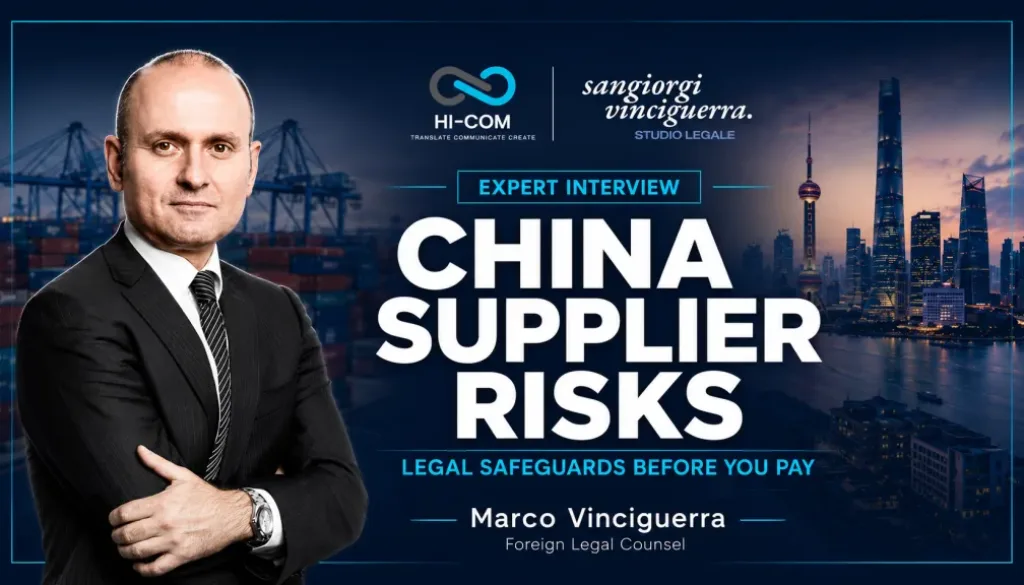
To explore this question, HI-COM interviewed Marco Vinciguerra, a foreign legal counsel with long experience advising foreign investors on corporate and commercial matters in China and Hong Kong. Marco is a French-Italian corporate and commercial lawyer, qualified in Italy and England & Wales. He has worked in Hong Kong, London, Milan and Shanghai, and his expertise covers corporate law, commercial law, employment law and dispute resolution.
This article summarizes the key legal and practical safeguards foreign companies should consider when working with Chinese suppliers. It also explains how tools such as NECIPS, the National Enterprise Credit Information Publicity System, can support supplier verification before doing business in China.
The first rule: know who is really behind the supplier
According to Marco, the first priority is simple: know exactly who you are dealing with.
Many foreign companies start discussions through email, WeChat, online marketplaces, social media or a supplier website. This is normal. However, it also creates risk. The company shown online may not be the company that will issue the invoice, receive the payment, manufacture the goods, or be responsible if something goes wrong.
In some cases, the website is only a façade. Behind it may be a small intermediary, a trading company, or one person using a mobile phone number and a professional-looking presentation. That does not always mean fraud. Many intermediaries are legitimate. However, if the buyer does not understand who is actually involved, the risk increases quickly.
Some warning signs should raise caution. A supplier website that is only in English can be suspicious, especially if the company claims to be a major Chinese manufacturer. A genuine Chinese manufacturer usually has a Chinese-language presence, because its domestic market and local business ecosystem still matter. Another red flag is a supplier that only provides a mobile number, with no landline, no clear office address and no identifiable structure behind the business.
These signs do not prove fraud by themselves. Yet they should push the buyer to verify more carefully.
Supplier relationships in China have improved, but risks remain
The business environment has changed significantly over the past 10 to 20 years.
Foreign companies are generally better informed today. Many have experience with China, sourcing agents, factory audits, compliance checks and logistics partners. As a result, some of the more obvious scams are less common than before.
However, the main problem has not disappeared. It has simply changed form.
Marco explains that many issues still start with a lack of caution. A buyer sees an opportunity that looks too good to miss. The price is attractive. The supplier is responsive. The timeline seems possible. Therefore, the buyer moves too fast.
This is exactly when mistakes happen.
The right approach is not to assume that every supplier is dangerous. It is to verify before trusting. A good deal should still make sense after legal checks, practical checks, payment checks and contract review.
Legal verification is useful, but it is only the first layer
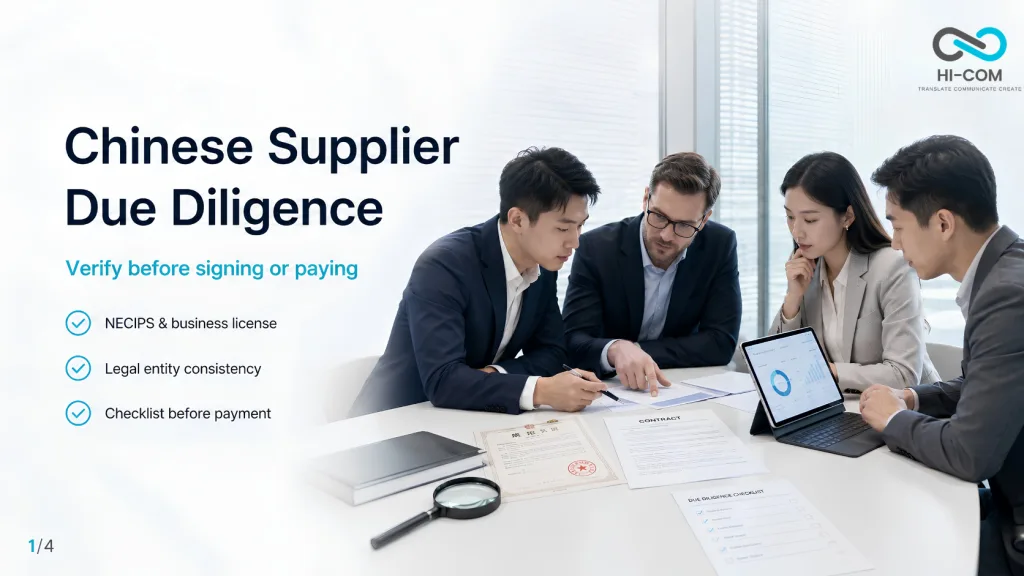
The first step in Chinese supplier due diligence is to confirm that the company legally exists.
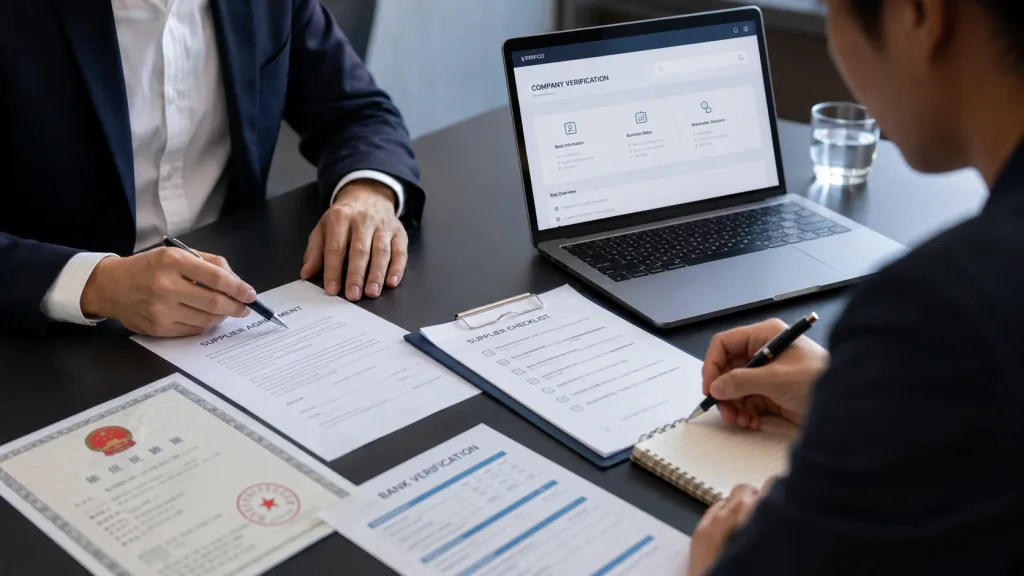
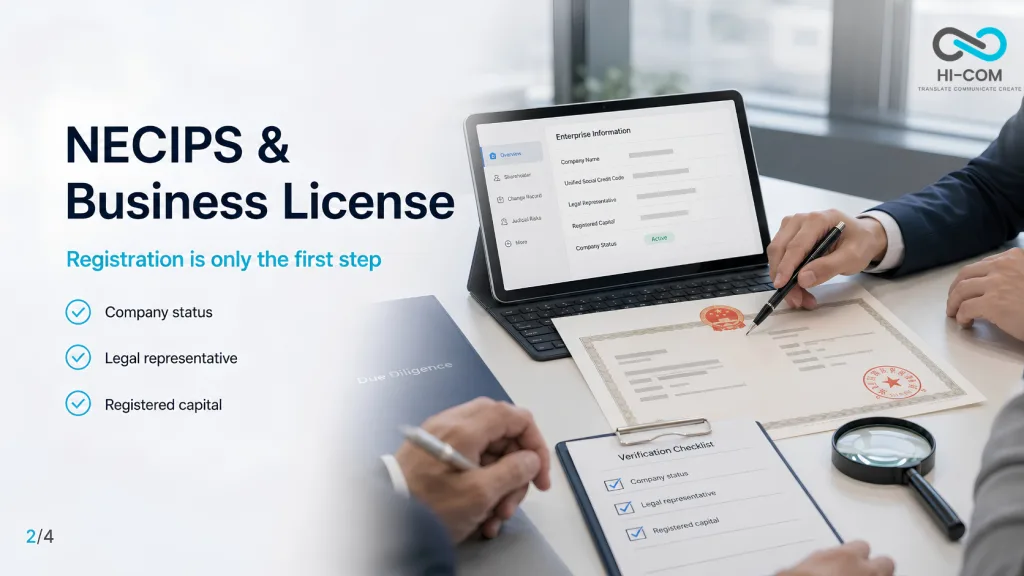
This can include checking the official company name, registered address, legal representative, shareholders, business scope and registration status. In China, one of the main public tools for this is NECIPS, the National Enterprise Credit Information Publicity System. HI-COM’s NECIPS guide explains that the platform can help foreign businesses verify whether a Chinese company exists and review public company information.
However, Marco’s advice is very clear: official databases are useful, but they are not enough.
NECIPS can show whether a company is legally registered. It may also show registration status, business scope, penalties, abnormal-operation records and other public information. But it does not prove that the supplier has real production capacity. It does not confirm that the factory exists. It does not tell you whether the person you are speaking with is authorized to act for the company. It also does not prove that the company can deliver what it promises.
That is why proper supplier due diligence must combine official checks with practical verification. The buyer should ask whether the company has offices, employees, equipment, a factory, production capacity and a business profile that matches its claims.
NECIPS and the problem of the official Chinese company name
One common difficulty for foreign buyers is that they often receive only an English company name.
This can be misleading. A mainland Chinese company must have an official Chinese legal name. Its business license is in Chinese. The English name used on a website, business card, Alibaba page or email signature may be unofficial.
This matters because NECIPS searches work best with the official Chinese legal name or the Unified Social Credit Code. Many foreign businesses struggle because the English name used in sales materials rarely matches the registered Chinese legal entity.
Before paying a supplier, the buyer should compare the business license, the Chinese company name, the contract name, the invoice details, the bank account holder, the company seal, the registered address and the person communicating with the buyer.
The key principle is coherence. If these elements do not match, the buyer should pause and ask for an explanation.
The Hong Kong bank account warning
One of the most important warnings from the interview concerns payment accounts.
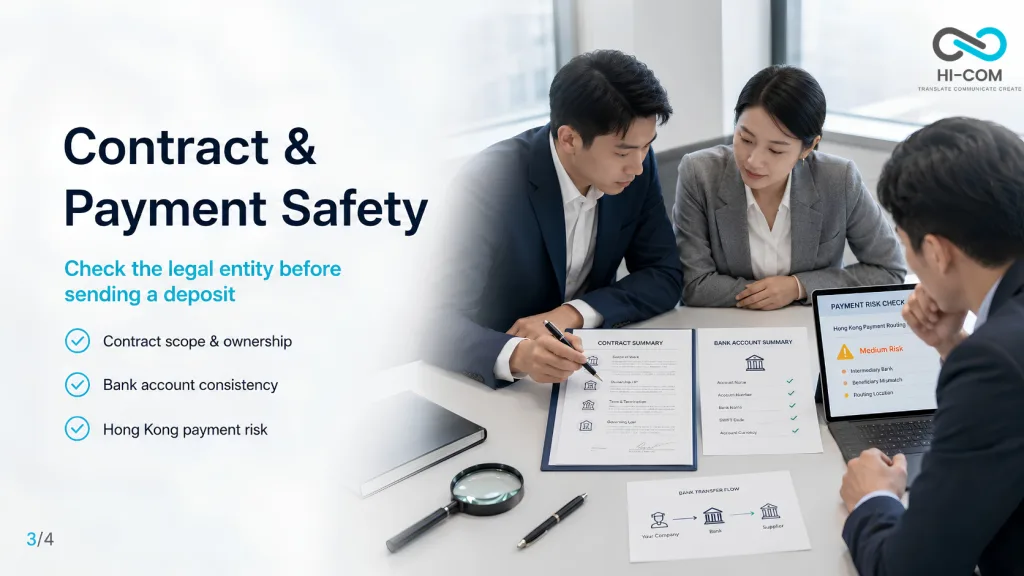
If a mainland Chinese supplier asks a foreign buyer to pay a Hong Kong bank account, the buyer should not ignore it. There may be legitimate commercial or tax reasons in some cases. But the buyer needs to understand exactly who is receiving the money.
If the bank account belongs to a Hong Kong company, the buyer may actually be contracting with a Hong Kong entity, not the mainland Chinese company it thought it was dealing with. If the supplier later disappears, legal action may become more complicated, more expensive and less effective.
The company name, business license, contract, invoice, bank account and communication records should all point to the same legal entity. If they do not, the risk is not theoretical. It can directly affect recovery options if the transaction fails.
What foreign companies should check before paying a Chinese supplier
Before making a deposit, foreign companies should build a simple but disciplined verification process.
Check the business license
Request the supplier’s business license. This is the basic proof that the company legally exists. Then check whether the Chinese name, Unified Social Credit Code, address and business scope are consistent with the supplier’s claims.
Verify practical existence
If possible, someone on the ground should visit the address. Does the office exist? Is there a factory? Are there employees? Is there equipment? Does the location match the supplier’s business story?
Identify whether it is a manufacturer or a trader
Working with a trader is not necessarily a problem. Many traders are reliable and useful. The issue is transparency. A trader should not present itself as a factory if it does not control production.
Check certifications and claims
If a supplier claims ISO certification, product compliance certificates or export qualifications, these should be requested and verified.
Avoid large upfront payments
The more the buyer pays before inspection or delivery, the less leverage it has if quality, timing or communication breaks down.
Contracts with Chinese suppliers: what should be written down?
A contract is not a magic shield. It will not prevent every problem. However, it gives clarity, evidence and a stronger position if a dispute arises.
Marco explains that a vague contract may prove that a business relationship existed, but it may not help much if it does not address the key points. A supplier contract should clearly define the product, specifications, quality standards, packaging, delivery timeline, inspection process, payment schedule and consequences of non-compliance.
For manufacturing projects, the contract should also address warranties, remedies for defective goods, late delivery, incomplete delivery, non-conforming products, confidentiality, IP ownership, non-use, non-disclosure, subcontracting restrictions and dispute resolution.
Payment clauses are especially important. The buyer should try to pay as little as possible in advance and keep part of the payment linked to production milestones, inspection, shipment or delivery.
A good contract also specifies the governing law, the dispute forum, and which language version prevails if the agreement is bilingual.
Is an English contract valid in China?
Yes, an English contract can be valid in China. Chinese law does not require every commercial contract to be written in Chinese.
However, if a dispute goes before a Chinese court, the contract will need to be translated into Chinese. Even if the judge understands English, the court will rely on the Chinese version submitted in the proceedings.
For important contracts, a bilingual agreement can be useful. Yet bilingual contracts must be drafted carefully. If the English and Chinese versions differ, the contract should clearly state which language prevails.
This point is often underestimated. A weak translation can create ambiguity exactly when clarity matters most.
WeChat is useful, but it should not replace documentation
WeChat is widely used in Chinese business. It is fast, practical and often unavoidable.
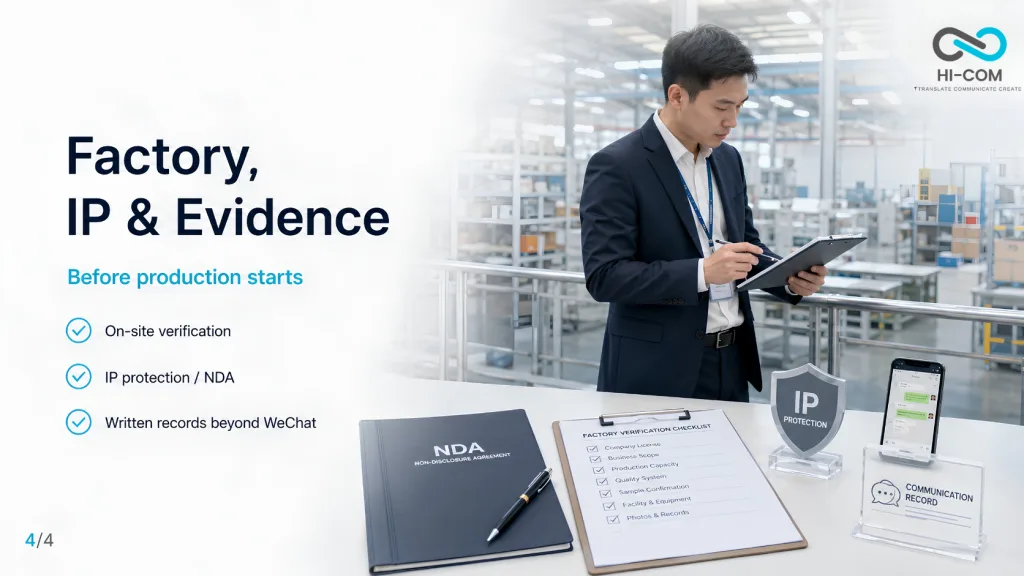
However, Marco warns that companies should not rely only on WeChat. If a dispute arises, WeChat records may need to be formally preserved, notarized, translated and submitted as evidence. This can be costly and complicated.
Foreign buyers should keep proper records from the beginning. This includes emails, purchase orders, signed contracts, invoices, inspection reports, product specifications, photos, videos, shipping documents and written complaints.
If the relationship becomes difficult, the company with better evidence is usually in a stronger position.
Protect intellectual property before production starts
Intellectual property should be addressed before production begins, not after a supplier relationship has already gone wrong.
If a company has a brand, design, technology, mold, formula, packaging concept, know-how or any valuable commercial asset, it should think about protection before sharing sensitive information.
Registering trademarks in China is especially important if the company plans to sell in China or manufacture products there. Many foreign companies discover too late that their brand has already been registered by someone else.
NDAs can help in some situations, especially when confidential information must be shared before a broader agreement is signed. However, an NDA is still only a written commitment. Its value depends on the reliability of the other party and the realistic possibility of enforcement.
For manufacturing relationships, companies should consider stronger agreements covering confidentiality, non-use, non-circumvention, ownership of molds and tooling, ownership of designs and restrictions on subcontracting.
What if the goods are defective or the delivery fails?
There are two types of protection: practical protection and legal protection.
Practical protection comes first. Avoid paying everything in advance. Use staged payments. Link payment to milestones, inspection or shipment. Where the order value justifies it, arrange a pre-shipment inspection.
However, even inspections are not perfect. The interview included a striking example: goods were inspected and sealed before shipment, but arrived in Europe with part of the contents replaced by bricks. This type of case suggests organized fraud and shows that even professional checks cannot remove every risk.
If defective goods arrive, evidence becomes critical. The buyer should collect the signed contract or purchase order, product specifications, emails, WeChat communications, photos, videos, inspection reports, written complaints and expert reports where necessary.
Legal action may be realistic if the amount at stake is significant. For small amounts, the cost of litigation may exceed the amount recoverable.
Court or arbitration in China: when does it make sense?
Court proceedings in China can be realistic, especially when the supplier is a real company with assets in China.
In some cases, it may be possible to apply for asset preservation measures, such as freezing a bank account up to the amount claimed. However, litigation should be assessed commercially. The company needs to consider the amount at stake, management time, evidence preparation, certified translation, legal fees and enforcement prospects.
Arbitration can also work, especially for larger international contracts. One advantage is confidentiality. Court judgments are generally public, while arbitration is private. This can matter when the dispute involves sensitive business information. However, arbitration is usually more expensive and should be reserved for transactions where the value and complexity justify it.
When should a lawyer or local expert be involved?
A lawyer is not always necessary at the first contact stage. Basic verification can sometimes be handled by a lawyer, accountant, consultant, logistics agent, sourcing expert or trusted local contact.
However, a lawyer becomes important when the transaction is large, the risks are significant, IP is involved, the contract needs careful drafting or a dispute may seriously damage the company.
The level of legal protection should be proportionate to the risk. A small test order does not require the same structure as a major manufacturing agreement. But once a buyer has concerns about quality, payment, IP, subcontracting or delivery, key obligations should be put in writing.
A practical checklist before sourcing from China
Before buying, sourcing or manufacturing in China, foreign SMEs should follow a disciplined checklist.
- Verify the company’s legal existence.
- Request the supplier’s business license.
- Identify the official Chinese company name.
- Check the Unified Social Credit Code.
- Compare the supplier’s claims with its public company information.
- Confirm whether the supplier is a manufacturer or a trader.
- Check whether the bank account matches the legal entity.
- Avoid large upfront payments.
- Protect intellectual property before sharing sensitive information.
- Keep written records.
- Use a written contract when the transaction matters.
- Arrange inspection before shipment when justified.
- Involve a lawyer or local expert when the deal is significant or legally complex.
Marco’s final takeaways are simple: verify before trusting, keep leverage and put key obligations in writing.
How HI-COM can support Chinese supplier verification
HI-COM is not a law firm and does not replace qualified legal counsel.
However, many supplier problems begin before legal action is needed. They begin with unclear company names, incomplete documents, Chinese-language records, mismatched bank details, vague communication, missing translations or lack of local verification.
HI-COM supports foreign companies with Chinese company verification, NECIPS research, document review support, business translation, supplier communication and cross-cultural coordination. Our role is to help international companies & clients better understand who they are dealing with before they sign, pay or launch production.
For legal advice, contract drafting or dispute strategy, companies should work with qualified legal professionals such as Marco Vinciguerra and the ALLASYA team. For supplier checks, business communication and China-side verification support, HI-COM can help you prepare the ground.
HI-COM’s expertise is especially useful before doing business in China, when companies need to understand, translate and verify Chinese-language documents before signing, paying or committing to a supplier. This can include business licenses, company registration documents, certificates, contracts, bank details, official Chinese names and administrative records.
For this type of preparation, HI-COM can support companies with certified Chinese translation, Chinese document review support, NECIPS-related company verification content, and practical guides such as our article on driving licence translation for China and abroad.
For personal legal advice, corporate structuring, contracts, investment matters or disputes in China and Hong Kong, readers can contact Marco directly through his professional profiles.
- Contact Marco on LinkedIn: Marco Vinciguerra on LinkedIn
- For China-related legal matters: Marco Vinciguerra at Allasya
- For Hong Kong-related legal matters: Marco Vinciguerra at Sangiorgi Vinciguerra Studio Legale
- Hong Kong contact page: Sangiorgi Vinciguerra Studio Legale contact
Conclusion: in China sourcing, trust should come after verification
Working with Chinese suppliers can create strong opportunities for foreign companies. China remains one of the world’s most important manufacturing and sourcing markets.
However, successful cooperation depends on discipline.
A good supplier relationship should be built on verified identity, coherent documents, realistic payment terms, clear contracts, protected intellectual property and proper evidence.
The most dangerous moment is often the beginning, when the opportunity feels exciting and the risks are still invisible.
Before sending money, sharing designs or signing a purchase order, take the time to verify. In China sourcing, trust is valuable. But it should come after verification, not before.
Prefer a quick summary? Watch our short expert video with Marco Vinciguerra on 5 practical tips before working with a Chinese supplier. It highlights the key checks to make before signing, paying or starting production in China.
Need help checking a Chinese supplier before signing or paying?
Contact HI-COM for China-side verification and business support.