

AI Interpreting and Simultaneous Interpreting in China: Pros, Cons and Best Use Cases
Real-time multilingual communication is changing fast.
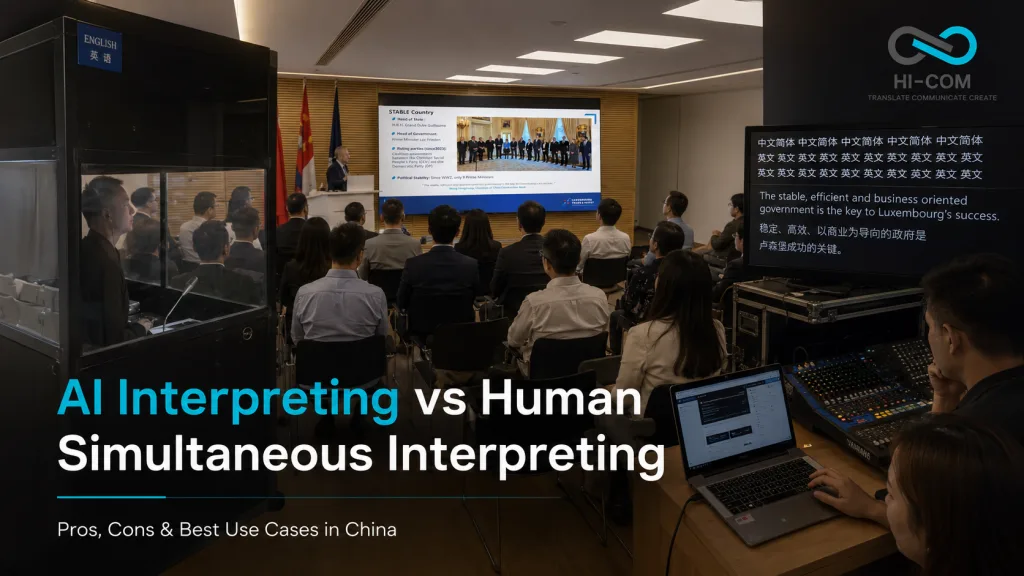
For years, international conferences in China mainly relied on human simultaneous interpreters, interpreter booths, receivers, headsets and technical teams. Today, a new option is becoming more common: AI interpreting and live captioning.
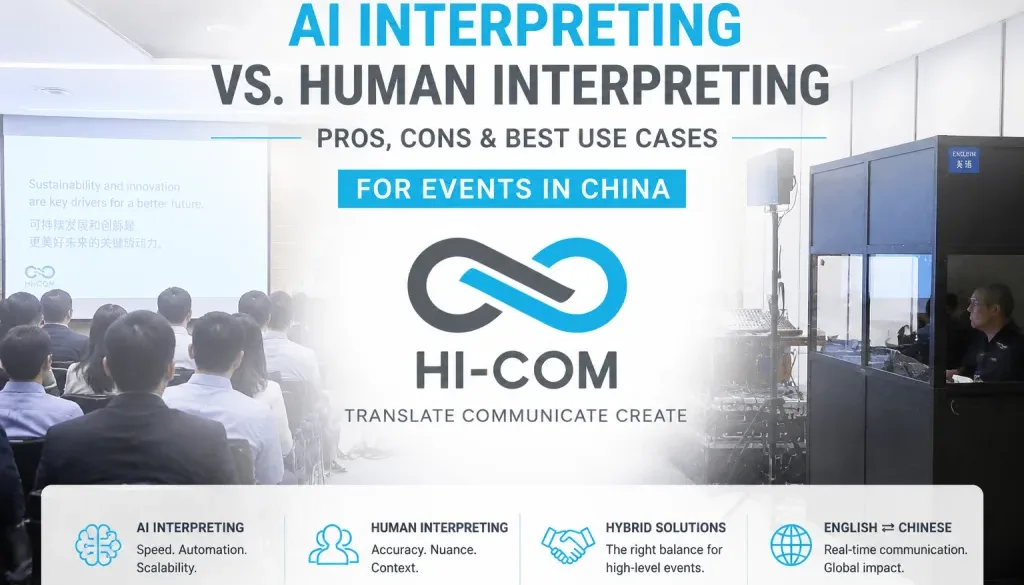
However, the issue is not whether AI will replace interpreters. The question we should really be asking ourselves is: when should event organizers use AI, when should they use human simultaneous interpreting, and when does a hybrid solution make more sense?
At HI-COM Asia, our answer comes from recent field experience. Our team has been supporting professional simultaneous interpreting missions in Beijing and Shanghai, as well as AI-powered English–Chinese live captioning and translation for corporate and diplomatic events.
So when should you use AI interpreting?
AI interpreting works best when speakers use clear pronunciation, the audio is clean, the topic is prepared in advance and the event format is controlled.
Human simultaneous interpreting is still the safer choice for high-stakes negotiations, diplomatic exchanges, legal discussions, technical debates, sensitive corporate meetings, and events with complex speaker dynamics.
For many professional events in China, the strongest solution is now hybrid: human interpreters for critical content, with AI live captions to improve access and audience comfort.
What recent HI-COM missions have taught us
HI-COM has recently been supporting several demanding multilingual event formats in China.
For the Beijing Energy Briefing, our team provided English–Chinese simultaneous interpreting, conference equipment and on-site technical support for a fast-moving market event covering LNG, crude oil, power, shipping, petrochemicals, and energy policy.
For the Mongolia Investment Forum Shanghai, HI-COM supported a high-level business forum with simultaneous interpreting, consecutive interpreting for B2B meetings, headsets, receivers, booth setup, and on-site technical management.
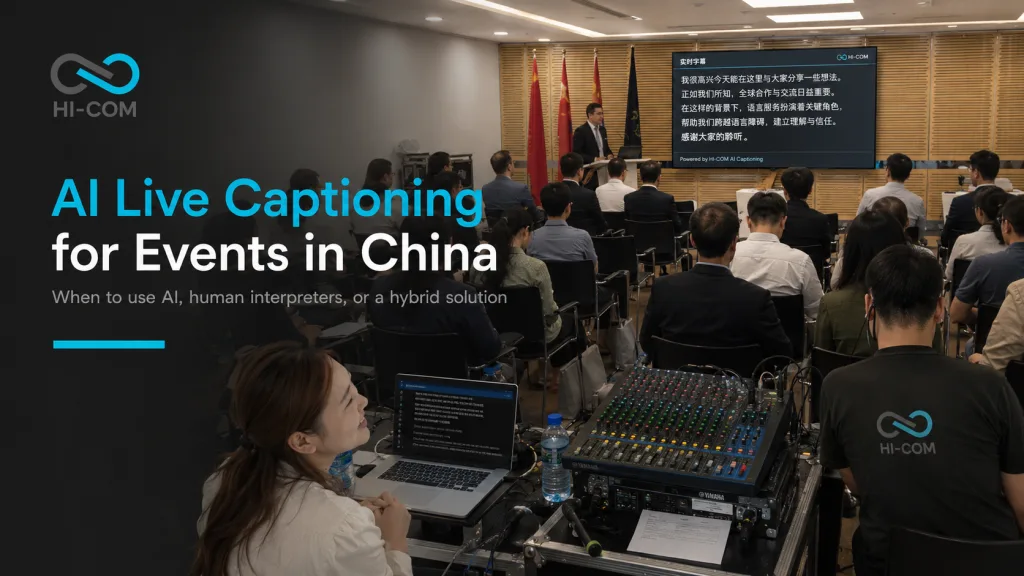
More recently, HI-COM also delivered AI translation and live captioning in Shanghai for English–Chinese events, including a sustainability and innovation summit, and a corporate seminar at a diplomatic venue.
These missions show one important point: successful event communication depends on more than language. It depends on preparation, sound quality, terminology, technology, audience needs and live supervision.
Advantages of AI interpreting and live captioning
AI interpreting can bring real value when it is used in the right context.
1. High accuracy with clear, standard speakers
When speakers use clear pronunciation and standard speech, AI recognition can be highly accurate. In these conditions, the system can produce coherent translation and captions that help audiences follow the content in real time.
This is especially useful for structured presentations, keynote speeches, internal training sessions, and seminars where speakers follow a prepared agenda.
2. Fast and simple setup
AI interpreting can be easier to deploy than a full traditional SI setup.
In some cases, the core system can run from one computer using a customized program. This reduces the need for heavy equipment, especially when the event only requires live captions or translated text on screen.
However, simple software does not mean simple delivery. The microphone, sound system, screen display and internet connection still need to be tested.
3. Fully automated operation after setup
Once the system is configured correctly, AI interpreting can run with limited manual intervention.
This can be useful for events with clear speaker order, stable audio and predictable language direction. For organizers, it can reduce some operational pressure during the event.
4. Strong domain knowledge
AI tools can draw from large language datasets and domain-specific knowledge. This helps them choose suitable terminology in sectors such as sustainability, finance, technology, energy, manufacturing or corporate strategy.
This is valuable when the system is properly prepared before the event.
5. Event customization
One of the biggest strengths of AI interpreting is customization.
Before an event, HI-COM can prepare the system with speaker names, company names, attendee lists, industry terms, presentation materials and glossaries. This helps the AI avoid generic transliterations and produce more relevant output.
For example, names, institutions and technical terms can be prepared before the event starts. As a result, the captions become more useful for the audience.
The limits of AI interpreting
AI interpreting is powerful, but it is not magic.
It performs well under the right conditions, but becomes less reliable when those conditions disappear.
1. Heavy accents and non-native speakers
AI recognition accuracy can drop when speakers have strong accents, speak too fast or too quietly, switch languages or use English as a second language.
This matters in international events. Many speakers are experts, but not all are trained public speakers. Some may speak with regional accents, use informal expressions or change pace during a panel discussion.
In these cases, human interpreters still bring judgment, adaptation and context awareness.
2. Latency
AI often waits to capture a longer speech segment before reorganizing the content. This helps the system understand context, but it can also create a delay.
For captions, this delay may be acceptable. For live interpreting, it may feel less natural, especially during fast exchanges, Q&A sessions or panel debates.
3. Audio quality is critical
AI interpreting depends heavily on source audio.
If microphones are too far from speakers, if several people are speaking at once, or if the room has too much background noise, the output can suffer quickly.
That is why on-site technical support remains essential. A professional setup must include microphone checks, audio routing, sound levels, display configuration, and live monitoring.
4. Network dependency
AI interpreting requires a stable internet connection.
For professional missions, HI-COM provides a dedicated Wi-Fi setup when needed to improve network stability. This reduces risk, but it does not remove the need for preparation.
For diplomatic venues, government events or confidential meetings, the network and device configuration must also respect venue rules.
5. Names can be misrecognized or pronounced incorrectly
Names can also be a weak point for AI interpreting.
Person names, speaker names, company names and institutional names may be misrecognized, translated inconsistently or pronounced incorrectly, especially when they are unfamiliar, non-English, strongly accented or not included in the event preparation materials.
This is why HI-COM recommends preparing speaker lists, attendee names, company names and key terminology before the event. For high-level meetings, human review and live monitoring remain important.
AI interpreting vs human Simultaneous Interpreting
The right choice depends on the risk level of the event.
Use AI interpreting when:
- The event has clear speakers and structured presentations.
- The audio setup is controlled and tested.
- The content can be prepared in advance.
- The audience mainly just needs captions or general understanding.
- The event has lower confidentiality or legal risk.
AI can work well for corporate seminars, training sessions, product presentations, internal events, live captions, audience accessibility and bilingual screen support.
Use human simultaneous interpreting when:
- The event is high-stakes or sensitive.
- The topic is legal, diplomatic, financial or highly technical.
- The discussion includes negotiations or live debate.
- Speakers may speak with heavy accents, or use idioms, humor or informal speech.
- Precision and tone are critical.
Human interpreters can manage nuance, tone, speaker intention, ambiguity and cultural context. They can also react when speakers improvise, interrupt each other or use unclear phrasing.
Use a hybrid solution when:
- The event needs both accuracy and accessibility.
- Some sessions are formal while others are lower-risk.
- The audience benefits from both audio interpreting and live captions.
- The organizer wants AI support without removing human control.
For example, human interpreters can manage the main interpreting, while AI captions-transcription support reading access. This can help attendees follow key terms, names and bilingual content more comfortably.
Hybrid delivery is often the best option for modern international conferences in China.

HI-COM’s approach: technology with human control
At HI-COM, we do not treat AI interpreting as a standalone software tool.
We treat it as part of a managed event communication system.
Before the event, we review the agenda, language directions, venue setup, speaker profiles, glossary, equipment needs, and audience format.
During the event, our team manages the audio chain, tests the system, monitors latency, checks caption quality, and responds to technical issues.
After the event, we can also support follow-up language needs, such as translated materials, subtitles, transcripts or certified Chinese translation for official documents.
This is where HI-COM’s wider language expertise matters. Our team provides multilingual interpreting services in China, certified Chinese translation and terminology support through HI-COM’s translation resources.
Why professional support still matters
AI can reduce friction. It can improve accessibility. It can also make multilingual events more flexible.
However, professional delivery still depends on people.
Someone must select the right solution. Someone must prepare the terminology. Someone must test the microphones. Someone must check the network, and someone must monitor the system when speakers change, audio drops or captions drift.
For event organizers, the goal is not to use the newest tool. The goal is to make sure every attendee can understand the content clearly.
That is why HI-COM offers three options: professional human interpreting, AI interpreting and live captioning, and hybrid event language solutions.
Conclusion: choose the right interpreting solution that best mitigates risk
AI interpreting and simultaneous interpreting in China are not competing solutions. They are tools for different communication needs.
AI is useful when the event is structured, audio is clean, and the content can be prepared in advance.
Human simultaneous interpreting remains essential when nuance, precision, sensitivity and live judgment matter.
Hybrid solutions can offer the best of both worlds.
Planning an international event in China?
HI-COM can help you choose the right setup, prepare the terminology, manage the equipment, and deliver professional English–Chinese communication support from start to finish.
Contact HI-COM to discuss AI interpreting, live captioning, simultaneous interpreting or hybrid event language support in China.
Last modified: 5 August 2026.