

AI Translation and Live Captioning in Shanghai for English–Chinese Events
Real-time multilingual communication is changing quickly.
International events no longer rely only on traditional interpreting booths and headsets. Today, organisers can also use AI-powered simultaneous translation, live captioning and hybrid language solutions.
However, the technology on its own might not guarantee a successful event.
Audio quality, terminology, network stability, room acoustics, display configuration and on-site monitoring will all have an affect the final result. For large corporate events and diplomatic venues, technical preparation becomes especially important.
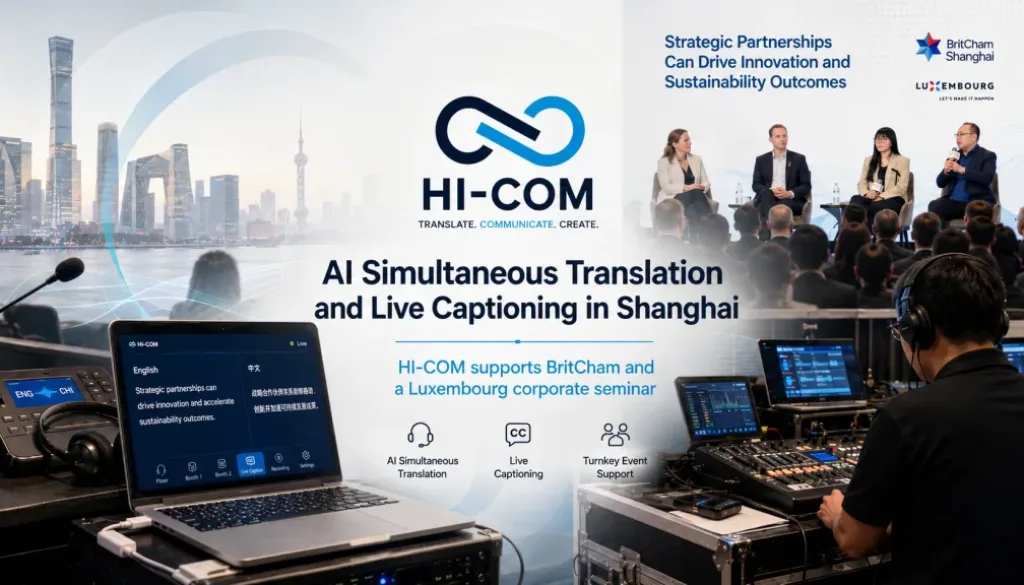
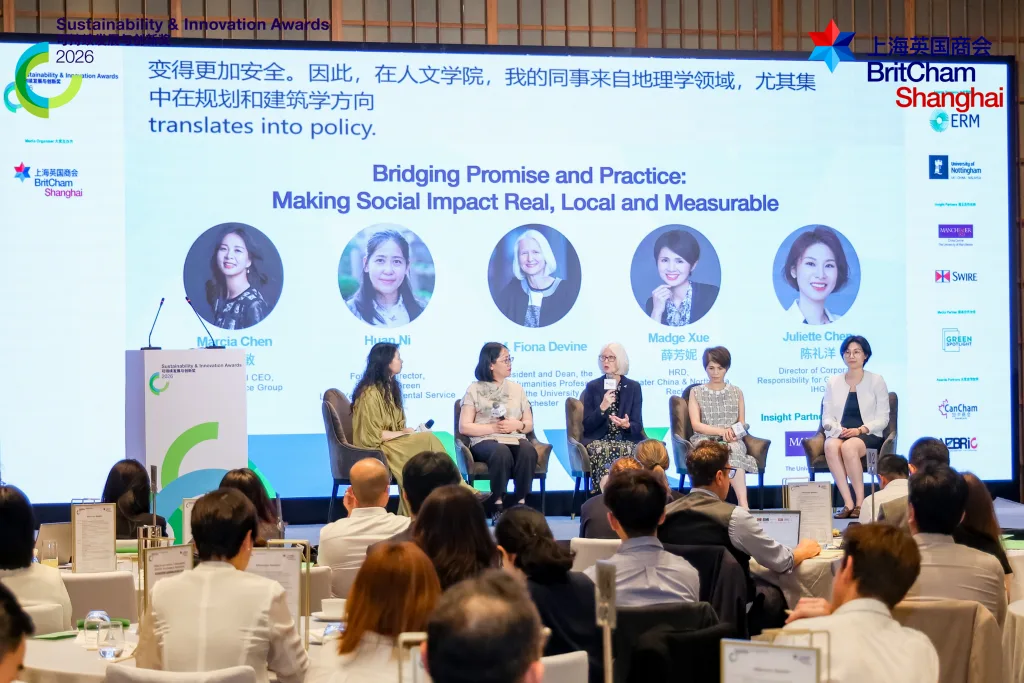
On 23 and 24 June 2026, HI-COM supported two unrelated high-level events in Shanghai with bidirectional English–Chinese AI simultaneous translation and live captioning. The solution covered both English-to-Chinese and Chinese-to-English communication, depending on the language used by each speaker.
The first job took place during the BritCham Shanghai Sustainability & Innovation Summit and Awards Ceremony. The second supported a corporate seminar held at a Luxembourg diplomatic venue in Shanghai.
Although the audiences and venues were different, both events shared one objective: making English- and Chinese-language content clear and accessible in real time to both Chinese- and English-speaking attendees.
Two Shanghai events with different communication needs
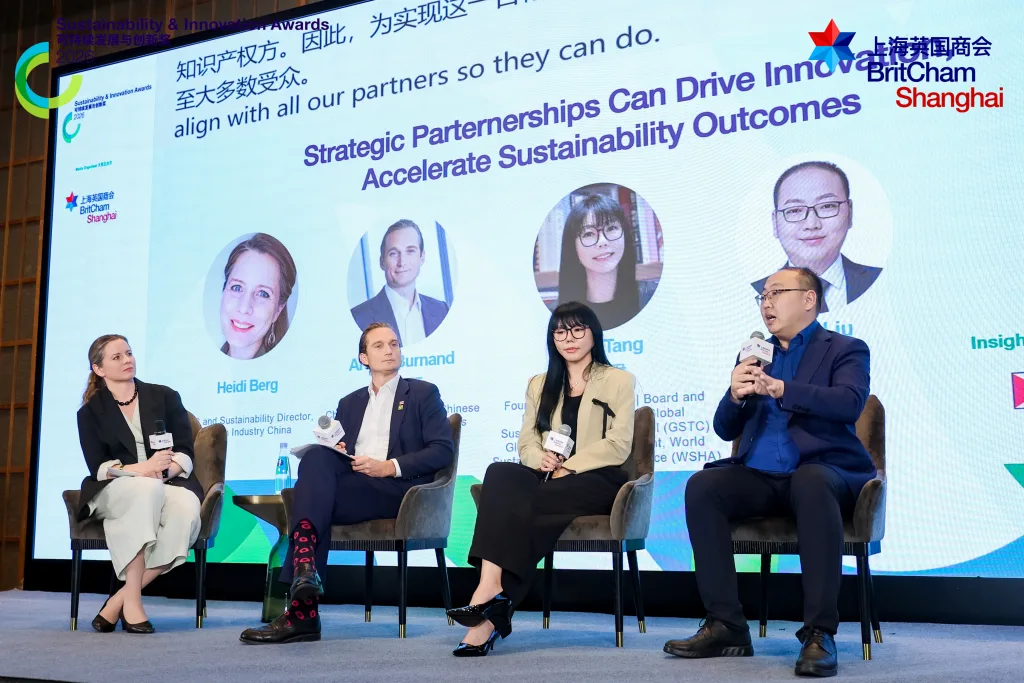
Supporting BritCham Shanghai’s Sustainability & Innovation Summit
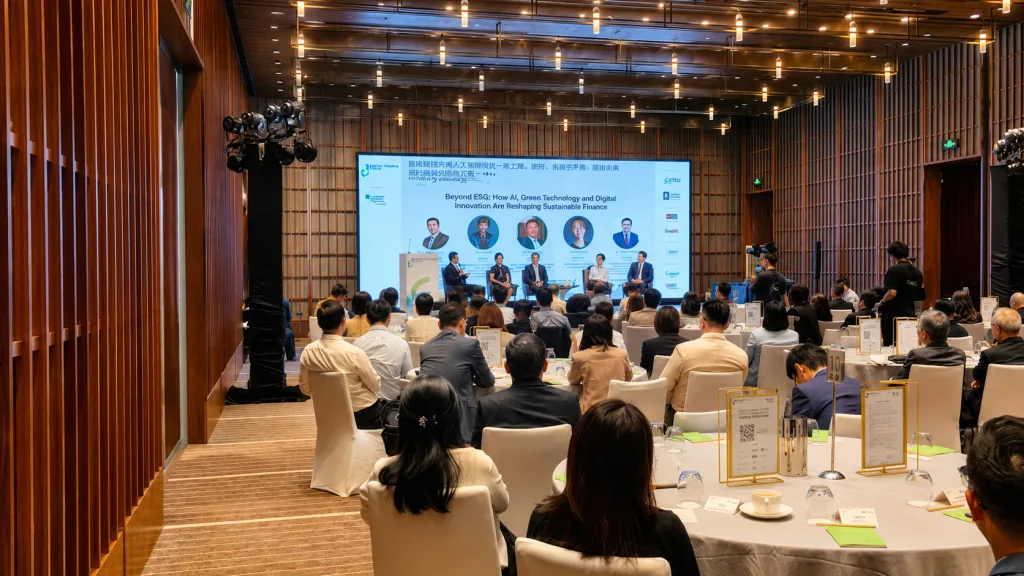
Hosted by the British Chamber of Commerce Shanghai, the Sustainability & Innovation Summit and Awards Ceremony 2026 brought together senior executives, investors, academics, industry experts and government representatives.
The full-day programme included keynote speeches, panel discussions, business case studies, networking sessions and an awards ceremony. Its main themes included climate action, green technology, sustainable supply chains, outbound investment, industrial transformation and cross-sector partnerships.
These subjects involve specialised vocabulary, long panel discussions and speakers with different presentation styles.
Following every detail in real time can be challenging when an international programme includes both English- and Chinese-language contributions. The AI solution supported English-to-Chinese and Chinese-to-English translation where required, helping attendees follow the content without interrupting the programme.
Real-time Chinese and English captions also provided a visual alternative for participants who preferred reading the translated content.
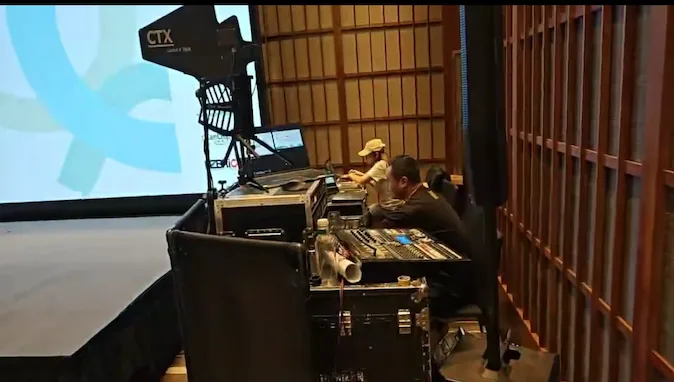
HI-COM provided the technical preparation, equipment configuration, on-site setup and live testing required for the event.
A controlled solution for a Luxembourg corporate seminar
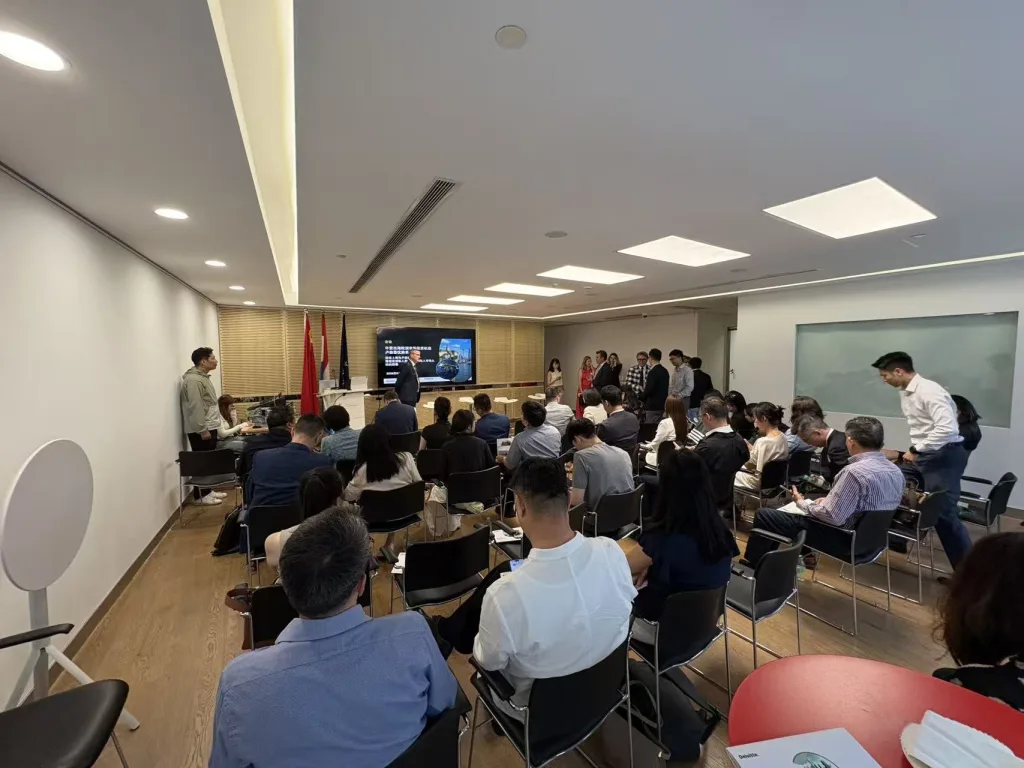
The following day, HI-COM supported a corporate seminar for approximately 50 attendees at a Luxembourg diplomatic facility in Shanghai.
The event included a professional panel of speakers representing major international companies, including Deloitte.
Because the seminar took place inside a diplomatic venue, discretion and technical control were central to the setup. HI-COM therefore focused on a reliable and carefully tested English-to-Chinese and Chinese-to-English AI translation and captioning workflow.
We cannot of course disclose sensitive operational details related to diplomatic facilities. However, the mission demonstrates an important point: AI event technology must adapt to the venue rather than force the venue to adapt to the technology.
AI simultaneous translation in Shanghai requires more than software
Many platforms can translate speech. Yet a professional event solution involves much more than opening an application.
The system must capture clean audio, recognise speech accurately, translate it into the target language and deliver the output with minimal delay.
In a bidirectional configuration, the technology must process both English and Chinese source audio. It must then deliver Chinese or English captions and translated audio according to the speaker and audience requirements.
Meanwhile, attendees must be able to access the translation comfortably. Organisers also need to be confident that the solution will remain stable throughout the event.
Connecting the AI workflow to the event audio
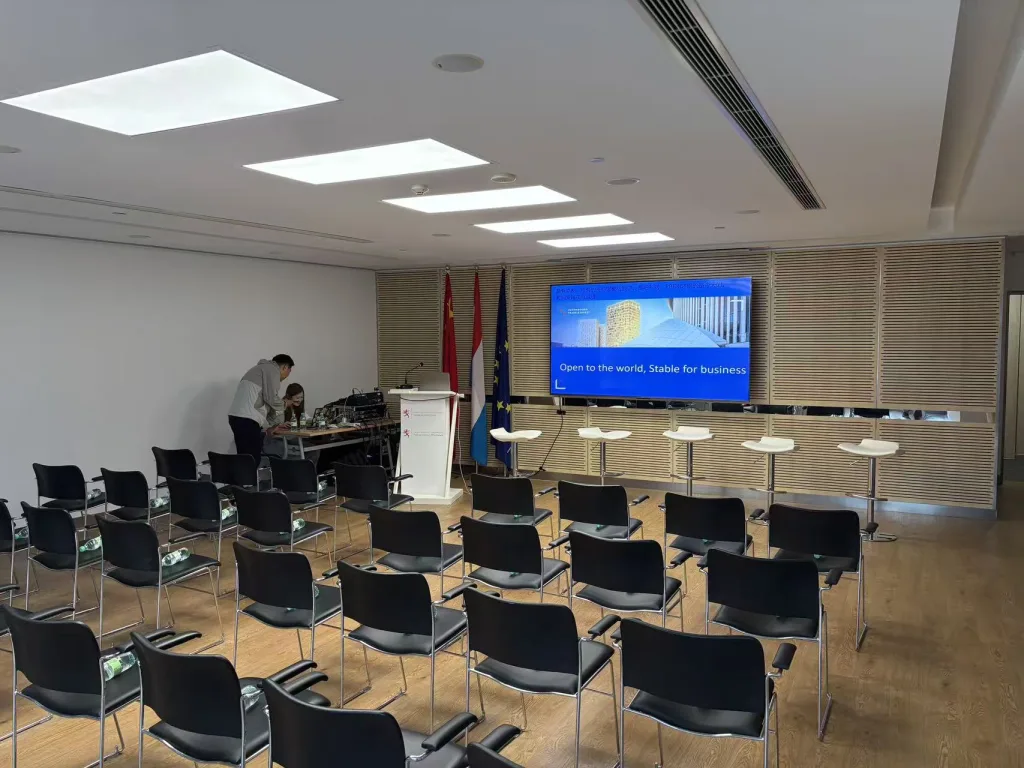
The quality of AI translation begins with the source audio.
If microphones are too far from the speakers, the system may struggle with names, accents or technical terms. Background noise and overlapping conversations can also reduce accuracy.
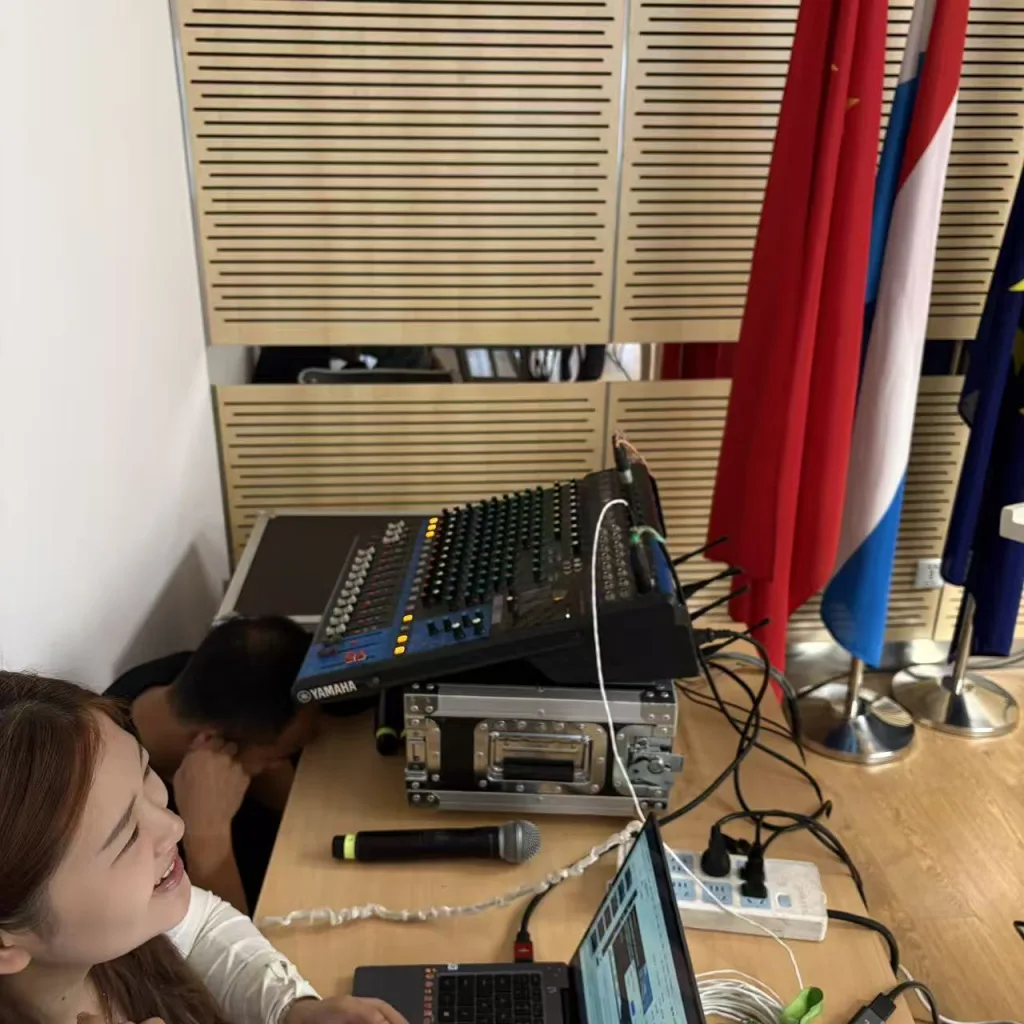
HI-COM reviews the audio chain before the event. This includes the microphones, mixer output, translation input and caption display.
The objective is simple: provide the system with the cleanest possible English or Chinese audio, depending on the speaker.
Testing the venue before the audience arrives
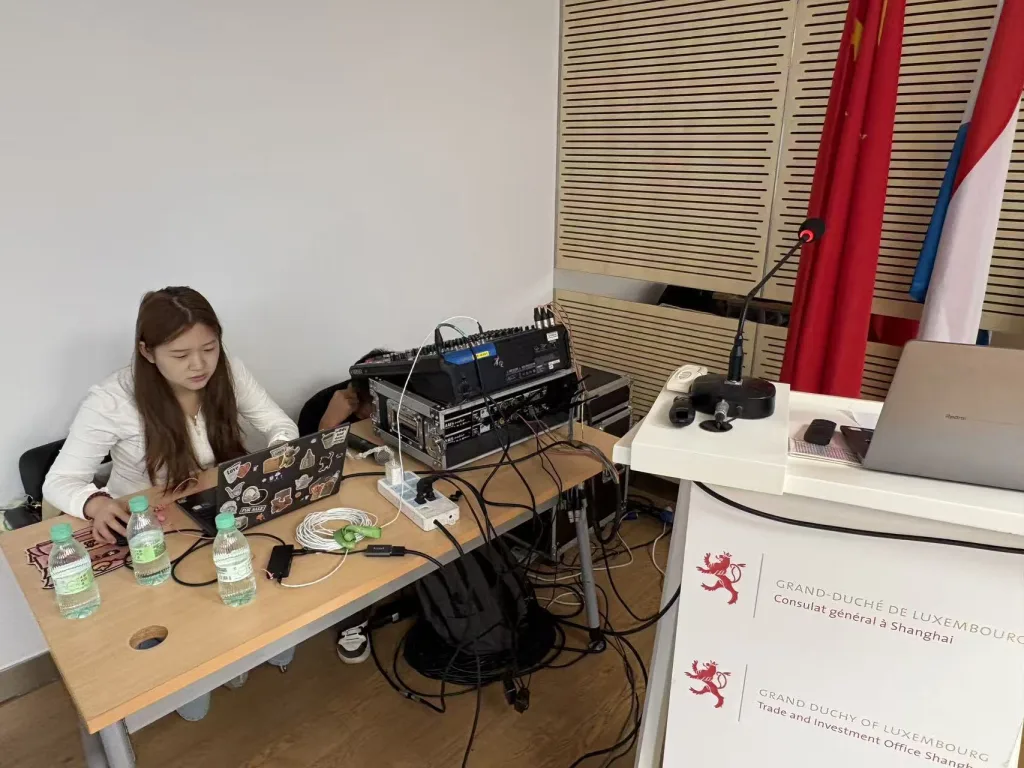
On-site testing is a critical part of every turnkey deployment.
The technical team checks the room acoustics, network conditions, device connections, display format and sound levels. It also confirms how the Chinese and English translations will reach the audience.
Testing must use the actual event configuration. A system that works in an empty office may behave differently inside a conference room with microphones, screens, speakers and dozens of connected devices.
Monitoring the system throughout the event
AI translation is automated, but professional delivery still requires human supervision.
An on-site technician monitors the audio feed, translation output, language direction, latency, captions and equipment status. If a speaker changes microphone, switches language or a connection becomes unstable, the technician can respond immediately.
This human layer is what turns an AI platform into a managed event service.
How bidirectional AI translation and live captioning work together
Bidirectional English–Chinese AI simultaneous translation and live captioning can support different audience preferences and multilingual event formats.
The process usually follows four stages:
- The system captures the speaker’s English or Chinese audio.
- Automatic speech recognition converts the source speech into text.
- Machine translation produces Chinese or English content in the required target language.
- The audience receives translated captions, translated audio or both.
Live captions help attendees follow the speaker visually. Translated audio supports participants who prefer listening rather than reading.
When both are available, attendees can choose the format that best fits the event, the speaker’s language and their own language preference.
The right turnkey solution depends on the event
There is no single configuration for every conference, seminar or diplomatic meeting.
HI-COM can design different event translation solutions according to the venue, audience, language directions, confidentiality level and subject matter.
AI-powered translation and captions
This configuration can work well for seminars, presentations, internal training and conferences with clear audio and structured speeches.
It can include:
- English-to-Chinese and Chinese-to-English AI translation;
- real-time Chinese and English captions;
- translated audio delivery in both language directions;
- venue equipment;
- system configuration;
- pre-event testing;
- on-site technical supervision.
Live captioning without translated audio
Some organisers only need translated subtitles in Chinese, English or both languages.
This option can reduce the amount of equipment while still improving access for participants using either language.
Captions may appear on a main screen, secondary display or approved personal device interface, depending on the event setup.
Human interpreting with AI-supported captions
AI is not automatically the right solution for every event.
Legal discussions, negotiations, diplomatic exchanges and highly technical presentations may require professional human interpreters. In these cases, a hybrid model can combine human simultaneous interpreting with AI-supported captioning.
HI-COM provides broader multilingual interpreting services in China, including simultaneous interpreting and business interpreting.
Secure configurations for diplomatic and government venues
Diplomatic and government facilities may have specific requirements concerning internet access, devices, audience distribution and information handling.
Therefore, HI-COM evaluates each venue before proposing a solution.
The deployment can be adapted around controlled access, approved hardware, restricted distribution and on-site technical management. The exact configuration depends on the venue’s rules and the sensitivity of the content.
Clear communication supports the entire event experience
Language access affects more than understanding.
When attendees can follow a panel clearly in either English or Chinese, they engage more confidently. They can respond to speakers, participate in networking and retain more information.
For organisers, a managed translation solution also reduces operational pressure. Instead of coordinating separate software, equipment and technical providers, they work with one team responsible for the complete workflow.
This is the value of a turnkey service.
HI-COM manages the language technology, equipment, setup, testing and live technical support. The organiser can remain focused on speakers, guests and event objectives.
Building on HI-COM’s event interpreting experience in China
These two Shanghai assignments complement HI-COM’s wider experience supporting multilingual business events in China.
Recent projects include English–Chinese interpreting and equipment for the Beijing Energy Briefing and the Mongolia Investment Forum Shanghai. Those missions combined professional interpreting, conference equipment and on-site technical coordination.
HI-COM also supports English-to-Chinese translation, Chinese-to-English translation and wider bilingual language support for business, marketing, legal and corporate communication.
This combined expertise allows our team to recommend AI, human interpreting or hybrid solutions according to the real communication risk.
Conclusion: event technology must serve the audience
Bidirectional English–Chinese AI simultaneous translation and live captioning can make international events more accessible, flexible and efficient.
However, successful delivery depends on preparation.
The audio must be clear in both source languages. The system must fit the venue. The output must be easy to access. Technical specialists must also monitor the solution throughout the event.
HI-COM’s recent work with BritCham Shanghai and a Luxembourg corporate seminar demonstrates how technical planning and multilingual expertise come together.
For high-level corporate events, diplomatic seminars and international conferences in China, clear communication should never depend on software alone.
It requires a complete, tested and professionally managed solution.
Planning an international event in China?
Contact HI-COM to discuss bidirectional English–Chinese AI simultaneous translation, live captioning, professional interpreting and turnkey conference equipment.