

HI-COM Renews TAC Membership: Translation Expertise in China
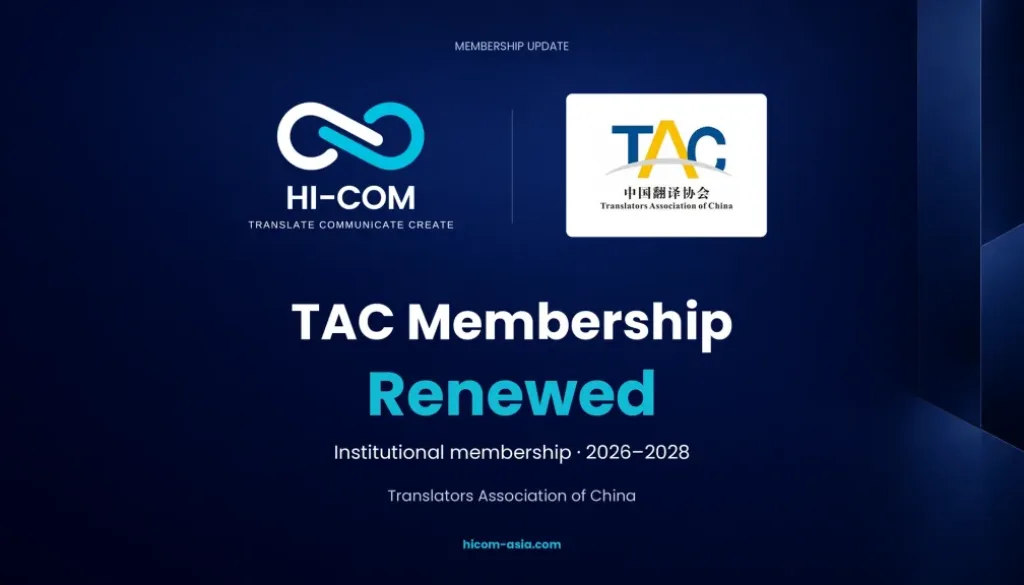
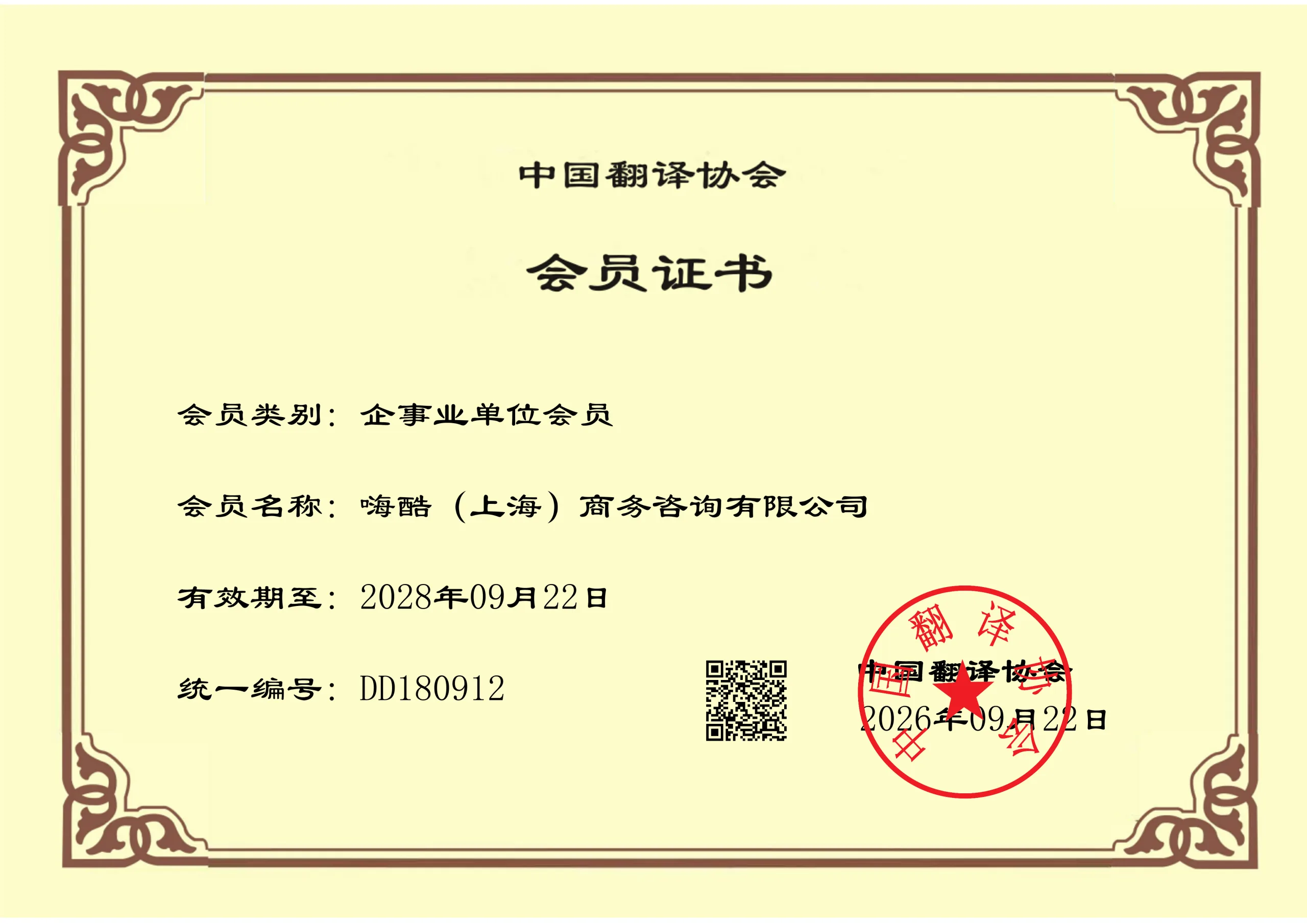
HI-COM has renewed its institutional membership of the Translators Association of China (TAC), with its current certificate valid until 22 September 2028. Issued on 22 September 2026, the certificate confirms HI-COM’s continuing membership of China’s national translation association—a professional affiliation that complements our practical experience supporting multilingual business and official-document projects.
For companies and individuals working across borders, choosing a language partner is a decision about responsibility as much as language. A contract must preserve its meaning. A technical document must use consistent terminology. An official translation must follow the receiving organisation’s instructions. Our renewed TAC membership reinforces the professional commitment behind that work: informed preparation, careful delivery and a clear understanding of the Chinese context.
TAC Membership: A Verifiable Connection to China’s Translation Profession
Founded in 1982, the Translators Association of China brings together organisations and professionals across the translation and interpreting sector. Its activities include professional exchange, training, industry research and standards development. TAC has belonged to the International Federation of Translators since 1987, connecting China’s language-services community with the international profession.
Its membership rules establish expectations concerning professional ethics, industry norms and responsible business conduct. For HI-COM, maintaining institutional membership affirms our commitment to these expectations and our continuing place within China’s professional language ecosystem.
The certificate provides clients with a concrete credential they can inspect. It records our Shanghai entity, 嗨酷(上海)商务咨询有限公司, and the validity of its membership through September 2028.
A China-Based Translation Partner With International Perspective
HI-COM’s translation and localisation services support communication into and out of Chinese, as well as projects across more than 40 languages. From our Shanghai base, we work with businesses and individuals whose documents, products and messages need to move between Chinese and international environments.
That breadth matters when one project contains several types of content. A company preparing for China may need corporate documents, technical information and customer-facing materials. Each serves a different purpose and calls for different terminology, review priorities and presentation.
Our approach starts with that intended use. We establish what the content must achieve, identify the appropriate language resources and plan the delivery around the reader, document format and deadline. The result is a project scope that addresses the practical task behind the translation request.
Specialist Content Calls for Specialist Attention
A legal clause, an engineering instruction and a marketing headline cannot be handled with the same editorial priorities. Professional translation depends on understanding where precision is critical, which terms must remain consistent and how the target audience will use the information.
Useful questions to settle before production include:
- Which source file is authoritative, and are any pages or attachments missing?
- Which names, product references and technical identifiers must remain consistent?
- Who will approve terminology or resolve an ambiguous source passage?
- Is the deliverable intended for internal reference, publication or official submission?
- Does the translated layout need to mirror the original?
These questions make expertise visible in the workflow. They also help clients compare providers using the quality of the proposed process, alongside price and turnaround.
Certified Chinese Translation: Prepare for the Intended Submission
Official-document projects need an additional layer of preparation. Diplomas, academic transcripts, civil records, company documents and other supporting paperwork may require a particular translation format, certification statement or seal, depending on where they will be submitted.
HI-COM’s certified Chinese translation service supports clients preparing documents for use in China and abroad. We ask about the destination, receiving organisation and stated requirements so the appropriate translation route can be assessed before production.
For clients, the practical priorities are clear:
- Complete coverage of the document, including relevant stamps and annotations
- Consistent names, dates, document references and institutional titles
- A legible presentation that allows the source and translation to be compared
- The certification format requested for the intended procedure
Clarifying Requirements Early Makes the Project Easier to Manage
For example, a diploma with an attached apostille presents two linked documents to review. The client should provide both, together with any instructions from the university or administrative authority. Whether the apostille itself requires translation, and which certification format is appropriate, should be established for that submission.
Our role is to help clients prepare the language-service component with those requirements in view. Final acceptance remains with the receiving organisation.
Have instructions from an authority or institution? Share them alongside your documents so HI-COM can assess the required translation scope.
Translation, Notarisation and Apostille: Coordinate the Right Steps
Cross-border document preparation can involve several distinct procedures. Understanding their different roles helps prevent an incomplete or incorrectly sequenced request.
| Process | Role in document preparation |
|---|---|
| Translation | Conveys the source document’s content in another language |
| Translation certification | Provides the required statement, signature or agency confirmation, according to the intended use |
| Notarisation | Performs the relevant notarial act; its scope depends on the document and procedure |
| Apostille | Authenticates the origin of an eligible public document for use under the applicable Apostille Convention framework |
HI-COM provides apostille and notarisation support in China alongside its language services. This allows clients to discuss the document, destination and translation needs together when planning their next steps.
TAC membership confirms our professional affiliation. Apostilles and notarial acts remain the responsibility of the competent issuing authorities and professionals. Keeping these roles clear is part of giving clients reliable guidance about the service they are requesting.
Professional Trust Built Through Evidence and Delivery
The renewed membership is one part of HI-COM’s trust story. Clients should also be able to understand the scope of their project, the review process, the deliverable and the responsibilities of each party.
Our continuing commitment is to connect professional language expertise with practical knowledge of working in China. Whether the task involves specialist business content or official paperwork, the starting point remains the same: understand the purpose, define the requirements and manage the work carefully.
With our TAC membership renewed through September 2028, HI-COM continues to invest in its place within China’s language-services community and in the relationships that support international communication.
Discuss Your Translation or Document Project With HI-COM
Need professional translation, certified Chinese translation or support preparing documents for cross-border use? Send your project to HI-COM.
Include the document type, source and target languages, intended country or receiving organisation, deadline and any instructions you have received. Our team can then assess the scope and recommend the appropriate service and next steps.
Ready to discuss your translation or document project?