

Niu Lai (牛来): How China’s “Worst” Animated Movie Became a Viral Box-Office Phenomenon
It made less than RMB 8,000 in ten days. Then the jokes started. Within days, cinemas were adding screenings, the box office had crossed RMB 20 million, and yellow cow figurines were already appearing on Taobao.
Welcome to Niu Lai, perhaps China’s strangest cultural hit of 2026.
At HI-COM, we spend a lot of time watching how trends actually move through China. Not only what becomes popular, but why.
A strange Douyin clip becomes a Weibo discussion. A Weibo discussion becomes a Bilibili roast. Someone checks the company behind it on Tianyancha. The joke moves into group chats. Sellers notice. Products appear on Taobao.
Sometimes the entire cycle takes weeks. With 《牛来》 (Niu Lai), it took days.
The 86-minute Chinese animated film arrived in cinemas on August 5, 2026 with virtually no promotional momentum. During its first ten days, fewer than 300 people reportedly bought tickets and cumulative box office remained below RMB 8,000.
For most films, that would be the end of the story. For Niu Lai, it was the beginning.
Chinese netizens discovered the movie’s stiff animation, strangely hypnotic characters, almost expressionless cows and extraordinarily unlikely production history. People mocked it. Then other people became curious about what they were mocking. Then those people bought tickets. Then they posted their own jokes. Then cinemas scheduled more screenings.
By August 19, box office had moved beyond RMB 20 million. The internet had performed a resurrection. And no one seemed entirely sure whether they were watching a children’s animation, a meme, a social experiment or all three at once.
The HI-COM version in one sentence:
Niu Lai became popular because Chinese audiences were repeatedly told how bad it was until “I need to see this for myself” became a stronger sales argument than any trailer could have been.
Niu Lai: the essentials
- Chinese title: 牛来
- Pinyin: Niú Lái
- Release date: August 5, 2026
- Run time: 86 minutes
- Director: Xin Yumeng (信雨萌)
- Screenwriter: Sun Lifang (孙丽芳)
- Language: Mandarin Chinese
- Production company: Dalian Jingyuan Culture Film and Television Media Co., Ltd.
- Production: mother-and-son team, ~5 years
- First ten days: ~RMB 7,700 at the box office
- By August 19: More than RMB 20 million
- Main marketing engine: largely the Chinese internet itself
And yes, the company behind the movie previously worked in interior decoration. Keep that detail in mind. It explains a surprising amount of what happened next.
First: what is Niu Lai actually about?
Behind the screenshots and jokes is a relatively earnest children’s story.
Niu Lai is a weak newborn calf who initially struggles even to stand. A skylark arrives, and much of what follows unfolds through a dreamlike adventure.
Inside that dream, Niu Lai befriends an injured leopard named Bao La, faces rejection from the herd, survives drought and attacks, loses his mother and gradually grows from a timid calf into a leader capable of protecting others.
Eventually, the dream ends. Niu Lai returns to reality. Nothing appears to have physically happened — but something inside him has changed. He finally stands.
It is essentially a story about growing up, courage, loss, friendship, prejudice and responsibility. On paper, perfectly respectable material for children’s animation.
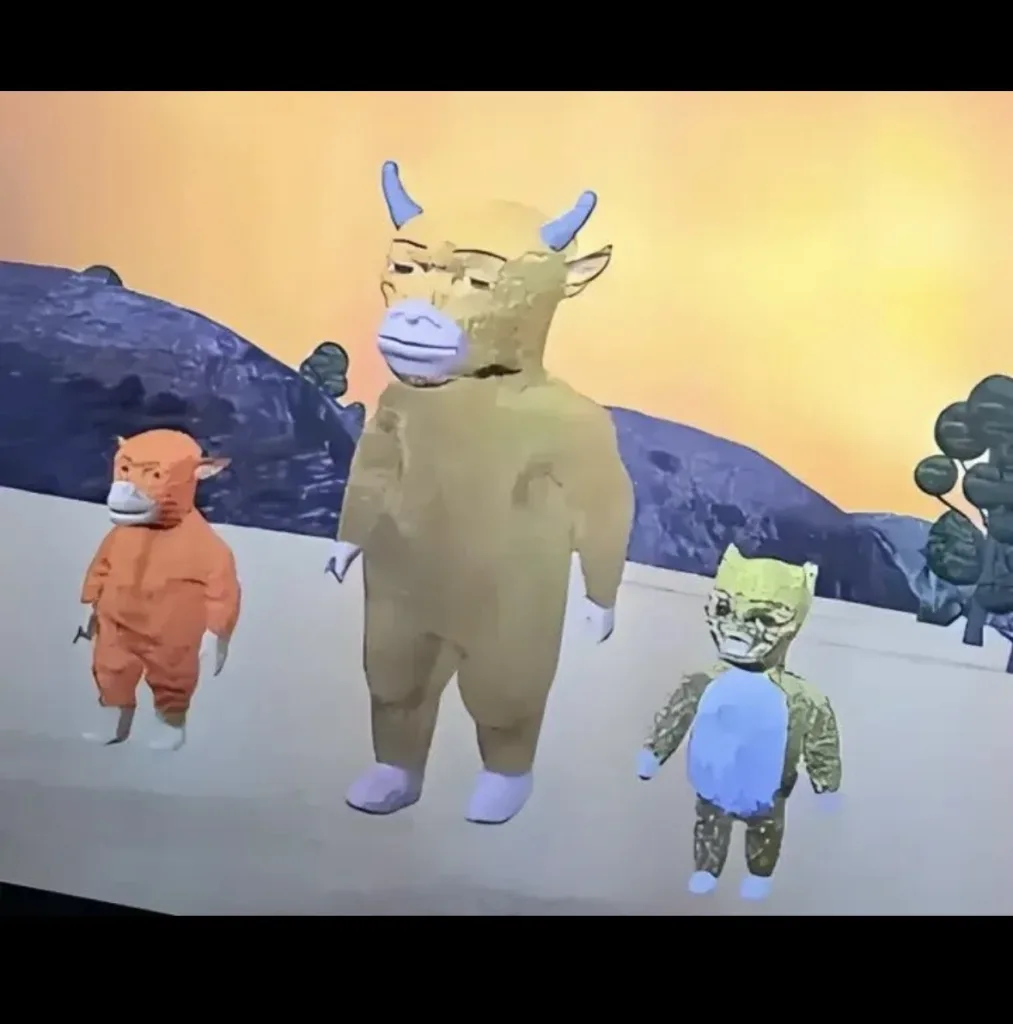
Then you see Niu Lai.
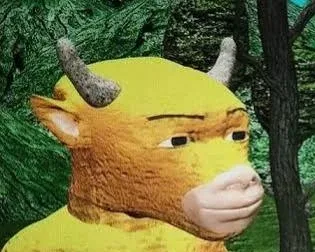
That face would soon become more important than the plot.
The best plot twist wasn’t in the screenplay
Chinese netizens are very good at investigating things. Brands know this. Celebrities know this. And in August 2026, the people behind Niu Lai learned it too.
Users began looking into the film’s production company: Dalian Jingyuan Culture Film and Television Media Co., Ltd. And discovered its previous identity: Dalian Jingyuan Decoration Engineering Co., Ltd.
In other words, before entering cultural and film production, the company had operated in interior decoration and renovation. The internet immediately recognised the comic potential.
Suddenly, Niu Lai had a much better pitch than anything its official marketing could have invented: “A renovation company made an animated movie.”
That sentence did almost everything a viral hook needs to do. It was simple. Surprising. Repeatable. And just plausible enough to demand verification.
One recurring joke compared the movie to an interior-design rendering that had suddenly begun moving. Another imagined a property floor plan and renovation quotation appearing halfway through the movie.
And, visually, you can understand why. Some backgrounds, materials and character movements feel closer to an architectural walkthrough, early 3D visualisation or virtual property tour than to what audiences normally expect from contemporary theatrical animation.
The joke therefore worked on two levels: the company really had a renovation background, and the film sometimes looked like it did too.
For once, corporate registration records had become part of a movie’s entertainment value.
At HI-COM, that detail is particularly interesting because it reveals something broader about China: corporate identity is increasingly public storytelling material.
Consumers do not only search for your product. They search for you, often on the same public registries used for checking a Chinese company’s registration and business history — tools like Qichacha and Tianyancha that most international brands only associate with supplier due diligence, not entertainment.
“Before I built with bricks. Now I build with polygons.”
The renovation-company story is funny. But stopping there would make Niu Lai less interesting than it actually is.
Behind the meme is a very unusual human story.
Director Xin Yumeng, born in 1992, did not emerge from one of China’s major animation studios. His background involved landscape-related design, interior work and BIM before he began teaching himself the skills needed to build an animated feature.
An earlier remark attributed to him resurfaced as the film went viral:
“Before, I built with bricks. Now I build with polygons.”
It is almost too perfect.
Production reportedly took around five years. Xin handled an enormous amount of the work himself. His mother, Sun Lifang, wrote the screenplay and contributed voices and music. She also wrote, composed and performed the end-credit song Rain After the Breeze Has a Fragrance (《雨后轻风有香》).
There was no giant studio infrastructure hiding behind them.
Xin has described buying computer equipment second-hand through Xianyu (闲鱼) because new hardware was expensive. Machines failed. Motherboards reportedly burned out.
And, in a detail that feels almost absurdly appropriate in 2026, Xin has said that the film was made without AI.
That matters, because while the internet was laughing at how rough Niu Lai looked, people were simultaneously discovering that a son and his mother had spent years manually trying to make it exist.
The reaction became more complicated. The film was easy to mock. The persistence behind it was not. That contradiction is one reason Niu Lai developed a life beyond a normal “bad movie” joke.
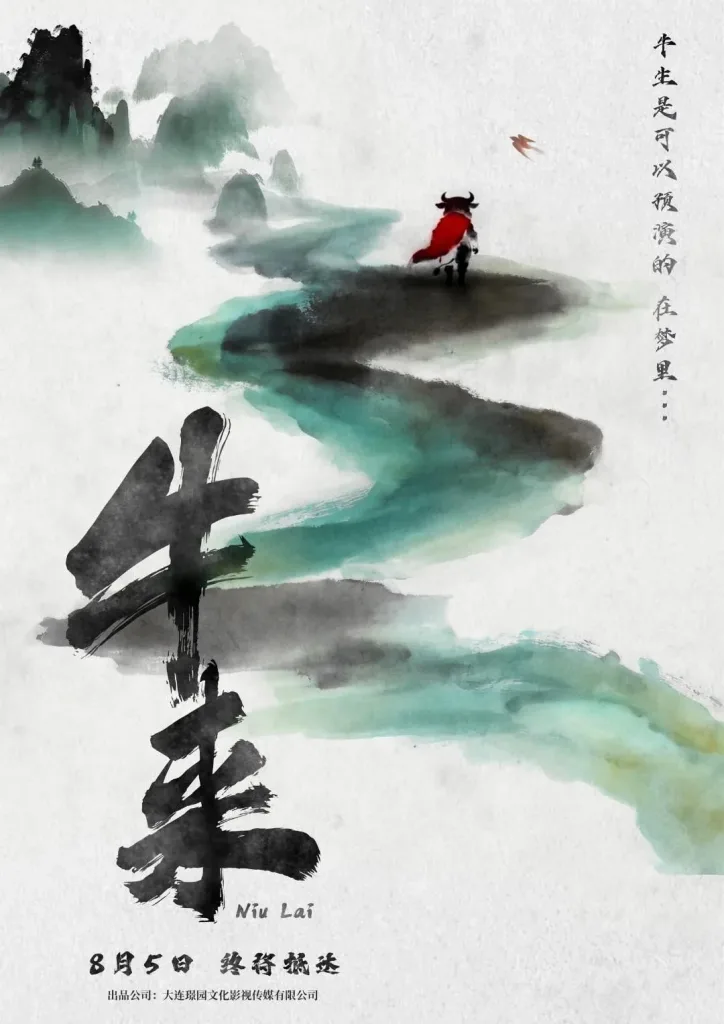
The poster promised poetry. Then the cow appeared.
If somebody had designed Niu Lai specifically for the “Expectation vs. Reality” meme format, they could hardly have done better.
One of the film’s most striking promotional visuals is an elegant Chinese ink-wash poster. A lone bull. Mist. Mountains. A red cape. A visual atmosphere somewhere between classical Chinese painting and an arthouse fantasy film. Beautifully restrained. Almost philosophical.
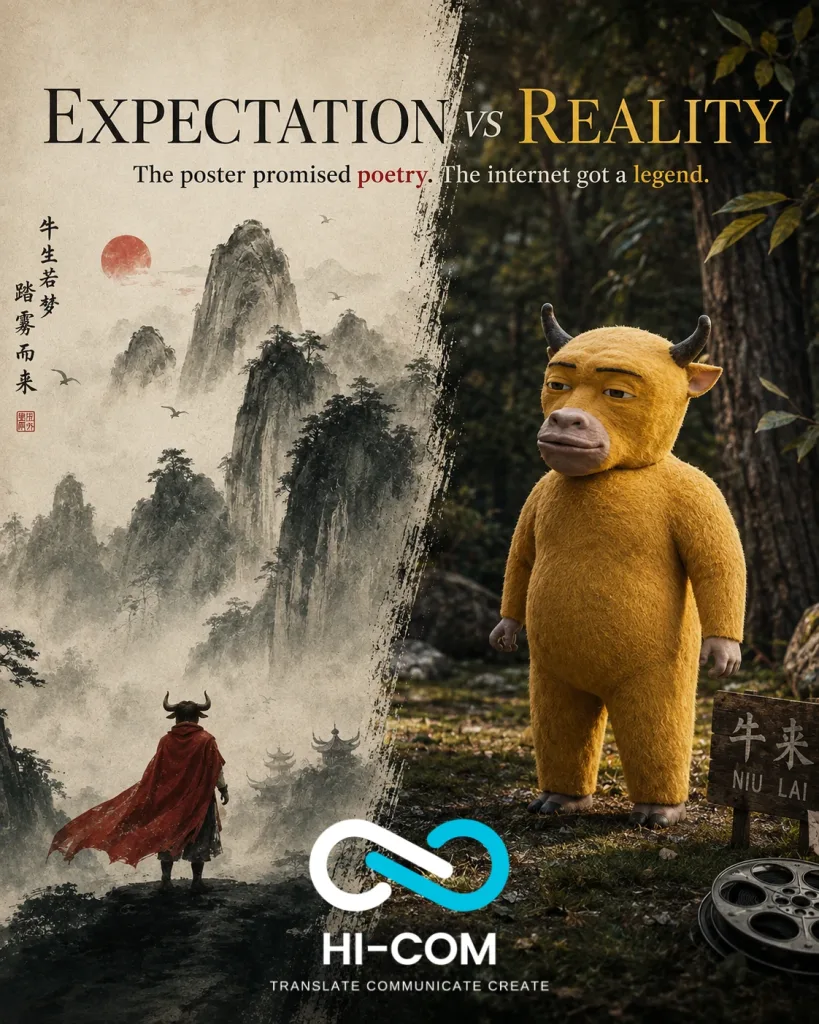
Then there is the actual animation. The contrast is spectacular. The movie’s crude 3D models and stiff visual language sit so far from the promise of the poster that the difference itself became content.
It is the kind of mismatch social media loves because no explanation is necessary. You put the two images next to each other. People understand the joke immediately.
And this is where something important happens: the weakness of the product becomes an asset for the content surrounding it. Normally that is a branding disaster. In this very specific case, it became distribution.
The box-office disaster that became the advertisement
During its first ten days, Niu Lai reportedly made around RMB 7,700; Beijing News’s own count, published August 15, put the precise ten-day figure at RMB 7,711 from 278 viewers. Screenings had become extremely limited.
Then a hashtag started circulating: #牛来票房7352元没有万# — approximately, “Niu Lai’s box office is RMB 7,352, there is no ‘ten thousand’ after it.”
(The hashtag’s rounder RMB 7,352 and Beijing News’s own RMB 7,711 come from slightly different counting windows in the same few days; both numbers were genuinely in circulation, not a typo either way.)
It is a wonderful example of Chinese internet humour because the joke was basically accounting. The number looked so unbelievably small that users felt compelled to clarify: no, it is not RMB 73.52 million. Not RMB 7.35 million. Not even RMB 73,520. RMB 7,352.
The humiliation became funny. And the funny number became shareable. People began posting clips and screenshots.
Others started asking: “Can it really be that bad?”
The screening numbers moved just as fast as the jokes. According to Beijing News’s reporting, daily screenings jumped from 21 to 359 within 48 hours, the film’s share of nationwide screenings rose to roughly 2.4%, and box office in that same 48-hour window reached about RMB 251,000 — a small number in absolute terms, but a very large multiple of where it started.
Cinemas began receiving interest. Viewers reportedly travelled to screenings simply to experience the phenomenon themselves.
- August 15 — sales accelerated dramatically.
- August 17 — reported box office had passed RMB 10 million.
- August 18 — coverage citing AP put the figure at around RMB 17.1 million.
- August 19 — listings citing Maoyan showed the total above RMB 20 million; international outlets including Euronews and Cartoon Brew tracked broadly the same climb, though exact numbers moved by the hour and varied slightly by tracking platform.
Pause on that for a moment. A film that had essentially disappeared commercially was turned into a nationwide conversation in a matter of days.
At HI-COM, we sometimes talk about the speed of Chinese digital ecosystems with overseas brands. Niu Lai is what that speed looks like when nobody is controlling it.
The reviews did the job of the advertising
Normally, if people repeatedly describe your product as terrible, that is bad news.
Niu Lai found itself in the rare situation where every additional insult widened the curiosity gap.
Some of the sharpest lines were also the most quotable.
Reviewing the reaction for Beijing News, one commonly shared comment read, roughly translated: “even the paper cow burned as a grave offering has better modelling than this.”
Another: “even a first-year animation student could shoot something better.”
Reactions that spread widely in Chinese and international coverage included lines like “this movie can’t even be generated by AI” and the line that probably explains the entire phenomenon better than any marketing framework:
“I just want to see how bad it is.”
That is the point where conventional word-of-mouth logic breaks.
Normally: bad review → reduced purchase intent. Here: bad review → stronger curiosity → purchase.
In China, this sometimes resembles 反向种草 — a kind of reverse recommendation. The recommendation is technically negative. The behavioural result can still be positive.
We would be very careful about turning this into the lazy idea that “all publicity is good publicity.” It isn’t.
Most bad products simply fail quietly. Niu Lai crossed a much rarer threshold: its badness became distinctive enough to be entertaining in itself. That distinction is important.
And then China’s stock-market crowd found the cow
There is another layer that is difficult to appreciate if you only translate the movie title literally.
牛 (niú) means cow, ox or bull. In finance, 牛市 (niúshì) means bull market — which means 牛来 can very easily trigger: 牛市来了!
“The bull market is coming!”
Suddenly this strange yellow animated cow had an entirely separate life as a financial good-luck joke. Stock-market users began joining the conversation. A children’s animation had somehow become relevant to retail investors.
This is what we mean when we say that localisation is not translation. The wordplay only works because of language, Chinese financial terminology, online humour, cultural associations around 牛, and the habit of turning phrases into reusable memes.
The title did something brands spend enormous amounts of money trying to achieve: it escaped its original context. “Niu Lai” no longer referred only to a film.
It became something people could say. And once people can use your name independently of your product, that name starts carrying social currency.
To really understand Niu Lai, you need to understand 抽象
International coverage often describes Niu Lai as a “so bad it’s good” movie. That is useful. But it is incomplete.
A better Chinese internet reference is 抽象, chōuxiàng. Literally, “abstract.”
Online, the meaning is much messier, appropriately. 抽象 humour can be weird, absurd, awkward, inexplicable, surreal, contextless or intentionally ugly.
Sometimes something is funny precisely because nobody can explain why it is funny.
Niu Lai was almost engineered for this environment, even though it clearly wasn’t engineered for it at all.
The ingredients were already there: stiff animation, blank expressions, unexpected dialogue, strange pacing, cattle standing like people, odd camera choices, and, crucially, Niu Lai’s face.
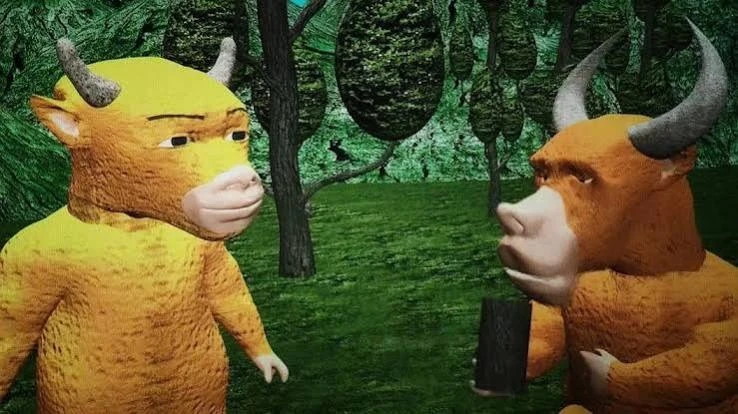
Look at that expression. It can mean: “I understand.” “I absolutely do not understand.” “My boss has scheduled another meeting.” “I have lost everything on the stock market.” “Fine.” “No.” “Yes.”
That is meme gold.
A conventional movie gives viewers characters. Niu Lai accidentally gave Chinese netizens a reaction template. And templates travel much further than scenes.
审丑: when the audience enjoys the wrong thing
Another useful concept is 审丑 shěnchǒu.
Roughly speaking, it describes the enjoyment or examination of something ugly, awkward, tasteless or “bad.” Not necessarily because the audience genuinely admires it. Because reacting to it is fun.
That distinction completely changes the economics of attention. A normal cinema ticket says: “I expect this movie to entertain me.”
A Niu Lai ticket increasingly said: “Everyone is talking about this ridiculous thing and I want to be part of the conversation.”
The entertainment was no longer entirely on the screen. It was between viewers. In the jokes. In the comments. In the screenshots.
In telling a friend:
“You have to see this.”
Not because it is good. Because describing it is no longer enough.
At that point, the movie stopped being merely a film. It became an event.
Why people recommending a “terrible” movie matters
Consider two conversations.
Conversation one:
“Have you seen that new animated film? It’s quite good.” “No.” “Okay.” Finished.
Conversation two:
“Have you seen that Chinese cow movie everyone says is unbelievably bad?” “No.” “You need to see his face.” “How bad is it?” “I can’t explain it.”
Now we have a problem. A useful problem. The listener has an information gap. They cannot fully participate until they have seen the thing. That creates curiosity, FOMO, shared language, and a reason to pass the story onward.
China didn’t just watch Niu Lai. It rebuilt it.
One mistake international brands sometimes make is talking about “Chinese social media” as though it were one giant platform. It isn’t. Niu Lai illustrates why that matters.
- Weibo. The story becomes a public conversation. Hashtags, screenshots, jokes and rapidly changing narratives spread quickly.
- Douyin. The film becomes compressed. A strange expression, movement or line only needs a few seconds to become a clip, reaction or remix — the same mechanic behind most of HI-COM’s Douyin marketing work in China, minus the accidental part.
- Bilibili. The phenomenon becomes something people can dissect. Roasts. Comparisons. Edits. Commentary. Danmaku. Longer explanations of why something is hilariously wrong.
- Douban. People rate it, review it and participate through ironic criticism.
- Qichacha and Tianyancha. And here Niu Lai becomes particularly Chinese. Corporate-information platforms unexpectedly become entertainment platforms because users begin investigating the company behind the film.
- Taobao. Then the meme becomes an object.
That cross-platform movement is the real story.
Film → screenshot → roast → corporate investigation → meme → ticket → new viewer → new meme → merchandise.
No single platform created Niu Lai. The ecosystem did.
HI-COM checked Taobao. The cow was already there.
This is the part we found especially interesting.
On August 19, 2026, while the box-office story was still developing, HI-COM checked Taobao manually to see whether sellers had already reacted. They had.
We found listings for small Niu Lai 3D-printed figures, larger desktop models, plush versions, keychain-style products, and movie-inspired collectibles.
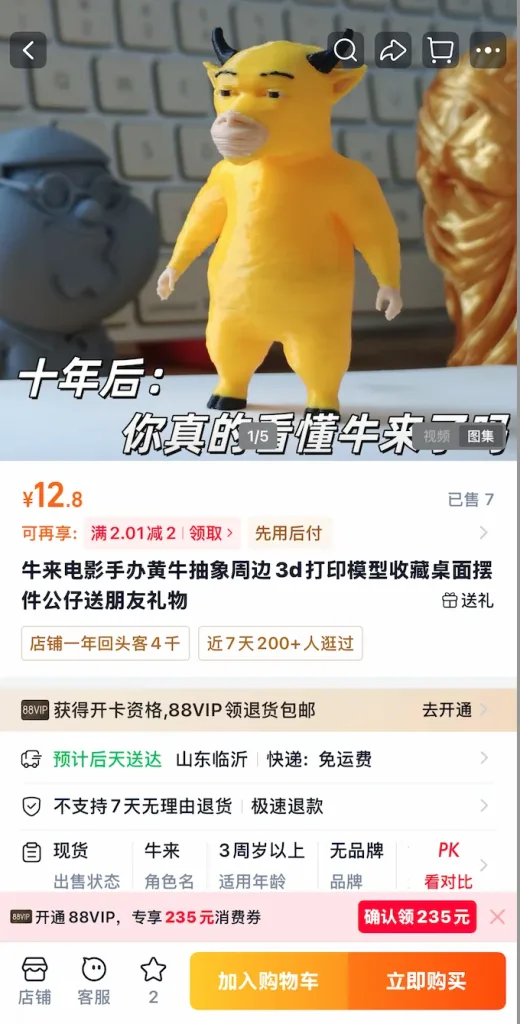
To be clear: this does not demonstrate that Niu Lai already has a major official licensing or merchandising business. Some products appeared to be third-party. Individual sales figures visible in our screenshots were modest.
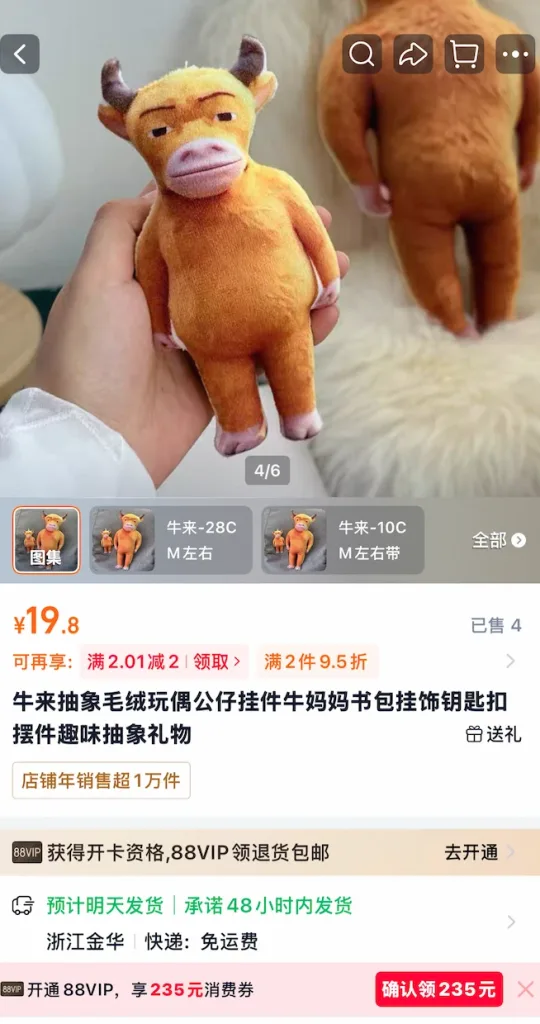
But those numbers are almost beside the point. What interested us was the reaction time.
The sequence was essentially: movie → meme → recognisable face → physical product — in a matter of days.
This is something companies entering China should pay attention to. Chinese e-commerce ecosystems are extremely responsive. Manufacturers, small sellers, 3D-printing shops and marketplace merchants can react to an emerging visual language much faster than a traditional corporate licensing process ever could.
The cow did not need to become Mickey Mouse. It only needed to become recognisable. Recognition created an object.
From meme to merch: the Chinese internet can commercialise attention frighteningly fast
There is an important distinction here. Nobody knows whether the Niu Lai merchandise visible today will still be selling six months from now.
Probably much of it will not. That is how meme economies work. But that does not make the phenomenon commercially irrelevant. It makes it time-sensitive.
A seller does not necessarily need a five-year brand strategy. They may only need a recognisable image, cheap production, a marketplace listing, and seven good days.
This is why trend monitoring in China cannot always happen through quarterly reports. By the time a traditional business has identified the trend, scheduled the meeting, approved the budget, requested three quotations, prepared the campaign, and translated the deck, the internet may already have moved on.
Niu Lai is a funny case. But the speed behind it is not funny at all. It is a competitive reality.
Then the joke became unexpectedly human
The story could easily have ended as collective ridicule. But the more people learned about the production, the harder that became.
Five years. Self-taught animation. Second-hand computers. Technical failures. One inexperienced creator trying to make a feature film. His mother learning and contributing alongside him. An original song at the end.
Suddenly the internet was dealing with two different truths:
“This is technically very bad.”
And:
“These people really tried.”
Both can be true.
Ridicule mixed with sincerity produces something much more durable: affection. The cow becomes ridiculous but strangely lovable. The amateurism becomes funny but also human. The creators stop being anonymous producers of “bad content” and become a son and his mother who spent years attempting something objectively difficult.
So, is Niu Lai actually good?
By conventional professional standards, the film has been heavily criticised for its animation, voice work, storytelling, pacing, editing and overall finish.
It is also difficult to argue that the viral success suddenly fixes the filmmaking.
We should therefore resist one particularly seductive interpretation:
“Niu Lai proves quality doesn’t matter.”
It proves nothing of the sort.
Thousands of poor-quality products enter the market every year. Almost all disappear. Niu Lai is an outlier because several unusual elements collided at precisely the right moment.
What international brands can actually learn from Niu Lai
The useful lessons are less spectacular than “make something terrible and go viral.” They are also much more valuable.
1. Being good is not enough to be discussed
Quality matters. But quality alone does not create conversation. Products spread when people have something to say about them. That may be beauty, utility, identity, surprise, humour, controversy, or, occasionally, a cow with the facial expression of somebody waiting for a delayed flight. The important question for brands is: what is the conversation hook?
2. Your customers can change what your product means
The creators released a children’s animation. The public turned it into a bad-movie cult object, a meme, a stock-market joke, a social activity, a reaction-image library, and a merchandise opportunity. None of those meanings belonged entirely to the producer. This is a fundamental feature of modern Chinese consumer culture: brands publish, consumers reinterpret, platforms accelerate. Once the process starts, control becomes limited.
3. China should be understood as a platform ecosystem, not a platform list
It is easy to write a strategy saying “we need Weibo,” “we need Douyin,” “we need Xiaohongshu.” The harder question is how information moves between them. Niu Lai is interesting because different platforms performed different functions: one surfaced the joke, another expanded it, another explained it, another rated it, another exposed the company behind it, another sold the object. That movement matters much more than a checklist of accounts.
4. Cultural understanding cannot be translated after the campaign
The 牛 / 牛市 joke works because of Chinese language and cultural context. You cannot fully reproduce that effect by writing an English campaign and translating it afterwards. The strongest local communication often begins with language, behaviour, platform conventions, humour and cultural associations. Then the creative idea emerges. Not the other way around.
5. UGC is not merely “content.” It can become infrastructure.
People often talk about user-generated content as though it means customers posting a nice picture of a product. Niu Lai shows the extreme version. Users effectively built the awareness layer, the commentary layer, the recommendation layer, the meme layer, and much of the distribution layer. The official campaign became almost irrelevant. The audience built its own.
6. A human story can rescue attention from becoming cruelty
The renovation-company story generated laughter. The mother-and-son story generated empathy. That transition matters. Brands frequently focus only on the first click. But durable engagement usually requires another layer: a reason to care, a story, a person, something behind the spectacle. Niu Lai accidentally had that.
7. Speed in China is not a cliché
We saw Niu Lai merchandise appearing while the story was still developing. That should tell international companies something. Trend monitoring cannot always be monthly, centralised, slow, or detached from Chinese platforms. Sometimes the valuable window is measured in days.
The best marketing campaign of the film was the one nobody planned
There was no obvious blockbuster launch. No major influencer programme. No enormous trailer campaign.
Instead, Niu Lai had an almost nonexistent opening, a strangely beautiful poster, a hilariously awkward cow, a renovation company, a brutally specific box-office hashtag, some devastating reviews, a mother and son, and millions of curious Chinese internet users.
Then the audience did the rest. They created the positioning, the jokes, the reviews, the reaction images, the social proof, the recommendations, the cultural references, and, remarkably quickly, the merchandise.
If a marketing department had proposed all of this in advance, nobody would have approved the presentation. Which may be the most Niu Lai thing about the entire story.
HI-COM’s take: Niu Lai is not really a movie story
That is why we find this case so interesting.
The easiest article to write about Niu Lai is “look at this terrible Chinese animation that became popular.”
What happened is more revealing. Niu Lai shows how quickly meaning can be reassigned by Chinese consumers.
The producer made one product.
The internet created another.
And the second product — the shared joke, the meme, the collective experience — became more valuable than the first.
Niu Lai may be remembered less as a movie than as a face
The film itself is unlikely to change animation history. Its rise may deserve a place in Chinese internet history.
Niu Lai began with almost nobody watching. Then people watched because everybody said it was terrible. Then they told their friends to watch because apparently suffering is better when shared. Then cinemas added screenings. Then journalists arrived. Then investors made bull-market jokes. Then Taobao sellers produced cows. And somewhere inside this chaotic sequence, an expressionless yellow animal became one of the strangest cultural symbols of the summer.
Related reading
FAQ: Niu Lai (牛来)
What is Niu Lai?
Niu Lai (牛来) is a Chinese animated movie released in 2026, directed by Xin Yumeng and written by Sun Lifang. Its story follows a young calf through a dreamlike journey involving friendship, danger, loss and personal growth.
When was Niu Lai released?
Niu Lai was released in mainland China on August 5, 2026. Its runtime is approximately 86 minutes.
Why did Niu Lai go viral?
The film initially attracted attention because internet users mocked its rudimentary 3D animation, unusual characters and the fact that its production company had previously operated in the interior-decoration sector. That negative attention produced curiosity, memes and user-generated content, eventually bringing audiences into cinemas.
How much did Niu Lai make at the box office?
During its first ten days, Niu Lai reportedly generated only around RMB 7,700. Following its viral breakout, revenues increased sharply. By August 19, 2026, reported totals had moved above RMB 20 million, although the figure continued changing while the film remained in cinemas and varied slightly between tracking platforms.
Who created Niu Lai?
The core project was largely developed by Xin Yumeng and his mother Sun Lifang over approximately five years. Xin handled numerous production tasks, while Sun contributed to the screenplay, voice work and music.
Was Niu Lai created using AI?
Xin Yumeng has stated that the movie was produced without AI and has described purchasing second-hand computer hardware through Xianyu during production.
What does 牛来 mean?
牛 can mean cow, ox or bull, while 来 means “to come.” The title can therefore be read loosely as “the bull/cow is coming.” Chinese users also connected it humorously with 牛市来了, meaning “the bull market is coming.”
Where can I read more about Niu Lai?
For background and continuously updated information, see the Chinese Wikipedia page for 牛来.
Understanding Chinese trends before they become yesterday’s news
Niu Lai is an extreme example, but the mechanisms behind it are not unusual: platform-native humour, secondary creation, memes, social commerce, cultural references and rapidly changing consumer behaviour influence brands in China every day.
HI-COM works with international companies operating in China to understand not only what Chinese consumers are saying, but the language, cultural signals and platform behaviours behind it.
Because in China, translation tells you what the words mean. Market understanding tells you why everyone suddenly cares about a yellow cow.