M Visa vs Z Visa in China: Is Your Trip Business or Work?
Last checked: 23 October 2026. Prepared by HI-COM Asia’s document translation team.
Quick answer
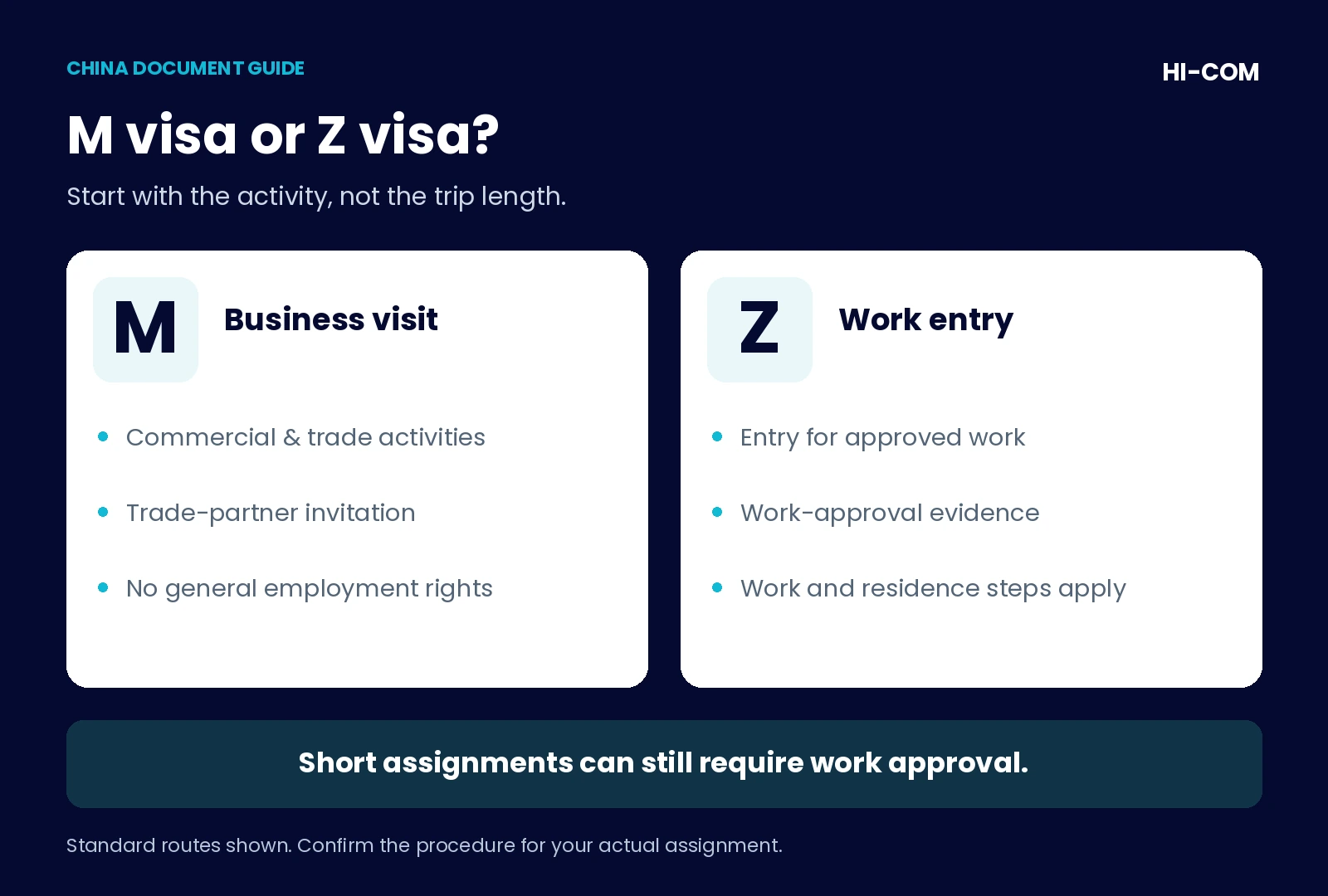
An M visa is for commercial and trade activities. A Z visa is the usual entry route for work, together with the applicable work authorisation and residence formalities. The distinction depends on what you will do in China, not simply how many days you stay. Some short assignments require work approval, while specific activities have narrowly defined exceptions. [1][3][4][5]
A week of supplier meetings and a week delivering technical work can require different preparation. Calling both a “business trip” does not settle the immigration question.
For employers and travellers, the practical starting point is a clear description of the activities. Once the appropriate route has been confirmed, the invitation, work-approval documents, translations and any authentication can be prepared around it.
This guide explains the standard M/Z distinction, the short-term work rules to check, and the documents that often need attention. Special categories and exemptions follow their own conditions.

M Visa and Z Visa: the Main Differences
| Question | M visa / business visit | Standard Z work-entry route |
|---|---|---|
| Main purpose | Commercial and trade activities | Entry for approved work |
| Typical supporting evidence | Commercial-activity documents or an invitation from a Chinese trade partner | The applicable work-approval document, commonly a Notification Letter of Foreigner’s Work Permit |
| Does the visa alone authorise ordinary employment? | No general right to take up employment | The visa is one stage; the applicable work and residence requirements must also be met |
| How long can you stay? | Follow the duration and entries granted on the visa | Follow the approved route and visa endorsements; short-term work has distinct rules |
| Role of the Chinese host | Document the genuine business purpose | Coordinate the employer-side work application and supporting evidence |
| Residence permit after arrival? | Not the normal outcome of an ordinary business visit | Required where the work route calls for it; duration matters for short-term assignments |
Chinese consular guidance distinguishes M commercial and trade documentation from Z work-related approval documents. The application checklist also depends on the mission handling your case. [1][5]
Visa validity, number of entries and the permitted length of each stay are different things. A long-validity, multiple-entry M visa does not become general work permission.
What Counts as Business, and What Needs Closer Review?
Ordinary commercial visits can include meeting trade partners, negotiating a purchase or attending a trade fair. The description should match the proposed activity and the supporting documents.
A hands-on assignment, a service delivered to a Chinese partner or an operational management role needs closer classification. Do not decide solely from a label such as “consultant”, “business visitor” or “employee of an overseas company”.
| Practical example | What to establish before travel |
|---|---|
| Supplier meetings and purchase negotiations | Whether the visit fits commercial and trade purposes, and whether an M visa or an applicable visa waiver is available |
| A technical or management task for a Chinese partner | Whether short-term work authorisation is required |
| Installation or commissioning connected with purchased equipment | Whether the specific after-sales and equipment exclusion applies to the contract and tasks |
| A short assignment at a Chinese group entity | Whether it fits the narrowly described intra-group provision, rather than assuming all secondments are business visits |
| A commercial film or advertising production assignment | The work approval and any sector-specific requirements |
| Taking up an ongoing role in China | The appropriate employment and residence route |
The short-term procedures distinguish technical, research, management and guidance work from certain specified activities outside that category. The exclusions include defined equipment-related services and certain assignments involving Chinese branches, subsidiaries or representative offices. They are not a blanket authorisation for all technical work or all secondments. [3][4]
Does being paid abroad change the answer?
For planning purposes, explain the actual tasks, host, project, location and working arrangements. Overseas payroll alone is not a reliable way to classify the visit.
Give the Chinese employer or host that description and ask it to confirm the applicable procedure with the relevant authorities before committing to the trip.
For the business-visa form itself, our guide to the inviting entity in China explains how to identify the host and keep the supporting information consistent.
China Short-Term Work: Why Fewer Than 90 Days Is Not an Exemption
China has procedures for qualifying short-term work assignments of up to 90 days. The 2014 trial procedures took effect on 1 January 2015, and Shanghai’s published short-term work-permit guide continues to describe this category. [3][4]
It can include technical, research, management or advisory tasks with a Chinese partner, as well as specified sports, filming and fashion-related activities. The host must establish the correct approval route; performances and other regulated activities may have additional requirements.
The distinction at 30 days also matters
Under the short-term procedures:
- For approved work lasting no more than 30 days, the person works within the approved period and stays under the endorsed Z visa.
- For approved short-term work lasting more than 30 days, work-type residence formalities apply, with the visa indicating the requirement to complete them within 30 days of entry. [3]
Shanghai separately publishes a short-term work residence-permit procedure. [10]
This is why the statement “a Z visa is only for jobs lasting more than 90 days” is incorrect. A brief assignment can still require a work route, and the residence requirements cannot be reduced to one rule for every visit under 90 days.
Does the 30-Day Visa Waiver Allow You to Work?
The unilateral short-visit visa waiver covers permitted purposes such as business, tourism, family visits, exchanges and transit. Official guidance excludes entry for work under that waiver. Eligibility and policy dates depend on the traveller’s passport and arrangement. [8]
A qualifying commercial meeting and an employment assignment remain different activities, even if each lasts only a few days.
Keep evidence of the genuine purpose of entry and check the rule applicable to your passport before travel. For travel logistics beyond the visa question, see our business trip preparation guide for China.
The Usual Employer-Sponsored Work Route
For a standard work application starting overseas, the sequence commonly involves:
- The Chinese employer assesses the position, applicant category and required documents.
- The employer submits the work-authorisation application through the relevant system.
- The applicant uses the appropriate approval document to apply for a Z visa.
- After entry, the employer and applicant complete the applicable work-permit and work-type residence procedures within the required deadlines. [5][6]
The notification letter, entry visa, work authorisation and residence permit have different functions. Begin work only when the authorisations required for the approved route are effective.
Short-term routes, in-country applications and special talent categories can differ from this outline. Do not assume that arriving on an M visa guarantees a later change to a work route.
What Documents May Need Preparation for a China Work Permit?
A work-permit application commonly involves:
- An application form.
- Qualifications and evidence of relevant work experience.
- A degree certificate or other accepted qualification evidence.
- A certificate of no criminal record.
- Health-examination documentation.
- An employment contract or assignment evidence.
- Passport information, photographs and additional materials for the case. [6]
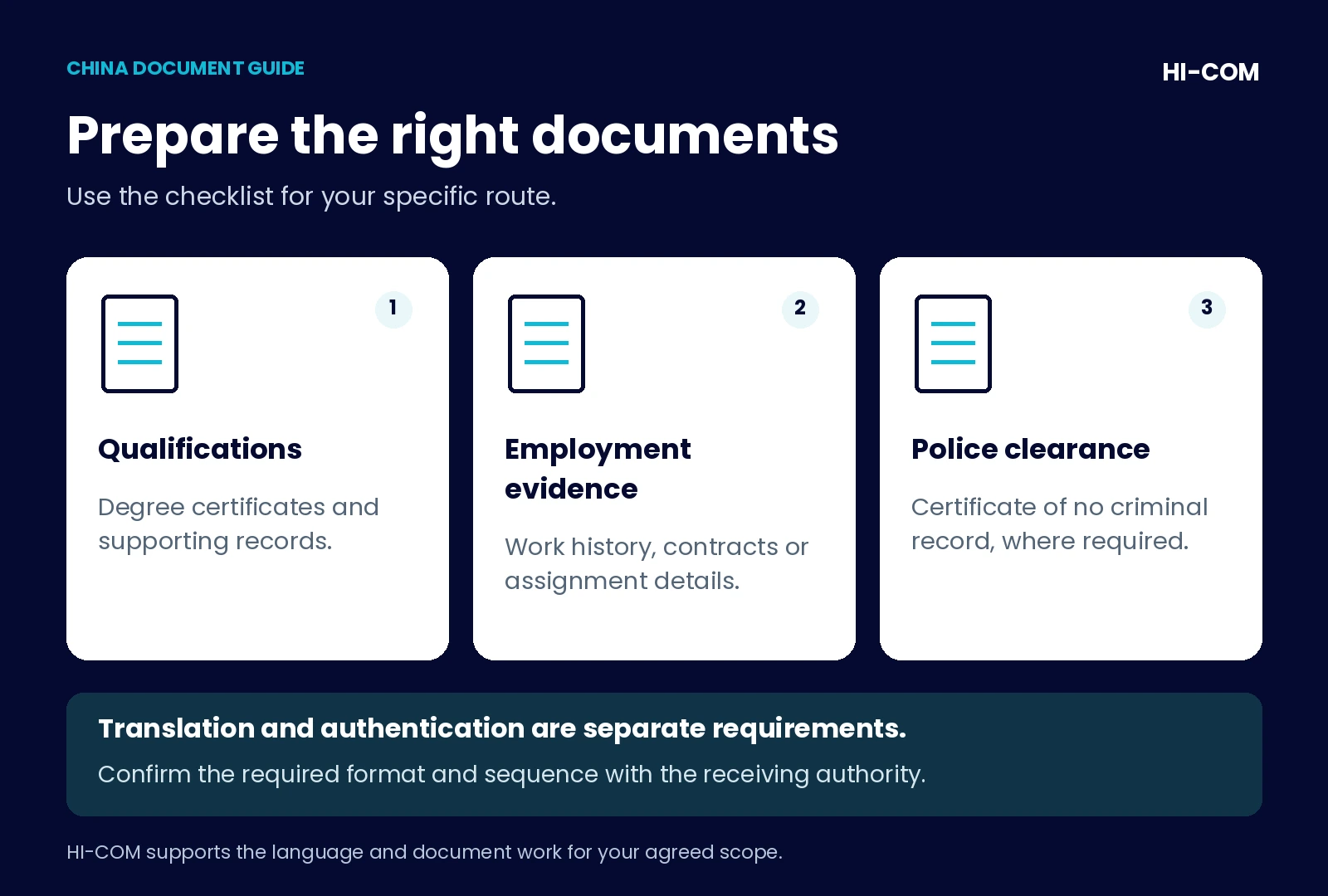
Requirements vary with the applicant category, city and procedure. A checklist for one city’s scheme should not be read as the national checklist for every applicant.
Degree certificates and employment evidence
Confirm which qualification is required and what authentication or accepted verification route applies. An academic transcript is not automatically a substitute for the requested degree certificate.
For employment evidence, check names, job titles, dates and the issuing organisation’s details before translation.
HI-COM’s academic document translation service covers degree certificates and supporting academic records. Translation is separate from academic credential evaluation.
Apostille and translation are separate procedures
Where authentication is required and the Apostille Convention applies, an apostille can replace consular legalisation for an eligible public document. It is issued by the competent authority where that document originates. The receiving authority’s document requirements still matter. [6][9]
Confirm the sequence before ordering the final translation. If an apostille is attached to the source certificate, its content may need to be included; a route involving a notarised translation can have a different order.
HI-COM’s apostille and notarisation support in China is a point of contact to discuss the document-preparation scope.
Chinese translations may also need the employer’s stamp
Do not assume that every work-permit file follows the same translation rule as a family residence application.
Beijing’s published Class B work-permit instructions require non-Chinese certification materials, except passports or international travel documents, to be accompanied by Chinese translations stamped with the employer’s official seal. Shanghai’s short-term work guide also specifies Chinese translations stamped by the employer. [4][7]
An agency-prepared translation can support the file, but any employer certification required by the procedure must still be supplied. Send the checklist to HI-COM with the source documents so the translation format and any additional certification elements can be assessed.
Illegal Employment in China: the Penalties to Understand
Article 43 of the Exit and Entry Administration Law covers work without the required authorisations, work beyond the permitted scope, and certain breaches of the rules for foreign students working to support their studies. [2]
Article 80 provides the following penalties:
| Who | Statutory penalty |
|---|---|
| Foreign national working illegally | RMB 5,000–20,000; in serious cases, 5–15 days’ detention plus that fine |
| Illegal employer | RMB 10,000 per illegally employed foreign national, capped at RMB 100,000, with illegal gains confiscated |
| Illegal job introducer | RMB 5,000 per person; capped at RMB 50,000 for an individual or RMB 100,000 for an entity, with illegal gains confiscated |
Removal measures also differ: Article 62 repatriation carries a one-to-five-year entry restriction; Article 81 deportation carries ten years. These are distinct legal measures, not an automatic outcome of every case. [2]
A valid stay does not by itself resolve an unlawful-employment issue. Overstay is a separate matter.
Before Travel, Settle the Activity and the Document Brief

Use a short written brief with the Chinese host:
For classification questions, the employer, the competent authorities or a qualified immigration adviser should confirm the route.
HI-COM’s role is to support the language and document work, including Chinese translation of qualifications, police clearance records and employment evidence in the agreed format. For business visits, we can also scope business interpreting in China around your meetings and site discussions.
Send us the receiving authority’s instructions, the source and target languages, the issuing country and your deadline. Our team will confirm the available translation and certification scope. Prefer WeChat? Use the direct team contact on our contact page.
DISCUSS YOUR CHINA DOCUMENT REQUIREMENTS
Frequently Asked Questions
Can I work in China with an M visa?
An M visa is for commercial and trade activities and does not provide general employment authorisation. Certain narrowly described short assignments have specific rules. Have the Chinese host confirm the classification of your actual tasks before travel.
Do I need a Z visa for a short assignment in China?
A short stay does not automatically remove work-authorisation requirements. Some technical, management, filming and other assignments fall under short-term work procedures even when they last fewer than 90 days. Specific exclusions may apply to other activities.
Is a Z visa the same as a work permit?
No. A Z visa is an entry visa for work. Work authorisation and any required work-type residence permit are separate parts of the process. The requirements depend on the approved route and duration.
Can I work during China’s 30-day visa-free stay?
The unilateral short-visit visa waiver covers permitted purposes such as business and tourism, not entry for employment. Confirm that your actual activity qualifies; a short duration alone does not make work a business visit.
Does payment by an overseas employer make my trip a business visit?
Overseas payroll alone does not establish the correct immigration category. Describe the tasks, Chinese host, project and working arrangements when asking the employer or competent authority which procedure applies.
Can I change from an M visa to a work route while in China?
Do not assume that this is available in your case. Ask the employer and local work-permit and exit-entry authorities whether an in-country application is permitted and what status you must maintain. A pending application does not itself authorise employment.
Does a Chinese translation replace an apostille or degree verification?
No. Translation, document authentication and academic credential evaluation are different procedures. Establish which are required, in which order and in what format, before commissioning the final document package.
What can HI-COM help prepare for a work-related application?
HI-COM can translate degree certificates, police clearance records, employment evidence and other supporting documents. Send the receiving authority’s checklist, languages and deadline so the team can assess the translation and certification requirements.
This guide provides general information, not individual legal advice. Confirm the applicable rules with the Chinese employer or host, the relevant work-permit and exit-entry authorities, and the Chinese mission handling the visa application.
Official Sources
- Chinese Consulate-General in Chicago: Requirements and Procedures for Chinese Visa Application, updated September 2025.
- National Immigration Administration: Exit and Entry Administration Law, Articles 41, 43, 62, 78, 80 and 81.
- Official reproduction of the 2014 trial procedures for short-term work (人社部发〔2014〕78号), effective 1 January 2015.
- Shanghai government: Guide to applying for a Foreigner’s Work Permit (≤ 90 days), displayed publication date 25 April 2025.
- Shanghai government: Applying for a work visa, updated 21 January 2026.
- Hunan government: Documents Required for Foreigners to Apply for Work Permits, 15 June 2026.
- Beijing government: Notification Letter of Foreigner’s Work Permit, Class B professional talents outside China.
- Chinese Embassy in Rwanda: visa-free entry FAQs, 30 July 2026.
- HCCH: Apostille Section.
- Shanghai government: Residence permits for short-term work.