Proof of Kinship for a Chinese Visa: Which Family Documents Do You Need?
Last checked: 19 October 2026. Prepared by HI-COM Asia’s translation team.
Quick answer
Proof of kinship is official evidence of your family relationship with your host in China. Common examples are marriage certificates, birth certificates and accepted certificates of kinship. Q1 and S1/S2 family applications normally require relationship evidence; Q2 requirements vary by application location. Check the document, copy, translation and authentication requirements for your own case. [1][2][3]
You know how you are related to the person you are visiting. Your application needs to make that relationship clear on paper.
For a spouse, one marriage certificate may establish the link. For a parent-in-law or grandparent, the evidence may run through another family member. A changed surname, a birth certificate without parents’ names or an incomplete translation can make that link harder to follow.
Start by identifying which official documents show your relationship and what format the receiving authority requires. That will tell you whether your existing civil records are enough or a separate kinship certificate is needed.
Start With Your Host: Is This a Q or an S Visa Application?
For a family visit, the distinction starts with your host’s nationality and immigration status. The intended length of stay then separates the short- and long-term categories. [1]
| Visa | Host in China | Intended stay | Family relationship |
|---|---|---|---|
| Q1 | Chinese citizen or foreign national with Chinese permanent residence | More than 180 days | Family reunion; the separate foster-care route has its own evidence |
| Q2 | Chinese citizen or foreign permanent resident living in China | Up to 180 days | Visiting relatives |
| S1 | Foreign national residing in China for work, study or other qualifying purposes | More than 180 days | Spouse, parents, children under 18 and parents-in-law under the ordinary family route |
| S2 | Foreign national staying or residing in China for work, study or other qualifying purposes | Up to 180 days | A broader family-visit category |
For example, visiting a spouse who holds a work-type residence permit normally points towards the S family route. Visiting a Chinese spouse points towards Q.
S1 and S2 also cover certain other private affairs. This guide focuses on family applications; those other situations have different supporting evidence. [1]
Which relatives are included?
Published visa guidance lists spouses, parents, children, children’s spouses, siblings, grandparents, grandchildren and parents-in-law for Q1 family reunion and S2 family visits. Q2 is described as a visit to relatives, with local documentation requirements. [2]
An adult child or sibling is not included in the ordinary S1 family list. Do not assume that eligibility under S2 establishes eligibility for a long-term S1 family application.
What Counts as Proof of Kinship?
Common evidence includes: [2]
- A marriage certificate establishing the marriage.
- A birth certificate identifying the relevant parent and child.
- A notarised certificate of kinship or another relationship certificate accepted by the receiving authority.
Some published checklists also list a certificate issued by a Chinese Public Security Bureau. That does not mean every applicant can obtain one or use it instead of their existing civil records.

Do you need a separate “kinship certificate”?
Not necessarily. “Proof of kinship” often describes the purpose of the evidence rather than one universally required document.
If an accepted marriage certificate establishes the relationship, you may not need a separate certificate with “kinship” in its title. Conversely, a notarised relationship certificate is not automatically a substitute for every underlying record: confirm what the receiving authority accepts.
A family photograph or a personal statement should not be treated as a replacement for the official relationship evidence requested.
Match the Documents to the Relationship
The examples below show how a documentary chain can work. They are preparation examples, not a promise that a consulate will accept a particular combination.
| Your relationship to the host | Documents to discuss with the receiving authority | What the evidence needs to show |
|---|---|---|
| Spouse | Your marriage certificate | You and the host are the married parties |
| Child | Your birth certificate | The host is named as your parent |
| Parent | The host’s birth certificate | You are named as the host’s parent |
| Parent-in-law | The host’s marriage certificate and the host’s spouse’s birth certificate | You are the parent of the person married to the host |
| Sibling | Your birth certificate and the host’s birth certificate, or an accepted kinship certificate | The relevant shared parentage |
| Grandparent or grandchild | Birth records linking both generations, or an accepted kinship certificate | Each link between the applicant and the host |
For a parent visiting an adult child, the important birth certificate is normally the child’s: it identifies the visiting parent. For a parent-in-law, the chain passes through the host’s spouse.
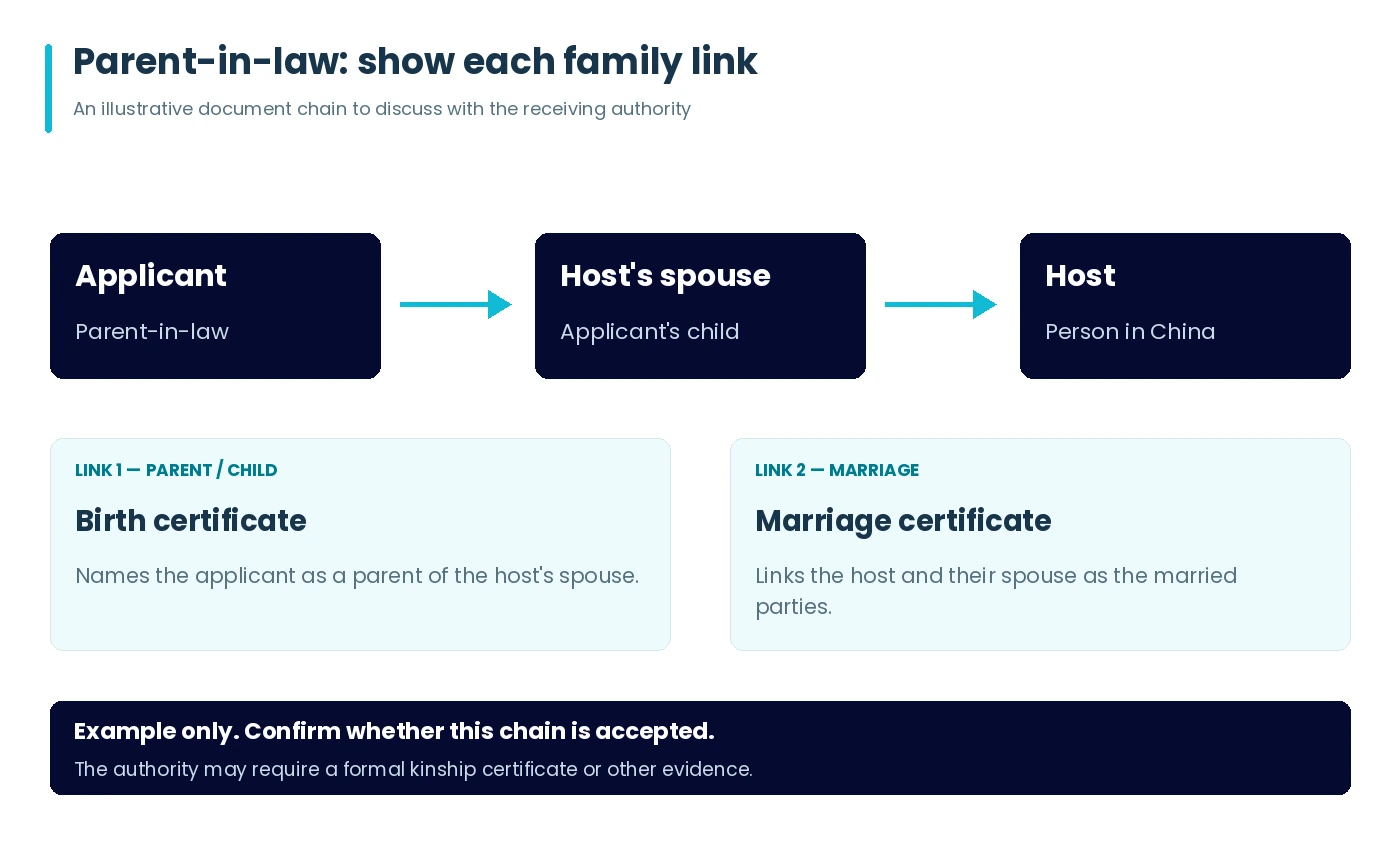
Where the chain is complicated, send a simple explanation to the visa centre and ask which records it wants. If an authority requires a formal kinship certificate, a logically complete chain alone may not satisfy that instruction.
What if names differ across the documents?
A maiden name, married name, legal name change or different transliteration needs to be explained, rather than silently corrected in translation.
Provide the relevant passports and any official record linking the names. The translation should accurately reflect the source while keeping the identities traceable. Ask the authority what additional evidence it requires for a discrepancy.
Q2 Proof of Relationship: Check Your Own Application Location
Q2 is a good example of why one online checklist should not be treated as a worldwide rule.
The Macao centre’s published Q2 list includes the invitation and the host’s identity and status documents without listing a separate kinship certificate. Milan’s Q2 list expressly requests certification showing the family relationship. [2][3]
Use the current instructions of the Chinese embassy, consulate or visa centre handling your application. Its Q2 requirements may differ from the examples above, and consular officers can request additional evidence. [3]
Do Family Documents Need Notarisation, an Apostille or Legalisation?
These are separate procedures. Establish which one is required before paying for it.
| Procedure | Function | What to confirm |
|---|---|---|
| Notarisation | A notarial act concerning a document, signature, copy or statement, depending on the jurisdiction | What exactly must be notarised, and by whom? |
| Apostille | Authentication of the origin of an eligible public document under the Apostille Convention | Does the Convention apply between the issuing country and China, and is authentication required? |
| Consular legalisation | An authentication route where applicable | Does this route apply, or is there an apostille route or exemption? |
| Certified translation | Translation with the certification elements required by the recipient | Which language, statement, signature, seal or translator qualification is requested? |
China has applied the Apostille Convention since 7 November 2023. Where it applies and authentication is required, an apostille generally replaces consular legalisation. It is issued by the designated authority where the document originates. Exemptions may also apply. [5][6]
An apostille authenticates the origin of a public document, including the relevant signature or seal. It does not establish the truth of every statement in that document or guarantee acceptance of a visa application. [5]
Is authentication required for every family visa?
No single rule should be inferred from a checklist that only mentions originals and copies.
For example, Milan’s S1 guidance distinguishes applicants joining a resident host from family members applying alongside a Z or X1 applicant. The latter route expressly refers to notarised and authenticated relationship evidence. Confirm how the mission’s current instructions apply to your document and circumstances. [4]
HI-COM’s apostille and notarisation support in China can help you assess the preparation route within the agreed service scope. An apostille for an overseas certificate is handled through the competent authority in its place of origin.
When Do You Need a Chinese Translation?
Ask the receiving authority which languages it accepts. There is no safe universal rule that every Chinese visa centre accepts all family certificates in English.
For a visa application overseas, follow that mission’s instructions. For a residence permit after arrival, check the local exit-entry authority’s requirements.
Shanghai provides a specific example: its guidance on a foreign-language marriage certificate for a private-affairs residence permit calls for a Chinese translation issued by a qualified translation agency in China. [9]
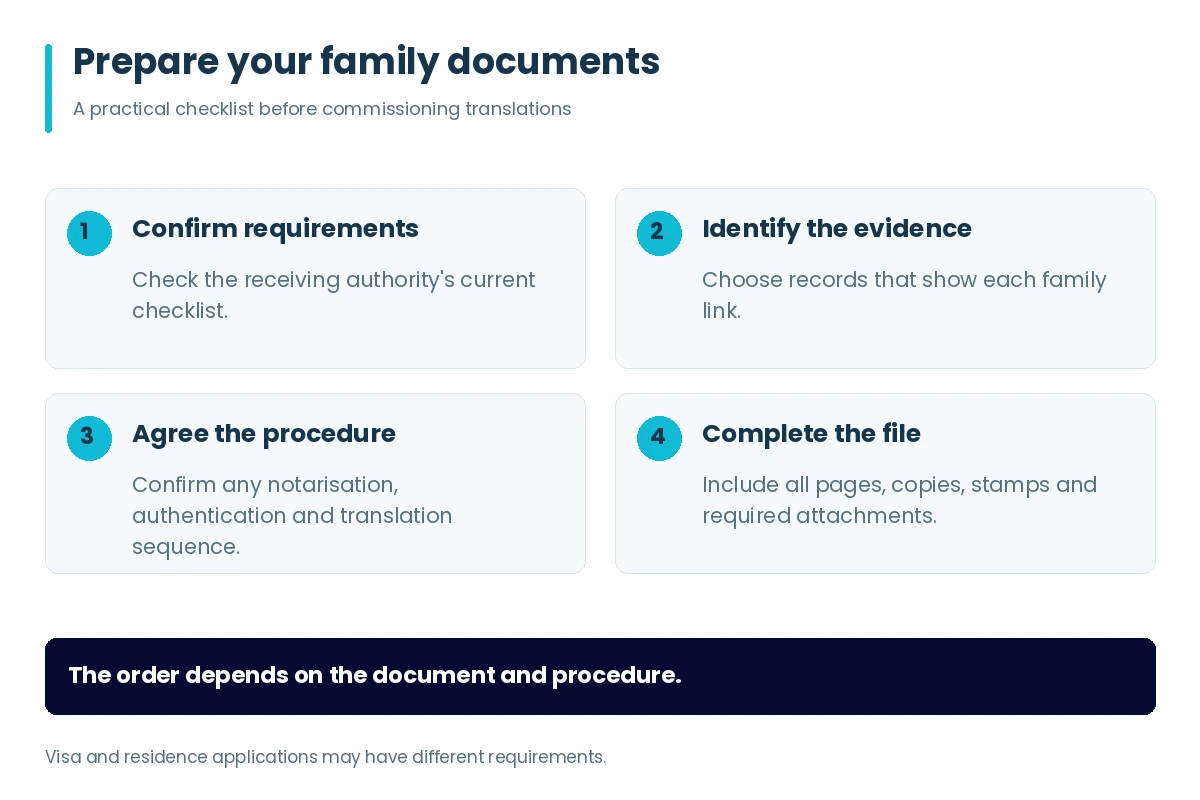
Confirm the sequence before commissioning the translation
Where the source certificate is apostilled, preparing the final translation afterwards allows the certificate and the attached apostille to be translated together.
But some routes involve a notarised translation or another notarial act before authentication. That can change the order. Confirm the full procedure rather than assuming “apostille, then translation” works in every jurisdiction.
For the translation brief, provide all pages, reverse sides, stamps, annotations and attachments. Include the receiving authority’s instructions and the passport spellings relevant to the file.
HI-COM’s certified Chinese translation service covers birth, marriage and kinship documents, with the certification format assessed for their intended use.
After Arrival: a Residence Permit Is a Separate Application
For Q1 and S1 entrants, published guidance instructs applicants to apply for the relevant residence permit within 30 days of entry. Preparing the overseas visa file is therefore only one stage. [2][4]
Shanghai’s S1 exemption is conditional
Shanghai’s published answers indicate that an applicant who entered on an S1 visa may be exempt from resubmitting relationship evidence at the residence-permit stage. This should not be read as an exemption from preparing the overseas visa evidence. [7][9]
A separate Shanghai answer, concerning the spouse of a foreign student, says the student must already hold a student-type residence permit with more than six months of validity remaining at the time of the application. That is a case-specific condition, not an exemption for every student’s spouse. [8]
Keep your family records available and confirm the local residence checklist before travelling.
Can you use an electronic certificate or e-Apostille?
An official e-Apostille is a valid electronic apostille under the Convention. Submitting a printed copy, together with an electronic civil certificate, raises additional questions about format and verification. [6]
Shanghai has addressed printed electronic documents in specific Korean family-certificate and Utah marriage-certificate cases. Those answers do not establish that every office accepts every printout. Check the required format and verification method for your own submission. [7][9]
Your Family-Document Checklist
Before ordering a translation or booking the appointment:
Need help identifying the host on the form? Read our guide to the inviting entity on a Chinese visa application.
Prepare Your Family Documents With HI-COM
HI-COM has worked with international clients in China for more than 10 years. Our translation team handles birth and marriage certificates, kinship records, invitation letters and attached apostilles.
Our focus is the detail that makes a document usable: accurate names and dates, clear relationship terminology, complete treatment of relevant stamps and annotations, and the agreed certification elements. Agency seals and supporting documents are prepared according to the confirmed project scope; the receiving authority determines acceptance.
Send us:
- The documents and their issuing country.
- The source language and the required translation language.
- The visa centre or immigration office receiving them.
- Its checklist or written instructions.
- Your appointment or submission deadline.
We will assess the files and confirm the translation scope, certification format, price and available delivery schedule. If your deadline is close, mention it in your first message. Prefer WeChat? Use the direct WeChat contact on our contact page.
Frequently Asked Questions
What is proof of kinship for a Chinese visa?
It is official evidence linking you to your host in China, such as a marriage certificate, a birth certificate or an accepted certificate of kinship. The required document and format depend on your relationship, visa category and place of application.
Is a marriage certificate enough for an S1 visa?
For a spouse, it is usually the relationship document. It is not the complete S1 application: the invitation, host’s status documents and other required materials must also be supplied. Check the rules on originals, copies, translation and authentication.
How do I prove that I am the host’s parent-in-law?
A possible documentary chain is the host’s marriage certificate and the birth certificate of the host’s spouse naming you as their parent. Ask the receiving authority whether it accepts that chain or requires a formal kinship certificate.
Does a Q2 visa require proof of kinship?
It depends on the application location. Some official Q2 checklists request relationship evidence; others do not list it as a standard document. Follow the current checklist of the mission handling your application and any additional request.
Do family documents always need an apostille for China?
No. Establish whether authentication is required for the particular document and procedure. Where the Apostille Convention applies between the issuing country and China, an apostille generally replaces consular legalisation. Translation requirements remain separate.
Should I translate my certificate before or after the apostille?
Confirm the required sequence first. If the source certificate is apostilled, arranging its final translation afterwards can include the apostille. A procedure involving a notarised translation may require a different order. Avoid treating one sequence as universal.
Can HI-COM help with birth, marriage and kinship documents?
Yes. HI-COM provides translation of birth, marriage and kinship certificates, including relevant stamps and attachments within the agreed scope. Share the receiving authority’s instructions and deadline so the team can confirm the certification format, price and delivery options.
This guide concerns family visa and residence procedures in China and provides general information, not legal advice. Confirm the latest instructions with the authority handling your application. Visa and residence decisions remain with the relevant authorities.
Official Sources
- Regulations on Administration of the Entry and Exit of Foreigners, republished following State Council Decree No. 814; amendment effective 1 October 2025. Articles 6, 7 and 36.
- Chinese Visa Application Service Center, Macao: Chinese Visa Application Materials, 24 August 2026.
- Chinese Visa Application Service Center, Milan: Q2 supporting documents, 26 August 2026.
- Chinese Visa Application Service Center, Milan: S1 supporting documents, including accompanying-family applications, 26 August 2026.
- Chinese Consulate-General in Adelaide: Apostille Convention notice, 25 October 2023.
- HCCH: Apostille Section, Convention status, competent authorities and electronic Apostilles.
- Shanghai Exit-Entry Administration: Korean family relationship certificate and authentication, 27 April 2026.
- Shanghai Exit-Entry Administration: spouse of a student entering on S1, 5 August 2026.
- Shanghai Exit-Entry Administration: foreign marriage certificates and private-affairs residence permits, 3 September 2026.