China Sourcing Agent (2027): What They Do, How They’re Paid and How to Vet One
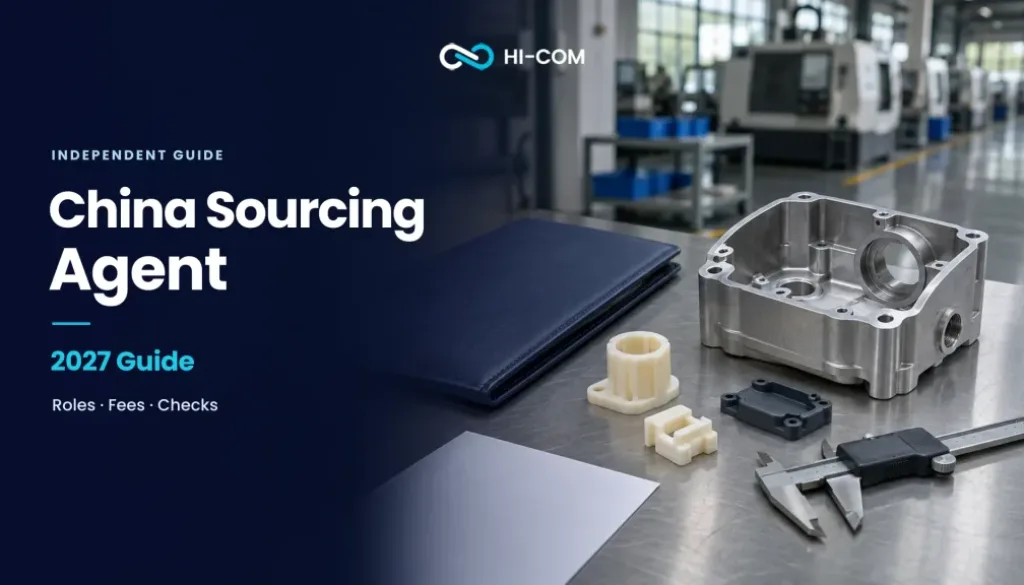
A China sourcing agent can save you months of supplier research, or quietly cost you money through hidden commissions, the wrong factory and goods that fail inspection. Most guides about China sourcing are written by agents selling their own service. This one is not: HI-COM does not work as a commission-based sourcing agent, so here is an independent look at what agents really do, how they make money and how to check one before you pay a deposit.
Quick answer
A China sourcing agent is a person or company based in China that finds suppliers, negotiates, follows samples and production, and arranges quality checks and shipping for foreign buyers. Agents are paid by commission, fixed fee or retainer, and sometimes secretly by factories, so check who pays them, their legal registration and their references before you pay a deposit.
Written by the HI-COM Asia team in Shanghai · Updated November 2026 · Valid for 2027
What does a China sourcing agent do?
A sourcing agent in China (采购代理, cǎigòu dàilǐ, “purchasing agent”) acts as your local representative with Chinese suppliers. A good agent finds and compares factories, negotiates price and terms, follows samples and production, organises quality control and helps ship the goods. The agent should work for you, not for the factory.
In practice, the job covers six missions:
- Supplier search: shortlisting factories (工厂, gōngchǎng) and trading companies, on 1688, Alibaba, trade fairs and through local networks.
- Negotiation: price, MOQ (minimum order quantity), payment terms, lead time and Incoterms such as FOB or EXW.
- Samples: requesting, checking and sending samples, then confirming a “golden sample” as the reference for production.
- Production follow-up: checking that the factory starts on time, uses the agreed materials and keeps you informed.
- Quality control: arranging QC visits and a pre-shipment inspection before you pay the balance.
- Logistics: consolidating goods from several suppliers and handing them to your freight forwarder.
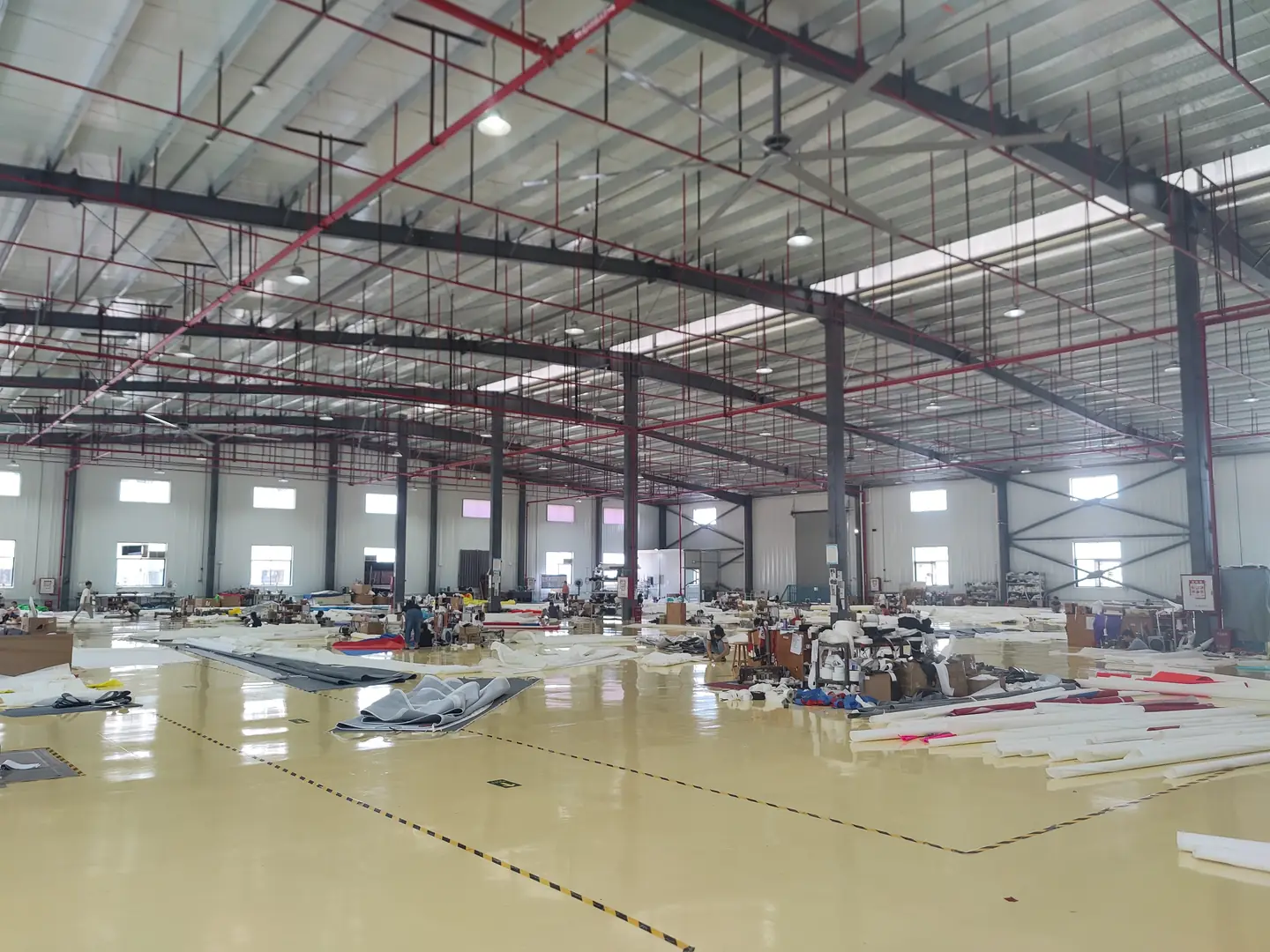
Not every agent does all six. Some only search and negotiate; others only inspect. The first thing to agree is the scope, in writing.
Sourcing agent vs trading company vs buying office vs import agent: what’s the difference?
The difference comes down to one question: who buys the goods, and who knows the factory? A sourcing agent helps you buy directly from the factory. A trading company (外贸公司, wàimào gōngsī) buys from the factory and resells to you. A buying office is your own team in China, and an import agent mainly handles customs and shipping.
| Type | Role | Who owns the goods | Factory transparency | Best for | Main risk |
|---|---|---|---|---|---|
| Sourcing agent (采购代理) | Finds and manages suppliers on your behalf | You, buying from the factory | Should be full: factory name and address disclosed | Importers without a team in China | Hidden commissions from factories |
| Trading company (外贸公司) | Buys from factories and resells to you | The trading company, until delivery | Often low: the factory is part of its business | Small or mixed orders, simple products | Margin and production control hidden from you |
| Buying office | Your own staff in China | You | Full | Large importers with steady volumes | Fixed costs and remote management |
| China import agent | Customs, export documents, freight | You | Not its role | Buyers who already have suppliers | No check on supplier or quality |
| China buying agent | Buys small quantities on 1688 or Taobao for you | You, through the agent’s account | Seller visible, factory often unknown | Samples, test orders, small online buyers | Limited checks on the real manufacturer |
Many companies call themselves a “China sourcing company” while working as trading companies. That is not a problem in itself, as long as you know which model you are paying for.
How are China sourcing agents paid?
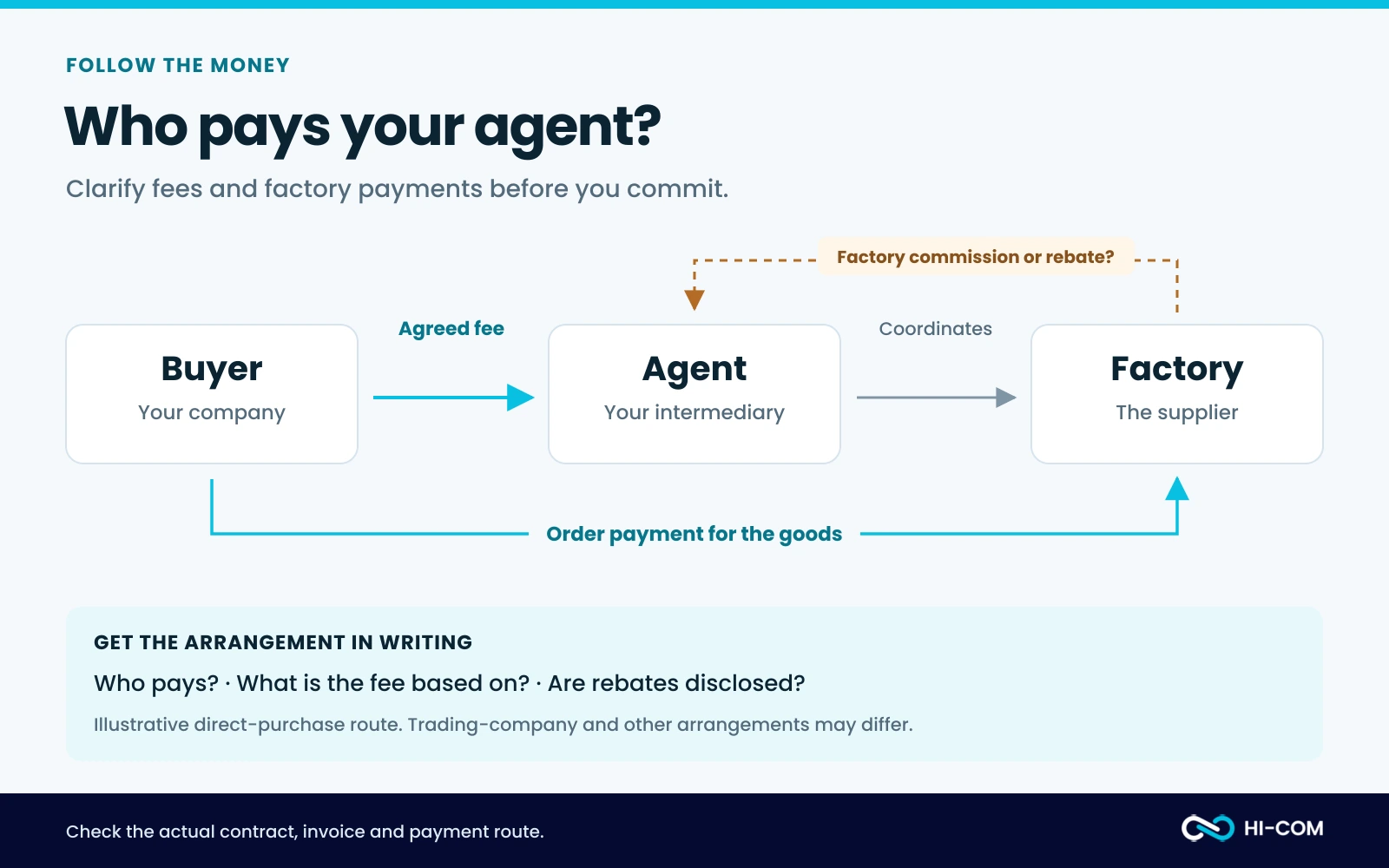
China sourcing agents are usually paid in one of four ways: a commission on the order value, a fixed fee per project, a monthly retainer, or money from the factory. The first three are normal if they are written down. The fourth is the main risk, because an agent paid by the factory has no reason to push for your interests.
| Payment model | How it works | Main risk |
|---|---|---|
| Commission on orders | A share of the order value, paid by you | The agent earns more when you pay more |
| Fixed fee per project | An agreed price for a defined task (search, audit, inspection) | Anything outside the scope costs extra |
| Monthly retainer | A regular fee for ongoing support | You pay even in quiet months |
| Paid by the factory | “Free” service for you, commission (回扣, huíkòu) from the supplier | Conflict of interest: higher prices, weaker quality checks |
Whatever the model, ask for it in writing, and ask the agent to confirm that it receives no undisclosed commission from suppliers.
Red flags: hidden commissions, fake factories and other risks
The most common problems with China sourcing agents are not dramatic scams but conflicts of interest: an agent who is quietly paid by the factory, a trading company presented as a factory, or a supplier name you are never allowed to see. These seven signals should make you stop and check.
7 warning signs before you pay
- The service is “free”, or the fee is far below everyone else’s.
- The agent refuses to give the factory’s full Chinese name and address.
- The “factory” turns out to be a trading company when you check its licence.
- You are asked to pay into a personal bank account or a third-party account.
- There is pressure to pay the deposit quickly, before samples are approved.
- No written contract, or a contract that does not name the agent’s company.
- No inspection report, or photos that could come from any factory.
Before any deposit, it is worth putting basic legal safeguards before you pay in place with both the agent and the supplier.
How to vet a China sourcing agent: a 10-point checklist
The best China sourcing agent for you is the one you can verify: a registered company, real references, a clear scope, declared fees and full access to the factories it uses. Run these ten checks before you sign or pay anything.
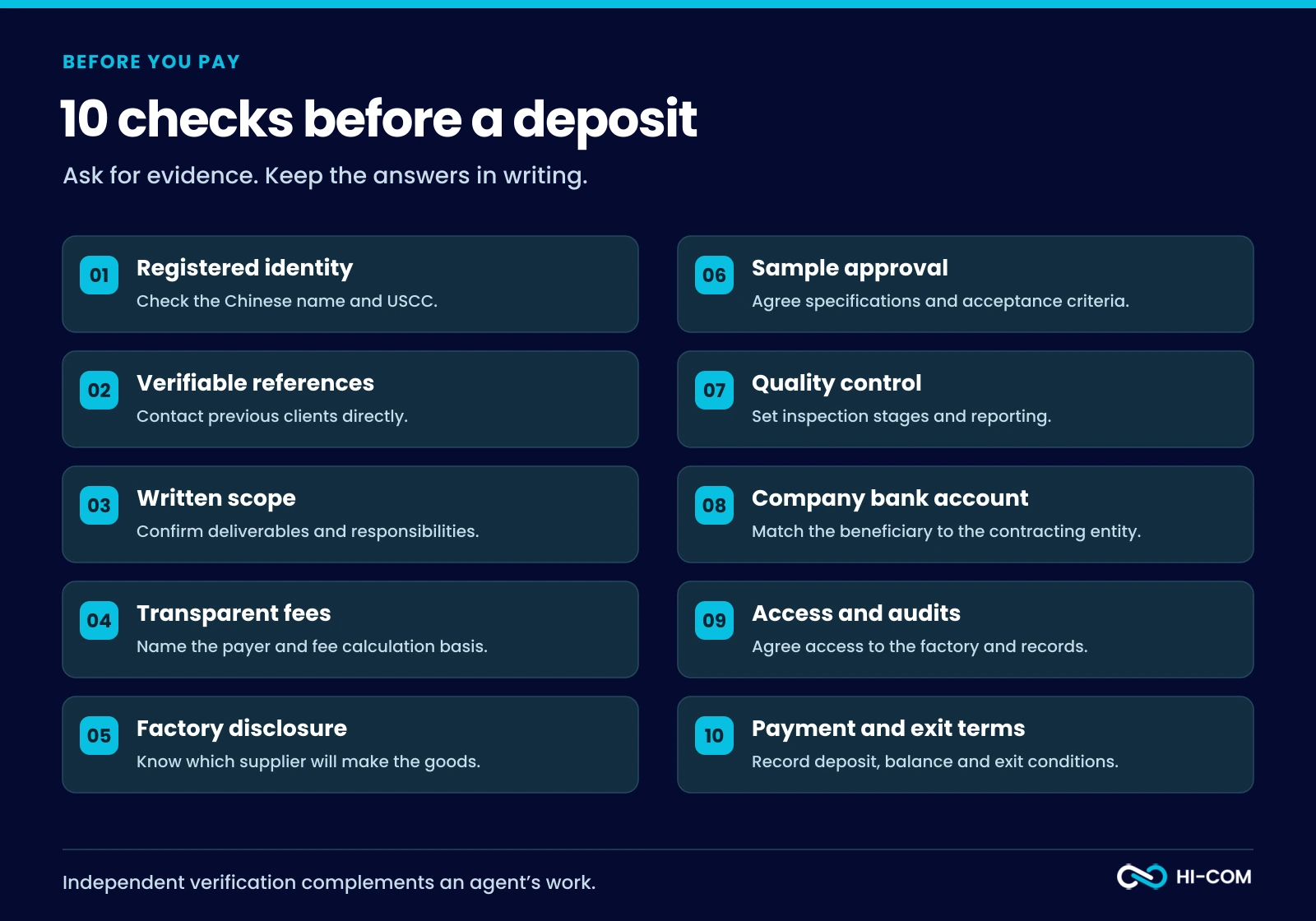
- Registered identity. Ask for the business licence and its unified social credit code (统一社会信用代码), then check the agent’s licence on NECIPS. Make sure you read the Chinese company name correctly.
- References. Ask for two or three clients you can call, ideally in your country and industry.
- Written scope. List exactly what the agent does: search, negotiation, samples, QC, shipping.
- Declared fees. Get the payment model in writing, with a statement that no hidden commission is taken from suppliers.
- Factory disclosure. Receive the full Chinese name, address and licence of each factory.
- Sample approval. No mass production before you approve a sample, kept as the reference.
- Quality control. Agree on QC visits and a pre-shipment inspection report with photos and measurements.
- Company bank account. Pay only into an account in the name of the company on the licence.
- Access. Keep the right to contact and visit the factory yourself, or to send an auditor.
- Payment terms. Link the balance to an approved inspection, and check who can sign for a Chinese company before the contract is stamped.
Not comfortable reading Chinese registry data? You can have a Chinese company checked for you, whether it is the agent or the factory.
Do you need a sourcing agent? When to use one and when to go direct
You need a sourcing agent in China when you buy custom or technical products from several factories, have no team on the ground and cannot follow production yourself. For simple products from one known supplier, sourcing from China directly, with good checks and an interpreter for key meetings, is often enough.
| Your situation | Usually the best option |
|---|---|
| First small order of a standard product | Verified supplier on 1688 or Alibaba, or a trading company, plus a company check |
| Custom product, several factories, no one in China | A vetted sourcing agent, with independent checks |
| You already know the factory | Go direct: company check, written contract, interpreter for negotiations |
| You visit trade fairs or factories yourself | A business interpreter, plus supplier checks after the visit |
| Large, steady volumes | Your own buying office or long-term partner |
Online marketplaces make the first step easy, and our overview of sourcing platforms such as 1688 and Alibaba explains how they differ. But a listing is not a verification: the supplier behind it still needs to be checked.
Sourcing agents in Guangzhou, Yiwu and Shenzhen: does location matter?
Yes. China’s manufacturing is organised in clusters, and an agent based near your product’s cluster knows the factories, visits them faster and understands local prices. A sourcing agent in Guangzhou is strong for garments, cosmetics and the Canton Fair; Yiwu for small commodities; Shenzhen for electronics.
Guangzhou (Guangdong)
Home of the Canton Fair, with large wholesale markets for garments, fabrics, leather goods and beauty products. Read our Canton Fair 2027 guide and see our business support in Guangzhou.
Yiwu (Zhejiang)
The world’s best-known small-commodities market: toys, accessories, gifts, household items, often in mixed small orders. See our Yiwu Market sourcing guide.
Shenzhen (Guangdong)
China’s electronics hub, from components to consumer devices, with fast prototyping and many tech suppliers.
Further north, Zhejiang and Jiangsu provinces host large clusters for machinery, textiles and home products. Whatever the city, the checklist above stays the same.
Sourcing at the Canton Fair or Yiwu: agent, interpreter or both?
At a trade fair or market, an interpreter and an agent do different jobs. An interpreter lets you speak with suppliers yourself, ask your own questions and judge them directly. An agent shortlists and follows up for you. Many buyers combine both: their own visit with a business interpreter for supplier negotiations, then independent checks before ordering.
For factory tours, a dedicated interpreter for factory visits helps you ask about capacity, materials and compliance on the spot, not by email weeks later. Preparing a market trip? Our Yiwu guide and Canton Fair guide cover the practical side.

From our missions
- Prodes supplier trip: for this French maker of professional indoor and outdoor equipment, a HI-COM interpreter worked in Chinese, French and English during factory tours, supplier meetings and business dinners, covering product specifications, pricing and timelines, compliance and production capabilities. Read the case
- CCF Shanghai 2026: English-Chinese consecutive interpreting from 19 to 21 March 2026 at a consumer goods and household products fair, including sourcing discussions. Read the case
- Canton Fair: a business interpreter supported a buyer eight hours a day over two days of meetings with Chinese suppliers. Read the case
What changes for sourcing from China in 2027
Three dates shape the first half of 2027 for importers. Plan orders around the Chinese New Year shutdown, book the Canton Fair early, and check documentation if you import machinery into the EU.
- 20 January 2027: the EU Machinery Regulation (EU) 2023/1230 applies, with new rules on instructions and importer duties. See our article on the EU Machinery Regulation 2027 and our user manuals for products made in China.
- 5 to 13 February 2027: official Chinese New Year holiday (New Year’s Day on 6 February), according to the State Council schedule. Many factories stop longer: read about Chinese New Year 2027 factory shutdowns.
- 15 April to 5 May 2027: spring Canton Fair in Guangzhou, in three phases (15-19 April, 23-27 April, 1-5 May).
How HI-COM can help (without acting as a commission agent)
HI-COM is not a commission-based sourcing agent. We work for the buyer: we check companies, interpret during negotiations and factory visits, support you at trade fairs and help you find partners, so you keep control of your suppliers. Our fees are paid by our clients, never by factories.
HI-COM Asia is a Shanghai-based consulting, marketing and translation company (ISO 17100, TAC member), with offices in Hong Kong and France. Depending on your project, we can:
- check an agent or a supplier before you pay a deposit;
- provide interpreters for negotiations, factory visits and trade fairs;
- plan your China trade fair visit;
- find partners and distributors in China;
- advise on which visa for a sourcing trip.
About to pay a sourcing agent or a new supplier?
Our Shanghai team checks the company behind it, reads the registry data in Chinese and tells you what to verify before the deposit.
Check your agent or supplier Free quote within a few hours, 24 h at the latest.
FAQ
What is a sourcing agent in China?
A sourcing agent in China is a local person or company that represents foreign buyers with Chinese suppliers. It finds and compares factories, negotiates, follows samples and production, organises quality control and helps with shipping. The agent should work for the buyer and be paid by the buyer.
How do I find a reliable sourcing agent in China?
Ask for recommendations from importers in your industry, then shortlist agents near your product cluster, for example a sourcing agent in Guangzhou for garments or cosmetics. Check each one’s business licence, call references, and compare written proposals that state the scope, the fees and how factories are disclosed.
How much does a China sourcing agent charge?
It depends on the model: a commission on orders, a fixed fee per project or a monthly retainer. Compare offers on the same scope, and ask for the fee and the payment model in writing, with a clear statement that no hidden commission is taken from factories.
Is it safe to use a sourcing agent found on Alibaba, Fiverr or Upwork?
It can be, but a marketplace profile is not a verification. Check that the person works for a registered company, ask for a contract in that company’s name, pay only into a company bank account, and test the agent on a small task before giving a full order.
Can a sourcing agent help with Amazon FBA or 1688 orders?
Yes. Many agents buy on 1688, inspect goods and prepare them for Amazon FBA, including labels and packaging. Make sure they check the real manufacturer behind the listing and send inspection photos before goods leave China.
Should my sourcing agent be paid by the factory?
No. An agent who receives commission from the supplier has a conflict of interest: it earns more when you pay more and has less reason to report quality problems. Choose an agent you pay directly, and ask for written confirmation that it takes no supplier commission.
Do I still need to verify the supplier if I use an agent?
Yes. Check the factory’s business licence and unified social credit code on the official registry (NECIPS), and make sure the company that invoices you is the one that makes your goods. An agent can help, but the verification should be documented and shared with you.