WFOE in China (2027): What It Is, Requirements and How to Set One Up
Quick answer: A WFOE (wholly foreign-owned enterprise) is a Chinese limited liability company owned 100% by foreign investors. It can sign contracts, invoice customers in RMB, hire staff and sponsor work permits in China. Since 2020 it is legally a “foreign-invested enterprise” under China’s Company Law, and since July 2024 its registered capital must be paid in within five years.
Written by the HI-COM Asia team. Last updated: 9 November 2026.
Planning to set up in China? Our Shanghai team handles your setup end to end: choice of structure, Chinese name, documents and translation, registration and legal filings, bank and tax setup, scoped to your project. Get a free proposal within a few hours, 24 hours at the latest.
In this guide:
- What is a WFOE in China?
- WFOE, joint venture or representative office?
- WFOE requirements in 2027
- How to set up a WFOE: 8 steps
- How long does it take?
- After registration: annual obligations
- Can a WFOE get you a visa?
- Common mistakes
- FAQ
What Is a WFOE in China?
A WFOE is a limited liability company registered in mainland China and owned entirely by one or more foreign investors: a foreign company, a foreign individual, or several of them. No Chinese shareholder is needed.
The term “WFOE” comes from the Wholly Foreign-Owned Enterprise Law, which was replaced on 1 January 2020 by the Foreign Investment Law. Since then, WFOEs, joint ventures and other foreign-invested companies follow the same Company Law as Chinese companies. People still say “WFOE” every day, and so do officials and banks, but the legal term is now foreign-invested enterprise (外商投资企业). On the business licence, the company usually appears as a limited liability company (有限公司). See how to read a Chinese company name and its suffixes.
What a WFOE can do:
- Invoice customers in China in RMB and issue official tax invoices (fapiao)
- Sign contracts in its own name
- Hire local and foreign employees directly
- Import and export, once registered with customs
- Send profits to the parent company after tax
What it cannot do:
- Operate in sectors that China’s Negative List for foreign investment prohibits, or restricts without a Chinese partner
- Act outside its registered business scope
Common types of WFOE by activity:
- Consulting or services WFOE: marketing, IT, design, management consulting
- Trading WFOE: buying and selling goods, import and export, distribution
- Manufacturing WFOE: production in China, often in an industrial zone
Choosing the activity is not a formality: it decides the business scope, the documents, the tax profile and sometimes the licences you need.
WFOE, Joint Venture or Representative Office?
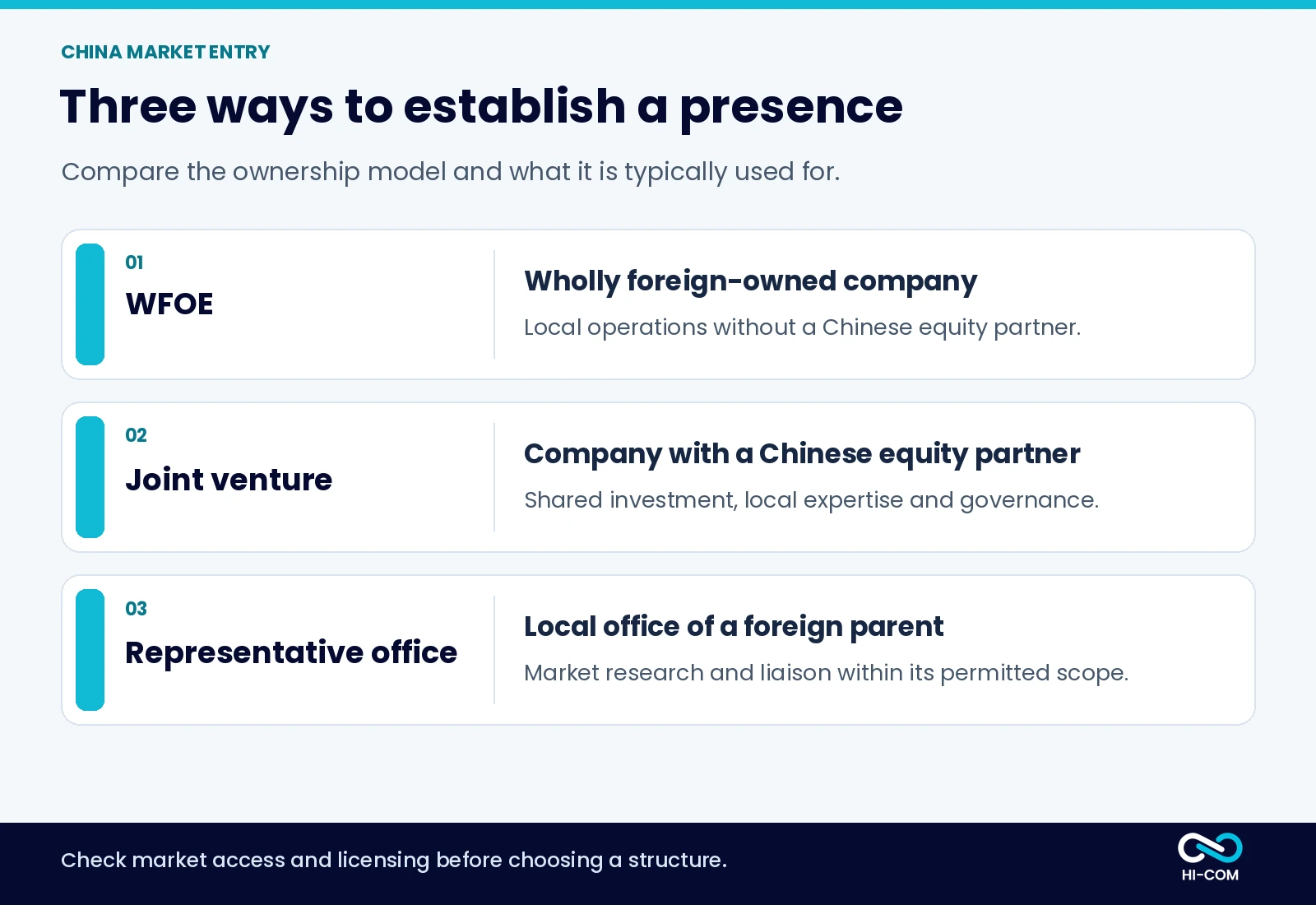
Most foreign companies compare three structures. The right one depends on whether you need to earn revenue in China, who controls the business, and how much you plan to invest.
On a phone, swipe the table sideways to see all columns.
| WFOE | Joint venture | Representative office | |
|---|---|---|---|
| Ownership | 100% foreign | Shared with a Chinese partner | Extension of the foreign parent, not a separate company |
| Earn revenue and issue fapiao in China | Yes | Yes | No |
| Hire staff | Directly | Directly | Through an authorised staffing agency |
| Control | Full | Shared, set by the JV contract and articles | Full, but very limited scope |
| Typical use | Sales, services, trading, manufacturing | Sectors that need a Chinese partner, or access to a partner’s network | Market research, liaison, supplier follow-up |
| Main risk | Setup and running costs | Disputes with the partner, control of the company chop | Cannot do business; taxed even without profit |
When a joint venture makes sense, check your partner first: its registered record, shareholders and legal disputes. See how to check a Chinese company in the official registry or ask for a Chinese company check.
Not sure yet that China is worth a company? Start with market research or a China market entry strategy. Many SMEs first test the market through a distributor and open a WFOE once sales justify it.
WFOE Requirements in 2027
1. An allowed business activity
Check that your activity is not prohibited or restricted on the current Negative List for foreign investment. Manufacturing has been fully open to foreign investors since the 2024 list. Some services, such as certain telecom, internet content, education or media activities, remain restricted or closed.
2. A foreign investor with clean documents
The shareholder can be a foreign company or a foreign individual. You will need its certificate of incorporation or passport, plus bank and identity documents for the people involved.
3. Registered capital you can actually pay
There is no general minimum registered capital for most activities. Under the revised Company Law, in force since 1 July 2024, the capital you subscribe must be fully paid in within five years of incorporation. Set an amount that covers your first months of operations (rent, salaries, setup costs) and that your parent company can really transfer. Too low can raise questions from banks and partners; too high creates a legal obligation you must meet.
4. A registered address in China
A WFOE needs a real commercial address, usually a lease in an office building. Residential addresses are not accepted. Some cities allow addresses in approved business centres or incubators for some activities.
5. Key people
- A legal representative (法定代表人), the person who legally represents the company. Choose carefully: this role carries personal responsibility.
- A director (or a board).
- A supervisor, unless all shareholders of a small company agree not to have one under the new Company Law.
- A finance contact for tax and banking.
6. A Chinese company name and business scope
The company must be registered with a Chinese name, which appears on the licence, contracts, invoices and chops. Its usual structure is city + brand name + industry + legal form, for example 上海 + [brand] + 咨询 + 有限公司. Pick a name that works for your brand, not only for the registration form: see our Chinese brand naming service.
7. Translated and authenticated documents
Foreign documents must be translated into Chinese and authenticated. Since 7 November 2023, China is part of the Apostille Convention: documents from other member countries now need an apostille instead of consular legalisation, which saves weeks. Documents from non-member countries still go through legalisation. Use a certified Chinese translation so names, numbers and addresses match exactly across every document.
How to Set Up a WFOE in China: 8 Steps
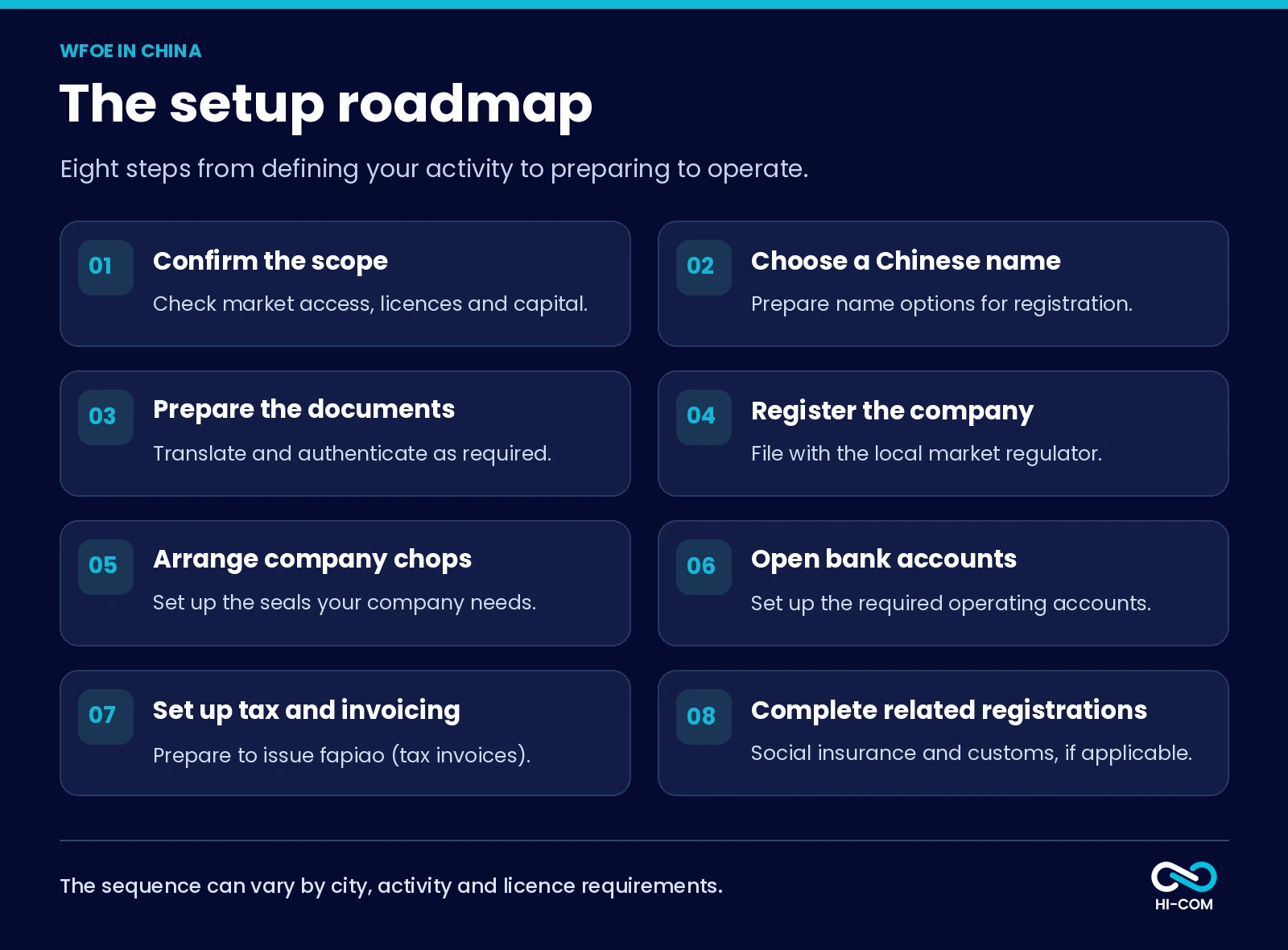
- Confirm the structure and business scope. Decide the WFOE type, city, business scope and registered capital. Check the Negative List and any sector licence.
- Choose and reserve the Chinese company name. Prepare several options. The local Administration for Market Regulation (AMR) checks them against existing names in that city and industry.
- Prepare, translate and apostille the documents. Investor documents, articles of association, appointment letters for the legal representative, director and supervisor, and the lease agreement, translated into Chinese with an apostille or legalisation.
- Register with the Administration for Market Regulation. File the application, mostly online. Once approved, you receive the business licence (营业执照) with the company’s Unified Social Credit Code. Foreign investment information is reported to the commerce authorities through the same system.
- Make the company chops. Engrave the official company chop and the other chops (finance, legal representative, often contract and invoice chops) with an approved maker, and file them with the public security bureau. In China the chop binds the company: read how chops, signatures and authority work in Chinese contracts.
- Open the bank accounts. A basic RMB account and a foreign-currency capital account to receive the registered capital. Banks usually meet the legal representative in person or by video and review the business plan.
- Register for tax and invoicing. Tax registration, choice of VAT status (small-scale or general taxpayer) and setup of electronic fapiao. Appoint an accountant or bookkeeping firm.
- Register for social insurance and, if relevant, customs. Social insurance and housing fund accounts for employees. A trading or manufacturing WFOE also registers with customs before its first import or export.
Then: inject the registered capital within five years, hire your team and start operating.
How Long Does It Take to Set Up a WFOE?
Plan for roughly two to three months from the moment your documents are ready to an operational company with bank accounts, depending on the city, the business scope and how fast documents come back from your home country. Apostilled documents, a clear business scope and a signed lease save the most time. A sector licence (food trading, medical devices, education and others) adds more time after the business licence.
After Registration: What a WFOE Must Do Every Year
- Monthly or quarterly tax filings, even with no revenue
- Annual corporate income tax reconciliation and an annual audit report
- Annual report to the market regulator, usually between January and June
- Foreign exchange and foreign investment reporting as required
- Social insurance and housing fund for every employee
- Keep the registered address, business scope and key people up to date
Profits can be sent to the foreign parent after corporate income tax, once the statutory reserve is funded. Dividends to a foreign parent are subject to withholding tax, which a tax treaty with your country may reduce. Ask your accountant to plan this before the first year closes.
Contracts with Chinese customers and suppliers should be bilingual and say which version controls: see our guide to the prevailing language clause in Chinese contracts.
Can a WFOE Get You a Visa in China?
Owning a WFOE does not give you a visa by itself. A WFOE can employ you and apply for your work permit, which then leads to a Z visa and a residence permit, if you meet the work permit criteria (degree, experience, salary and role). Short trips to set up the company or meet partners are business visits, usually on an M visa or under visa-free entry where your nationality qualifies. Read the difference between the M visa and the Z visa and how to fill in the inviting entity section of the visa form.
6 Common Mistakes When Opening a WFOE
- A business scope that is too narrow, so the company cannot invoice for its real activity.
- Registered capital that the parent company cannot actually transfer within five years.
- A Chinese name chosen in a hurry that does not match the brand or is already used as a trademark. Register your trademark in China early.
- A legal representative who is rarely in China or does not understand the role.
- Documents with spelling differences between the passport, the apostille and the Chinese translation.
- Signing a lease, a JV agreement or a distributor contract with a partner you have not checked. See the legal safeguards when working with Chinese companies.
How HI-COM Helps You Set Up in China
HI-COM’s Shanghai team runs your China setup as one turnkey project, scoped to your situation:
- Market entry strategy: decide if, where and how to enter, and which structure fits. China market entry strategy
- Chinese company name and brand naming, with a trademark check. Brand naming
- Certified translation of incorporation documents, articles and contracts. Certified Chinese translation
- Registration and legal filings, bank and tax setup, with specialist input where the project requires it.
- Partner and distributor search, and checks on Chinese companies before you sign. Partner search · Company check
- Marketing in China once the company is running. From plan to launch
Learn more about our China business consulting.
Tell us your activity, target city and timing. We reply with a free, tailored proposal within a few hours, 24 hours at the latest.
Related guides for your China setup
WFOE in China: FAQ
What does WFOE stand for?
Wholly foreign-owned enterprise: a limited liability company in mainland China owned 100% by foreign investors.
Is the WFOE still a legal structure in China?
Yes in practice, no in name. Since the Foreign Investment Law took effect on 1 January 2020, WFOEs are foreign-invested enterprises governed by the Company Law. Everyone still calls them WFOEs.
What is the minimum registered capital for a WFOE?
There is no general minimum for most activities. Under the Company Law in force since July 2024, the subscribed capital must be fully paid within five years, so choose an amount your business needs and your parent company can transfer.
Can a foreign individual open a WFOE?
Yes. The shareholder can be a foreign individual or a foreign company.
Can I run a WFOE from abroad?
Yes, but you need a legal representative, a registered address in China, a bank account and an accountant. Many companies appoint a local manager and keep the legal representative role with someone who travels to China regularly.
How long does WFOE registration take?
Usually two to three months from ready documents to an operational company with bank accounts, longer if your activity needs a sector licence.
What is the difference between a WFOE and a representative office?
A WFOE is a company that can earn revenue, invoice and hire directly. A representative office cannot do business: it can only do market research and liaison for its parent.
Do I need a Chinese partner to do business in China?
Not for most activities: a WFOE is 100% foreign-owned. A Chinese partner is required only in sectors restricted on the Negative List.
Does a WFOE need a Chinese name?
Yes. The company is registered with a Chinese name, which appears on the business licence, contracts, invoices and chops. An English name is optional and has no legal value in China.
Can a WFOE sponsor my work visa?
Yes, if you are employed by the WFOE and meet the work permit criteria. Ownership alone does not give a visa.
Sources
- Foreign Investment Law of the People’s Republic of China, in force 1 January 2020
- Company Law of the People’s Republic of China, revised 2023, in force 1 July 2024
- Special Administrative Measures for Foreign Investment Access (Negative List), current edition
- HCCH Apostille Convention, entry into force for China on 7 November 2023
- Foreign Investment Guide of the People’s Republic of China (2024), State Council