The China Apostille – How it works since joining the Hague Convention
China apostille in one sentence: since 7 November 2023, a Chinese public document used in another member country of the Hague Convention needs a single apostille certificate from China’s Ministry of Foreign Affairs or an authorised local Foreign Affairs Office, instead of embassy legalization.
The Hague Apostille Convention entered into force for China on 7 November 2023. For covered public documents, an apostille replaces diplomatic or consular legalization where the Convention applies between the issuing jurisdiction and the destination.
If you need to use Chinese documents overseas, whether it be for business, immigration, education, or legal purposes, this update is essential.
Looking for a specific document? Go straight to the guide:
What Is the Hague Apostille Convention?
The Hague Apostille Convention is an international treaty adopted in 1961 to simplify the authentication of public documents exchanged between countries.
Check the HCCH status table and declarations for the relationship between the issuing jurisdiction and destination. The receiving authority can confirm what document and translation it needs.
What Is an Apostille?
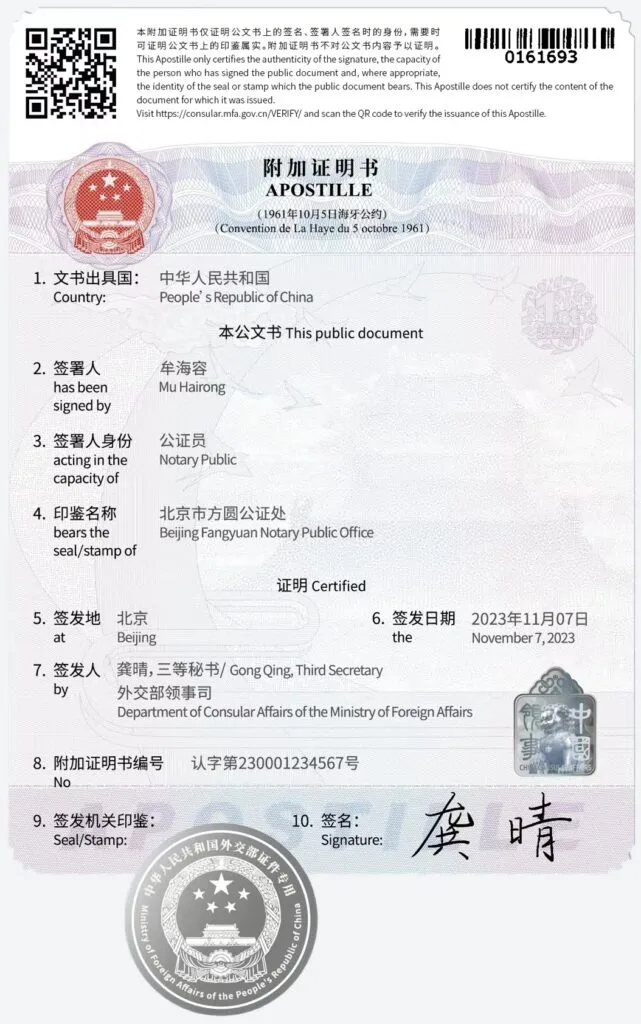
An Apostille is a standardized certificate attached to a public document that confirms:
- The authenticity of the signature
- The official capacity of the signer
- The validity of the seal or stamp
An apostille authenticates the signature, the signer’s capacity and, where applicable, the seal or stamp on a public document. The receiving authority assesses the document itself.
Each Apostille includes:
- Issuing country
- Name and position of the signing party
- Place & date of issue
- Apostille number
- Official seal and signature
Use the official online portal to verify an apostille issued in mainland China.
What Documents Can Receive an Apostille in China?
Common examples include:
Personal & Legal Documents
- Birth certificates
- Criminal record certificates
- Marriage certificates
- Powers of attorney
- Court documents
- Academic records
Commercial & Trade Documents
- Certificates of origin
- Commercial invoices
- Packing lists
- Inspection & quarantine certificates
- CCPIT-issued documents
The exact requirement depends on the foreign authority requesting the document.
Which Documents Cannot Receive an Apostille?
An Apostille cannot be issued if:
- The signature or seal is not genuine
- The signature does not match official records
- The document format is incorrect
- National or public interests could be harmed
- The document is outside the Convention’s scope
For destinations where the Convention does not apply, ask the receiving authority whether consular legalization or a different procedure is required.
Key Benefits of the Apostille System in China
Where the Convention applies, an apostille can replace embassy legalization for a covered public document. Preparation, translation, fees and processing times depend on the document and the authority handling it.
Where Can You Apply for an Apostille in China?
Apostilles are issued by:
- The Ministry of Foreign Affairs (MFA)
- Local Foreign Affairs Offices authorized by the MFA
Example: In Shanghai, Apostilles are handled by the Shanghai Foreign Affairs Service Center for documents issued by:
- Shanghai notarial offices
- Shanghai Customs
- Shanghai CCPIT branches
For documents issued in mainland China, check the list of competent authorities and their jurisdictions. Ask the relevant office about appointments, document packaging and submission methods. For documents issued in Hong Kong or Macao, check the corresponding territorial entries in the HCCH directory of competent authorities.
Apostille is not a translation. An apostille authenticates the signature and seal on a document; it does not translate it. If the receiving authority needs the document in another language, HI-COM provides a certified Chinese translation to meet the receiving authority’s requirements.
Do You Need an Apostille or Traditional Legalisation?
Check the Convention’s application and the receiving authority’s requirements for your document. For practical examples, see our guides to Chinese police certificates after leaving China, Chinese diploma apostilles and Chinese employment and resignation certificates.
If you need someone in China to coordinate the steps for your document, whether you are in China or abroad, our team can help.
Explore our apostille and notarisation services
Free quote within a few hours, 24 hours at the latest.