

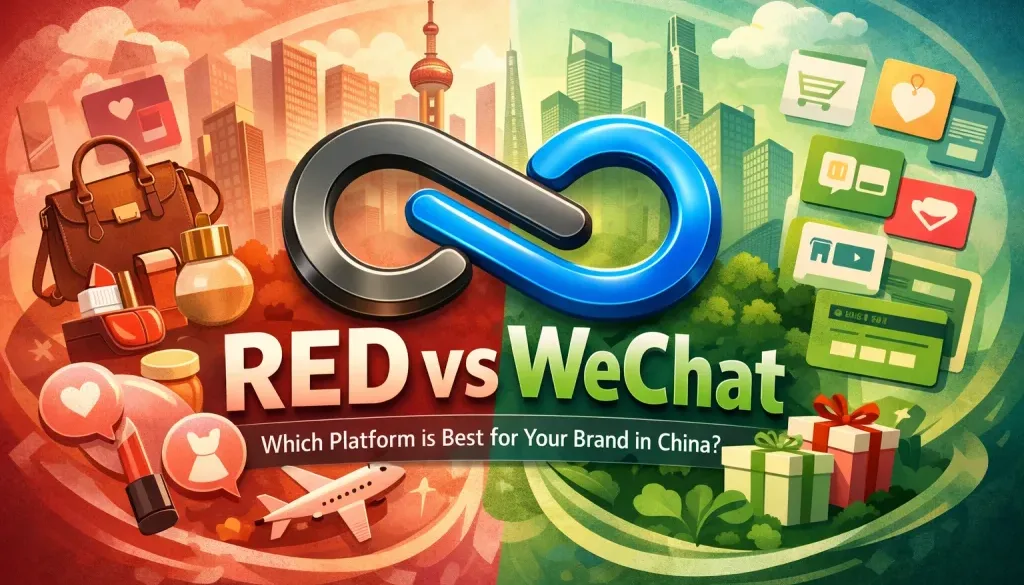
RED vs WeChat: which platform should you choose for your brand in China in 2026?
So you want to launch your brand in China. You’ve heard of Xiaohongshu (RED) and WeChat of course, but which of these two platforms is the best fit?
Both platforms are very powerful, but they serve different purposes. Understanding their differences will help you avoid wasting your budget and maximize your impact from the outset.
Xiaohongshu (RED): the platform for discovery and influence
RED is first and foremost a community. With over 300 million active users per month, the platform has become China’s number one lifestyle search engine.
Chinese consumers don’t go to RED to buy directly. Instead, they go there to search, compare, and form opinions.
This is exactly what major European fashion houses are doing. Dior, for example, collaborates with micro-influencers (KOCs) who post everyday looks that naturally incorporate their pieces.
The result?
Authentic content that is more credible than traditional advertising. Chanel, meanwhile, generates millions of dollars in Media Impact Value on RED every year, driven by highly engaged content creators.
RED works on a simple principle: zhongcao, or “planting grass”.
The idea is to create desire naturally, without forcing the sale. Brands that succeed on RED tell a story, a lifestyle, an emotion, as well as selling a product.
Who is RED for?
RED is ideal if your brand operates in the following sectors:
- Beauty and cosmetics
- Fashion and lifestyle
- Premium food
- Travel and hospitality
- Fitness and wellness
The user base is predominantly female (over 70%), young, and urban.
If your target audience is female consumers aged 18 to 35, the RED should be your priority entry point into China.
WeChat: the complete ecosystem for conversion and loyalty
WeChat is something else entirely. It is a super app used by over 1.3 billion people. In China, everything goes through WeChat from messages and payments through to reservations, customer service, and e-commerce. It is a tool for loyalty, not discovery.
Major European brands have understood this well. Louis Vuitton won the award for best WeChat Mini Program for its experience linked to the “Volez, Voguez, Voyagez” exhibition in Shanghai. Longchamp uses a Mini Program to allow its customers to customize their bags directly in the app.
Dior was the first luxury brand to sell its bags on WeChat and launched a system of customizable digital gift cards for its Chinese customers. Givenchy, for its part, offered a limited edition of its Voyou bag available exclusively via WeChat, in collaboration with influencer Mr. Bags.
What these examples have in common is that they use WeChat to create an exclusive, direct, and personalized experience with their Chinese customers.

Who is WeChat for?
WeChat is essential if you are looking to:
- Sell directly to your customers via a Mini Program
- Manage your customer service in real time
- Send targeted CRM campaigns
- Build customer loyalty with an integrated loyalty program
- Organize online events or live commerce
WeChat is suitable for all sectors. It is a channel for conversion and retention.
Without a presence on WeChat, it would be very difficult to build a lasting relationship with your Chinese customers.
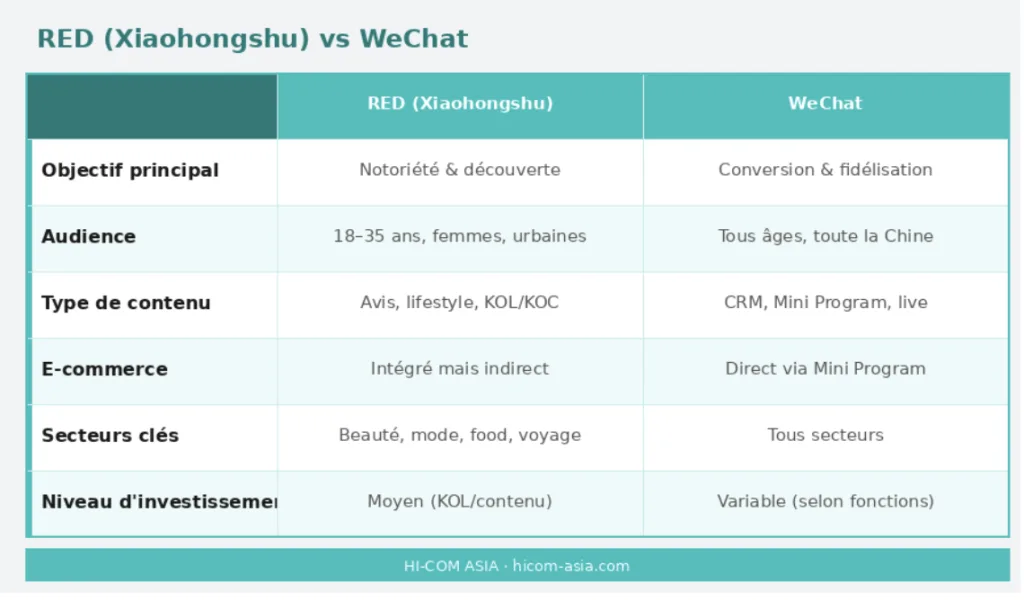
RED vs. WeChat: a comparison table
This table summarizes the key differences between the two platforms:
The HI-COM strategy: combining both platforms
At HI-COM Asia, we understand that brands that succeed in China don’t simply choose either RED or WeChat. They use the best of both.
RED creates desire, whereas WeChat turns that desire into purchases and loyalty.
A typical customer journey looks like this: a Chinese consumer discovers your brand on RED via an influencer’s post. After lking what they see, they then search for your WeChat account to find out more, place an order, or contact your customer service team. If they are satisfied, they will return via your WeChat campaigns. It’s a virtuous circle.
But for this circle to work, every piece of content must be perfectly localized, meaning that a word-for-word translation is not enough. The tone, cultural references, visual codes—everything must resonate with Chinese consumers. That’s where HI-COM Asia comes in, with its expertise in digital marketing, copywriting, and localization for the Chinese market.
What to focus on first, depending on your industry
Are you a beauty or fashion brand? Start with RED. First build your reputation through KOCs and authentic content. Then add WeChat to convert and retain customers.
Are you in B2B, hospitality, or finance? Start directly with WeChat. Create an Official Account, then explore the CRM and Mini Program features.
Are you a luxury brand? Both platforms are essential from the outset. RED for desirability, WeChat for exclusivity and customer relations.
Conclusion: don’t just choose, orchestrate
RED and WeChat are not competitors at all. In fact, they complement each other. Therefore the main challenge for brands is ton know how to intelligently combine the platforms according to your objectives, your sector, and your budget.
At HI-COM Asia, we support European brands at every stage of this strategy: from content localization to setting up KOL campaigns on RED, to creating and managing your WeChat presence.
Contact our team for an audit of your digital strategy in China.