How to Use Weibo in 2026-2027: Sign-Up, Verification, Posting and Marketing Guide
Quick answer
Weibo (微博, “microblog”) is China’s public square: an open social network where news, celebrities, brands and trending topics meet. It had about 551 million monthly and 254 million daily active users in September 2026. Brands use it for awareness, launches, celebrity and KOL campaigns, hot search visibility and official statements, not as their main sales channel. A foreign company can get a verified blue-V account, with or without a Chinese entity, if it prepares the right documents and Chinese translations.
If you live in China or work with Chinese consumers, you have heard of Sina Weibo. Launched in 2009, it is still where China follows breaking news, celebrity announcements and brand launches in real time. This guide covers both sides of the question: how to use Weibo yourself (sign-up, posting, English), and how a foreign brand should use it in 2026-2027 (verification, hot search, ads and KOLs), with the latest official figures.
Written by the HI-COM Asia team.
Updated November 2026 · Valid for 2026-2027 · Data checked 25 November 2026
In this guide
- What is Weibo?
- Weibo in numbers (2026)
- Is Weibo still worth it for foreign brands?
- How to sign up for Weibo
- How to get a verified Weibo account for a foreign company
- How to post on Weibo
- What is Weibo hot search?
- How to get followers on Weibo
- How to advertise on Weibo
- Who posts on Weibo: celebrities and KOLs
- Using Weibo in English
- Rules brands must know
- What changes in 2027
- FAQ
What is Weibo?
Weibo (微博, pronounced “way-bo”) means “microblog”. The platform was launched by Sina in 2009 and is run today by Weibo Corporation, listed in New York and Hong Kong. People often call it “China’s Twitter”, and the comparison works for the format: short posts, images, videos, reposts, comments, hashtags and a public trending list.
The real difference is how people use it. On WeChat, you talk to people you know. On Weibo, you follow people and topics you do not know: celebrities, journalists, experts, brands, government bodies and fan communities. That makes Weibo China’s public square, the place where a story becomes national news, where a celebrity confirms a partnership and where a brand answers a crisis.
Weibo in numbers (2026)
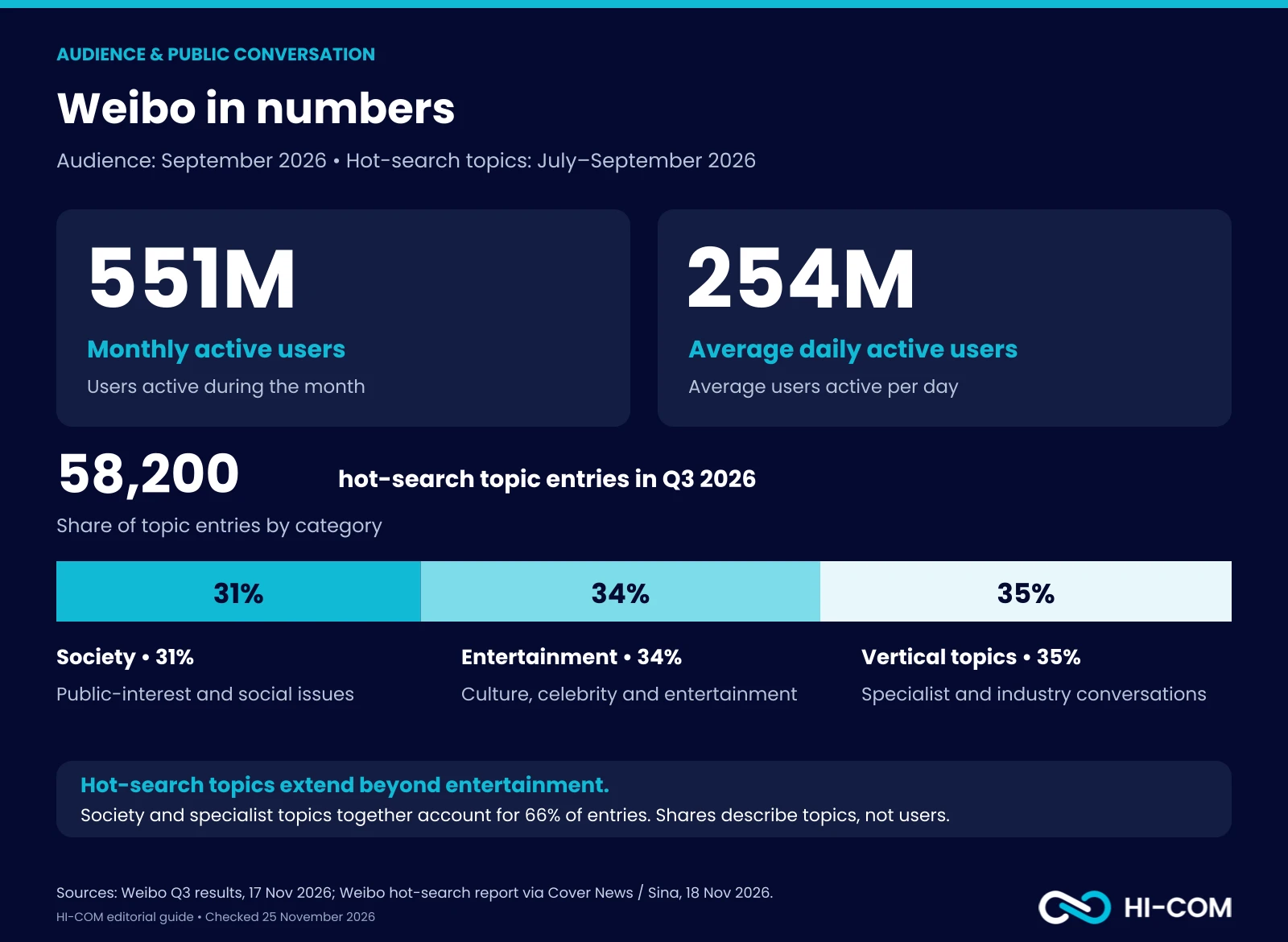
These are Weibo Corporation’s own published figures. No 2027 data exists yet; we will update this table with each quarterly release.
| Period | Monthly active users | Daily active users |
|---|---|---|
| September 2024 | 587 million | 257 million |
| June 2025 | 588 million | 261 million |
| December 2025 | 567 million | 252 million |
| March 2026 | 562 million | 254 million |
| June 2026 | 561 million | 254 million |
| September 2026 | 551 million | 254 million |
How to read it: daily use has been stable at around 250 to 260 million people since 2024, while monthly reach is slowly declining. The core audience comes back every day; occasional users come less often.
Who uses Weibo?
- Young adults: people born in the 1990s and 2000s make up nearly 80% of users (Weibo consumption report, December 2024).
- Older users are growing: 31 to 40-year-olds represented 22.9% of monthly active users in mid-2025, a rising share (Weibo, via Xinhua).
- Urban and affluent: more than 70% of users live in tier 1 to 3 cities, and more than a third use a phone priced above 5,000 RMB (2024 report).
Revenue and advertisers
Weibo earned 1.76 billion USD in 2025, of which 1.50 billion came from advertising, both flat on 2024. In Q3 2026, revenue was 410.2 million USD (-7% year on year) and advertising 344.1 million USD (-8%). Spending grew from internet services, smartphone makers and car brands, and fell in e-commerce, games and cosmetics. In other words, Weibo is where companies launch and build reputation, less where they push direct sales.
Is Weibo still worth it for foreign brands in 2026-2027?
Yes, if you use it for the right job. Weibo is no longer the platform where Chinese consumers decide what to buy; RED and Douyin have taken that role. But it remains the place where news breaks, celebrities speak and brands make official statements. Use Weibo for:
- Launches and announcements that need national visibility in hours;
- Celebrity, KOL and IP collaborations, which are announced and amplified on Weibo first;
- Hot search visibility around events, trade fairs and cultural moments;
- Reputation and crisis communication: journalists and consumers check your verified account first;
- A credible official presence: a verified blue-V account tells Chinese partners and consumers that the brand is real and active in China.
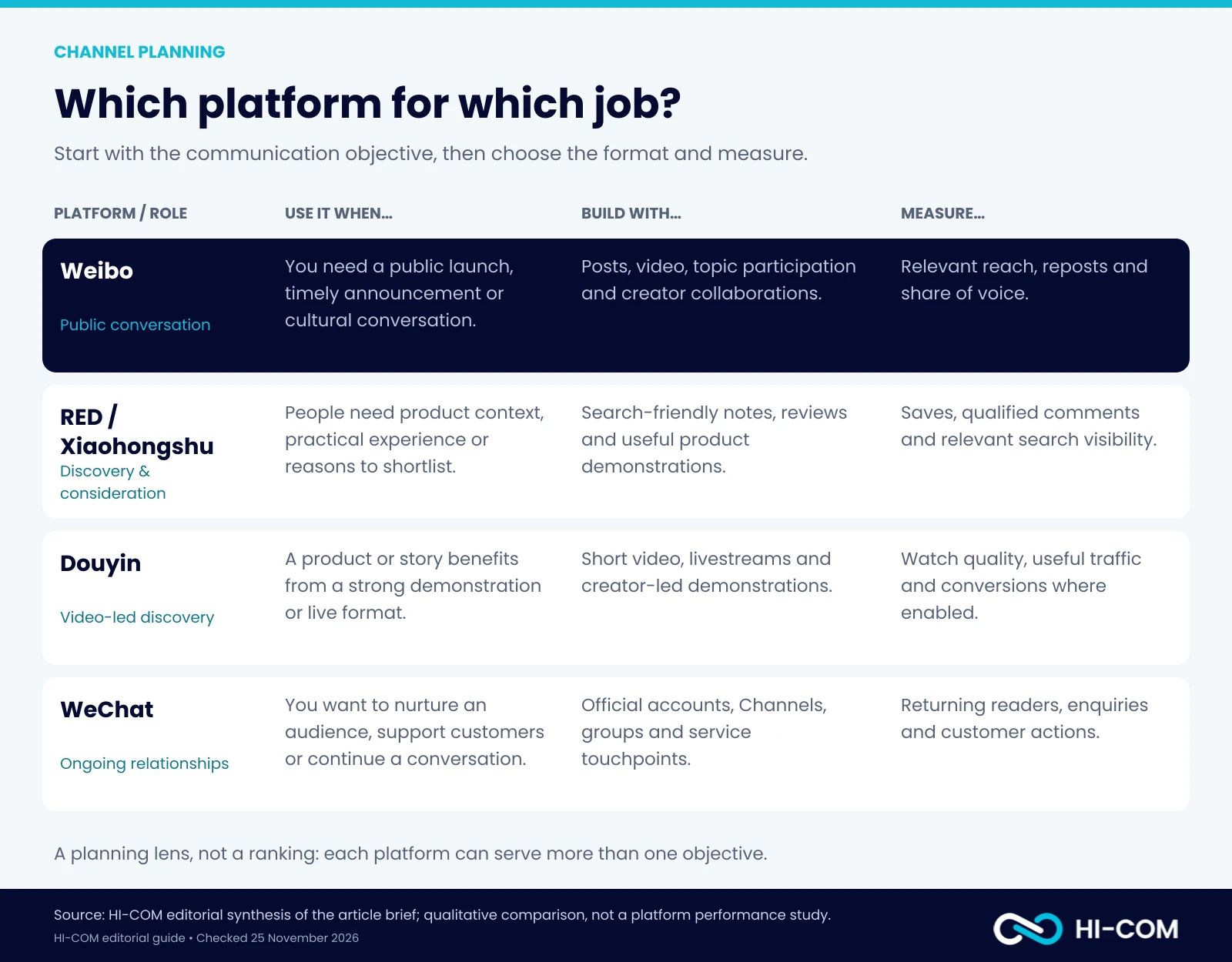
| Platform | Main role | Typical content | Best for |
|---|---|---|---|
| Weibo 微博 | Public square: news, trends, celebrities | Short posts, images, video, topics, hot search | Launches, PR, celebrity and IP campaigns, crisis communication |
| RED 小红书 | Search and purchase advice | Notes with photos, short videos, reviews | Beauty, fashion, travel, food, home, lifestyle |
| Douyin 抖音 | Entertainment and sales | Short videos, livestreams | Consumer goods, food, beauty, direct sales |
| WeChat 微信 | Owned channel and customer relationship | Articles, mini programs, Channels videos | B2B, services, loyalty, lead generation |
Most brands combine two or three platforms. For a full overview, see our guide to Chinese social media platforms, our comparison RED vs WeChat, and our pages on Douyin marketing and Xiaohongshu marketing.
How to sign up for Weibo (personal account)
Anyone can open a personal Weibo account, including foreigners outside China.
- Download the Weibo app (iOS or Android). The app is more reliable than the website for sign-up, and its interface follows your phone’s language, so it can be used in English.
- Register with your mobile number. Choose your country code: foreign numbers are accepted. Enter the verification code sent by SMS.
- Complete your profile: nickname (it must be unique), avatar, short bio. A complete profile looks more trustworthy and attracts more followers.
- Verify your identity if asked. Some features, such as livestreaming, may require real-name verification. Foreigners can usually verify with a passport.
A personal account is fine to follow brands, read the news and test the platform. A brand, however, needs a verified organisation account.
How to get a verified Weibo account for a foreign company
This is the question most guides skip, and the one we handle most often. HI-COM creates and verifies official Weibo accounts for foreign brands, and we run our own verified blue-V account, 嗨酷翻译 HI-COM.
Personal, verified or VIP: what is the difference?
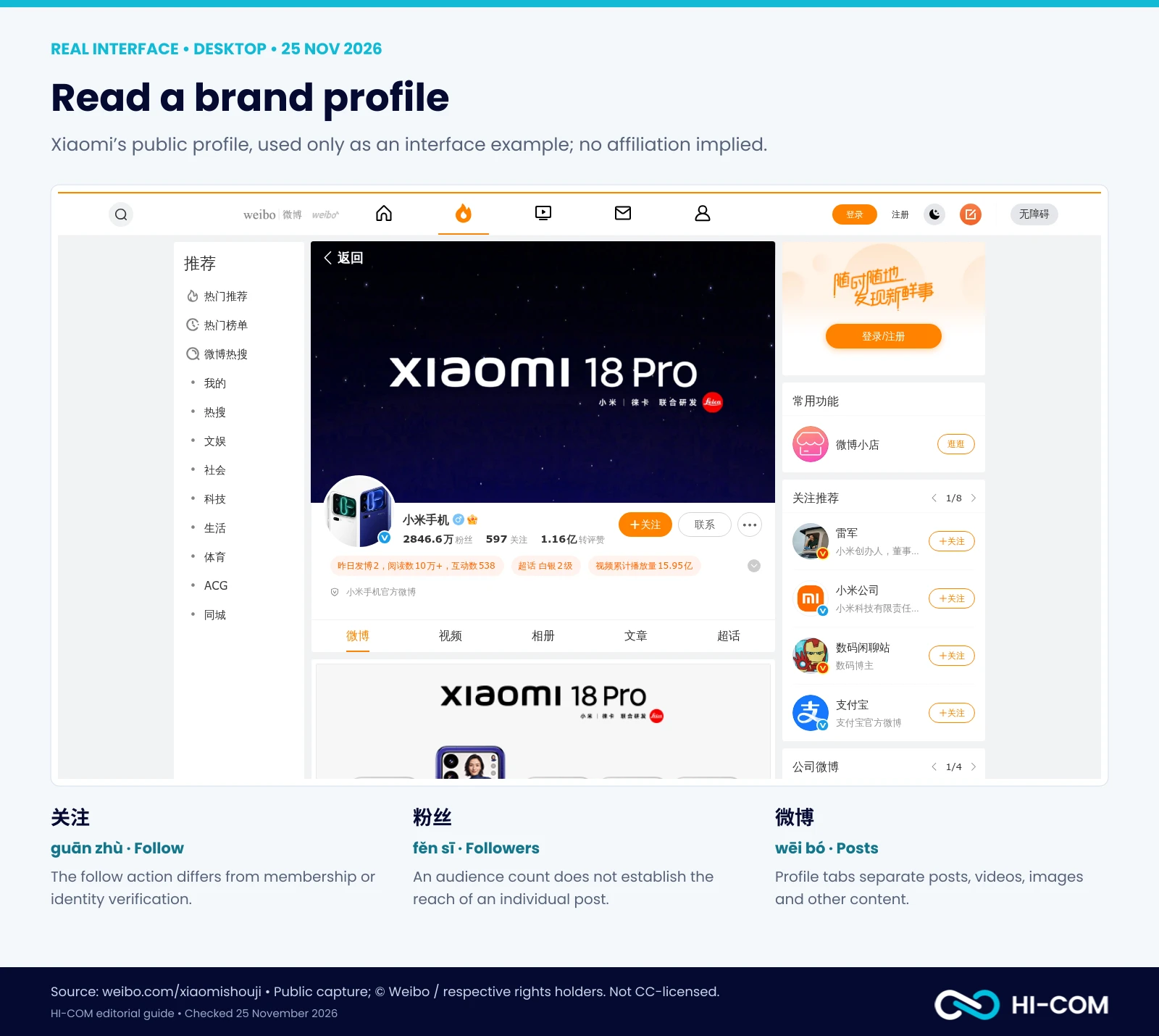
- Personal account: anyone with a phone number. No badge.
- Orange V: a verified individual, such as a celebrity, journalist, expert or creator.
- Blue V (蓝V): a verified organisation: company, brand, media, institution. It gives access to business tools such as data analytics, fan management, events and the ad centre, and it is the badge Chinese users look for before trusting a brand.
- VIP membership (会员): a paid option on top of an account, with extra display features.
How to get a VIP account on Weibo
Once your account is verified, you can subscribe to a VIP membership from the account settings. It is optional. Benefits have included editing posts after publication, pinning a post to the top of the profile, a customised cover and layout, and a membership badge next to the account name. The exact features change over time, so check the current list in the app before subscribing.
Three routes to a blue-V account
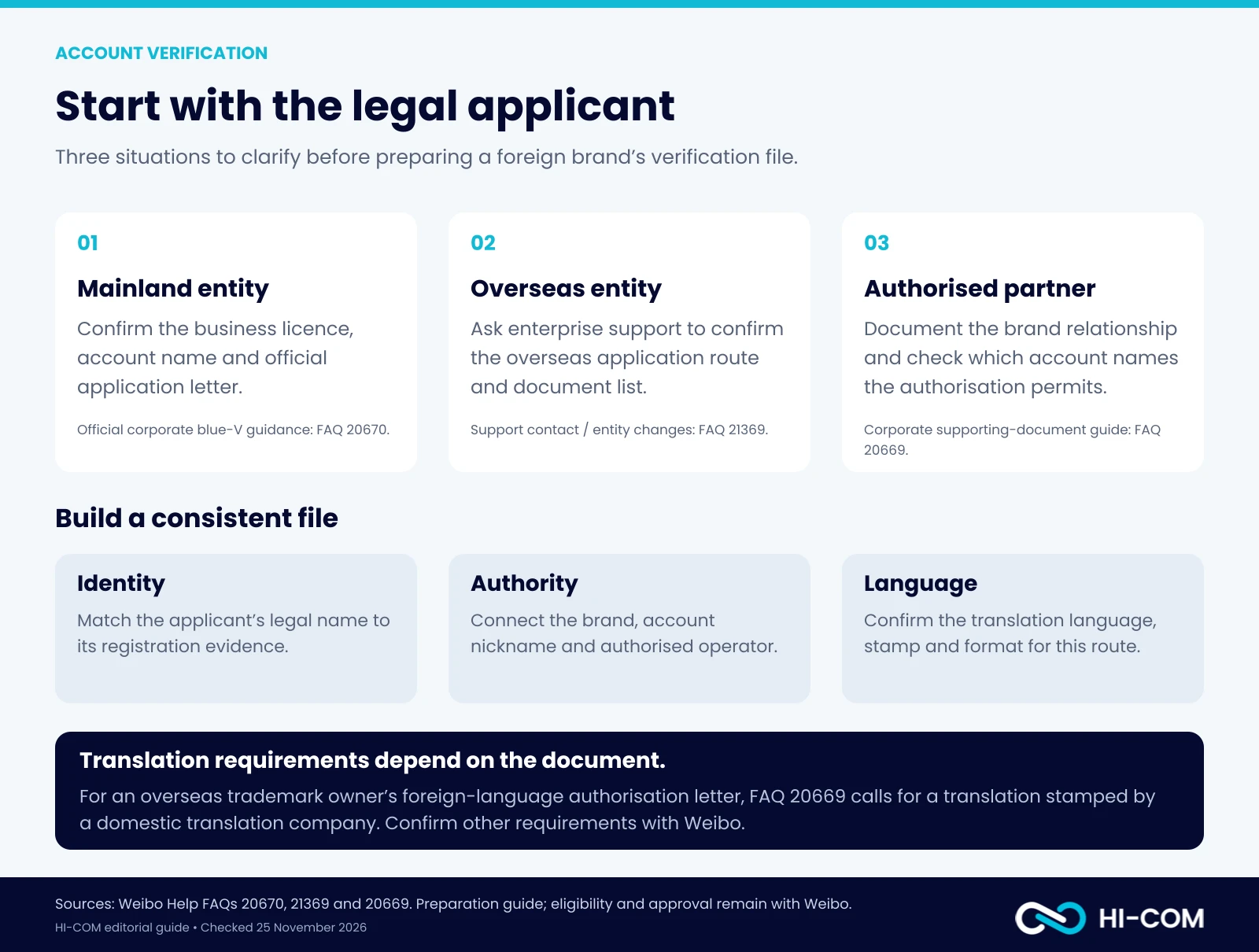
The right route depends on who the legal applicant is.
| Your situation | Who applies | Core documents |
|---|---|---|
| 1. You have a company in mainland China (for example a WFOE) | Your Chinese entity | Business licence, verification application letter with the company seal, trademark certificate if the account uses a brand name |
| 2. You have no entity in China | Your overseas company, through Weibo’s overseas verification channel | Company registration documents with a Chinese translation, signed or sealed authorisation letter for the person or agency operating the account, operator contact details |
| 3. You sell through a partner in China | Your official distributor or agent | Partner’s business licence, proof of brand authorisation (distribution agreement or authorisation letter), trademark registered in China |
Documents: what usually needs translating
For route 2, foreign documents such as a certificate of incorporation, a commercial register extract and the authorisation letter must come with a Chinese translation. A rejected file usually means an incomplete set, an unsigned letter or a translation that does not match the original. Prepare them once, properly:
- use the company’s exact legal name in both languages, everywhere;
- make sure the authorisation letter names the operator (person or agency) and is signed or sealed;
- keep the account name consistent with your registered trademark.
Verification must be renewed every year
A blue-V badge is not permanent. Weibo requires an annual review (年审) of the company’s qualifications. If the review lapses, the profile publicly displays a notice that the company’s qualifications have not passed the annual review, which is not the message a brand wants to send. Put the renewal date in your calendar.
Fees and processing times depend on the route and change over time; we confirm them for your case in your quote.
Want an official Weibo account for your brand?
We choose the right route, prepare the verification file and produce the certified Chinese translation of your company documents with our ISO 17100 team in Shanghai. Free quote within a few hours, 24 h at the latest.
How to post on Weibo
Posting works much like on X (Twitter), with a few Weibo-specific habits.
Posting from the app
- Tap the + button and choose the post type: text, photo, video, article or livestream.
- Write your text. Long posts are folded in the feed behind a 全文 (“full text”) link, so put the key message in the first line.
- Add a topic by typing #: Weibo topics are written between two hash signs, like #topic name#. Mention another account with @.
- Add images or a video. Posts with visuals get more engagement than plain text.
- Choose the visibility: public (公开), fans only, friends, or only you. Then publish.
Posting from a desktop
At the top of your home feed, you will find the compose box. Below it, icons let you add 表情 emoticons, 图片 pictures, 视频 video, @ mentions, # topics and 头条文章 articles (long-form posts). Before publishing, you can schedule the post for a later time and set its visibility. Business accounts also get a management back office for scheduling, analytics and comment moderation.
What works in a Weibo post
- Short and visual: a strong first line, one to nine images or a short video. Link to long content rather than pasting it.
- Written in Chinese: English-only posts reach very few users. Localise, do not just translate.
- Joined to a topic: adding a relevant #topic# or super topic (超话) puts your post in front of people who do not follow you yet.
- Regular: post at least two or three times a week, and more around launches and events.
What is Weibo hot search (热搜) and how does it work?
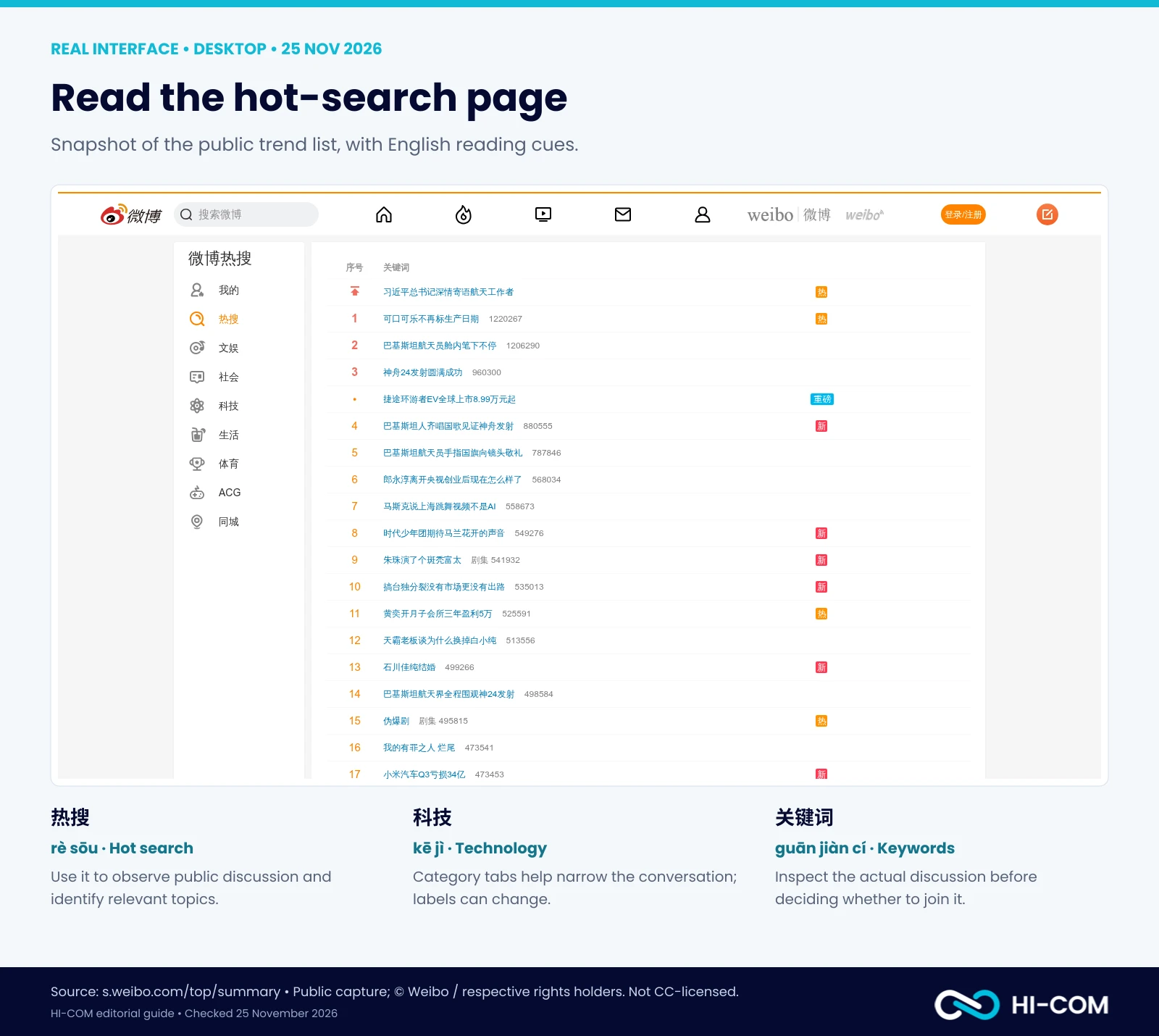
Weibo hot search (热搜, rèsōu) is the platform’s real-time ranking of the most discussed topics. It is the most watched list on Chinese social media: journalists, brands and other platforms follow it, and a topic that reaches it can become national news within hours.
- What drives it: searches, reads and discussion around a topic, in real time.
- What it contains: in Q3 2026, 58,200 topics reached hot search. Society and news made up 31%, entertainment 34% and vertical topics (sports, tech, cars, culture and so on) 35%. Weibo also counted 1,965 official statements and rebuttals linked to hot topics.
- What changed in 2026: Weibo restructured the hot search page in October 2026 and reported vertical topics up 7% year on year.
- Regulation: in September 2025, the Cyberspace Administration of China (CAC) summoned Weibo over its management of hot search, and Weibo set up a rectification team. Expect the list to stay closely moderated.
For brands: you cannot buy your way into the organic ranking. You can earn a place with newsworthy content, events or celebrity partnerships, or buy clearly labelled brand placements around hot search through Weibo’s ad products.
How to get followers on Weibo
- Get verified first. Users rarely follow an unverified brand account.
- Post regularly and in Chinese, with a consistent visual identity.
- Join existing conversations: relevant topics, trending moments and super topics, rather than only your own hashtags.
- Work with KOLs and celebrities whose audience matches yours. A repost by the right account brings more qualified followers than months of posting alone.
- Run giveaways (抽奖) that follow Weibo’s rules: they reward reposts and follows, but attract low-quality followers if the prize has nothing to do with your brand.
- Answer comments quickly. Weibo users judge brands by how they reply in public.
- Boost your best posts with a small paid budget (see below) to reach new audiences.
- Cross-promote your Weibo account on RED, WeChat, packaging and events in China.
How to advertise on Weibo
Weibo’s ad products cover every stage of a campaign:
- Splash ads (开屏): full-screen ads shown when users open the app. High reach, for launches.
- In-feed ads (信息流): sponsored posts in users’ feeds, targeted by interest, age, location or device.
- Fans Headline (粉丝头条): pushes one of your posts to the top of your followers’ or target users’ feeds.
- Search and hot search placements: labelled brand placements when users search keywords or browse hot search.
- Celebrity and KOL content: sponsored posts by creators, amplified with paid reach.
Two trends matter for 2026-2027. First, AI-generated creatives accounted for about half of Weibo’s in-feed ad spend by June 2026, so creative testing is faster and cheaper than before. Second, the advertisers who spend more are launching products (phones, cars, internet services), while pure sales advertising has moved to Douyin and e-commerce platforms. You can buy ads through Weibo’s self-service ad platform or through an agency; budgets depend entirely on your objective, so we do not quote standard rates.
Who posts on Weibo? Celebrities, KOLs and brands
Weibo is still the home base of Chinese celebrities. Every year, the Weibo Night ceremony crowns the most influential accounts: at the edition held on 5 February 2026, actor Xiao Zhan (肖战) was named “Weibo King” and actress Yang Mi (杨幂) “Weibo Queen”. When a celebrity confirms a brand partnership, the announcement usually goes out on Weibo first.
Brands use that power. Herbal tea brand Wanglaoji’s (王老吉) campaign with football player Erling Haaland generated more than 5.4 billion reads on Weibo in 2026. Creators are also paid directly by the platform: Weibo shared 420 million RMB of advertising revenue with creators in 2025 (+41%).
Who should a foreign brand work with? Rarely the biggest celebrity: mid-tier KOLs in your vertical (tech, cars, travel, food, beauty, education) often deliver better engagement per yuan, and fan communities in super topics can be very loyal. See our list of top Chinese KOLs and influencers and how we run KOL marketing in China.
Using Weibo in English
The interface: the Weibo app can display in English when your phone is set to English. The website and many menus remain in Chinese, which is why we annotated the screenshots in this guide.
Searching in English: it works, but not well. Weibo search returns the latest posts that contain your words, not necessarily the brand’s page or campaigns. Search “Mac lipstick” and you will see recent posts mentioning it, but maybe not the brand’s account. People come to Weibo for news and trends, not to search for products; for product research, Chinese users go to RED.
Posting in English: you can, but very few users will engage. A brand should post in Chinese, written for Chinese readers, and keep English for occasional international messages. Reading posts in English is easier: the app offers machine translation for many posts.
Rules brands must know
- Ads must be labelled. Sponsored posts, including KOL content, must be identifiable as advertising under China’s Advertising Law and internet advertising rules.
- AI-generated content must be labelled since the CAC labelling measures took effect on 1 September 2025.
- Specialised topics need qualifications. Accounts that post about health, finance, law or education may be asked to show professional credentials.
- Comparative and superlative claims (“the best”, “No. 1”) are restricted in Chinese advertising.
Our guide to China’s Advertising Law for social media covers these rules in detail.
What changes in 2027?
What we can say from Weibo’s own reporting in 2026:
- AI search will matter more. Weibo’s AI search (智搜) grew strongly in 2025, and conversational queries doubled quarter on quarter in Q3 2026. Brand content will increasingly be found through AI answers, not only through the feed.
- Video keeps growing. Video viewing time rose by double digits in 2026, and Weibo added more than 15,000 video creators in Q3 2026 alone.
- Hot search stays central, and regulated. Expect more vertical topics and close moderation.
- Advertisers stay cautious. On its Q3 2026 earnings call, Weibo described a cautious advertising market. Plan Weibo budgets around launches and moments rather than always-on spending.
The strategic takeaway does not change: in 2027, Weibo is where your brand earns visibility and credibility in China; RED and Douyin are where consumers decide and buy.
FAQ
What does Weibo mean?
微博 (wēibó) means “microblog”. It is the name of China’s largest open social network, launched by Sina in 2009, which is why it is often called Sina Weibo.
Is Weibo free?
Yes, personal accounts are free. Organisation verification, VIP membership and advertising are paid services.
Can foreigners use Weibo?
Yes. You can register with a foreign mobile number in the Weibo app. Some features may ask for identity verification, which foreigners can usually complete with a passport.
Can a foreign company get a verified Weibo account without a Chinese entity?
Yes, through Weibo’s overseas verification route, with your company registration documents translated into Chinese and an authorisation letter for the account operator. You can also verify through your Chinese entity or official distributor.
How much does Weibo verification cost, and how long does it take?
It depends on the route and on Weibo’s current conditions, and verification must be renewed every year. We confirm the cost and timing for your case in a free quote, within a few hours, 24 h at the latest.
What is the difference between Weibo and X (Twitter)?
The format is similar, but Weibo combines more functions: long articles, livestreams, super topic communities, a powerful hot search list and integrated brand tools. It is also China-focused: X is not accessible in mainland China.
Can I post on Weibo in English?
Yes, but engagement will be very low. Brands should post in Chinese, written by native speakers who know Weibo’s tone, topics and rules.
Launch your brand on Weibo
From account verification and translated company documents to Chinese content, KOL campaigns and ads, our Shanghai team runs your Weibo presence end to end. Free quote within a few hours, 24 h at the latest.
Discover our China marketing servicesEmail, WeChat or WhatsApp
Sources: Weibo Q3 2026 results (17 November 2026); Weibo Q4 and fiscal year 2025 results; Weibo Q2 2026 results (Sina Tech); Weibo Q1 2026 results; Xinhua, October 2025; Weibo 2024 consumption report (Sina Tech); Weibo hot search report Q3 2026; Beijing Daily, October 2026; Guangming Online, September 2025; China Daily, February 2026. Checked 25 November 2026.
HI-COM Asia is a Shanghai-based consulting, marketing and translation company (ISO 17100, TAC member), with offices in Hong Kong and France, that creates, verifies and runs Weibo accounts for foreign brands.