Top 10 Chinese Brands Taking On Western Giants: The Numbers Behind the Shift (2027)
Quick answer
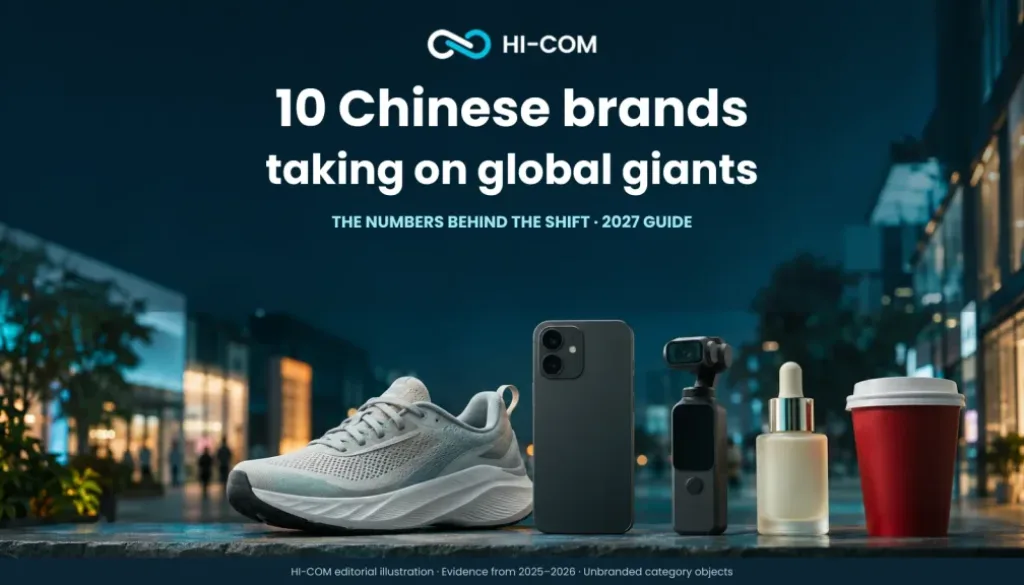
In about 15 years, Chinese brands have moved from “cheaper copies” to category leaders. In 2025, BYD sold more battery-electric cars than Tesla, Mixue ended the year with more outlets than McDonald’s, DJI shipped more cameras than all Japanese camera makers combined, and Chinese brands held 57.4% of China’s own cosmetics market. Here are the 10 match-ups that show the shift, the numbers behind each one, and what they mean for your brand in 2027.
Fifteen years ago, a “Chinese brand” outside China usually meant a factory name on a low-priced product. Today, Chinese companies lead global categories as different as electric cars, coffee, designer toys, cameras and short video. For a European brand, they are now the competitor to beat in China, and often abroad. For a Chinese brand, they are proof that a global brand can be built in a decade.
This guide compares 10 Chinese brands with the Western giants they challenge, using one verified figure per match-up. It is written by our team in Shanghai, where we work every day with both sides: Western brands competing in China, and Chinese brands preparing to go abroad.
Written by the HI-COM Asia team.
Updated November 2026 · Valid for 2027 · Data checked on 26 November 2026
In this guide
The 10 match-ups at a glance
| Chinese brand | Western giant | Key figure | Main lever |
|---|---|---|---|
| BYD | Tesla | 2.26M battery-electric cars sold in 2025 vs 1.64M Tesla deliveries | Vertical integration, wide range |
| Mixue | McDonald’s | 59,823 outlets vs 45,356 restaurants (end of 2025) | Low prices, own supply chain |
| Luckin Coffee | Starbucks | 36,310 stores worldwide vs 41,304 (June 2026) | App-only ordering, data |
| Anta | Nike, Adidas | RMB 80.22 billion revenue in 2025 (+13.3%) | Multi-brand portfolio |
| Pop Mart | Mattel | Revenue +184.7% in 2025 vs −1% for Mattel | Own IP, scarcity, community |
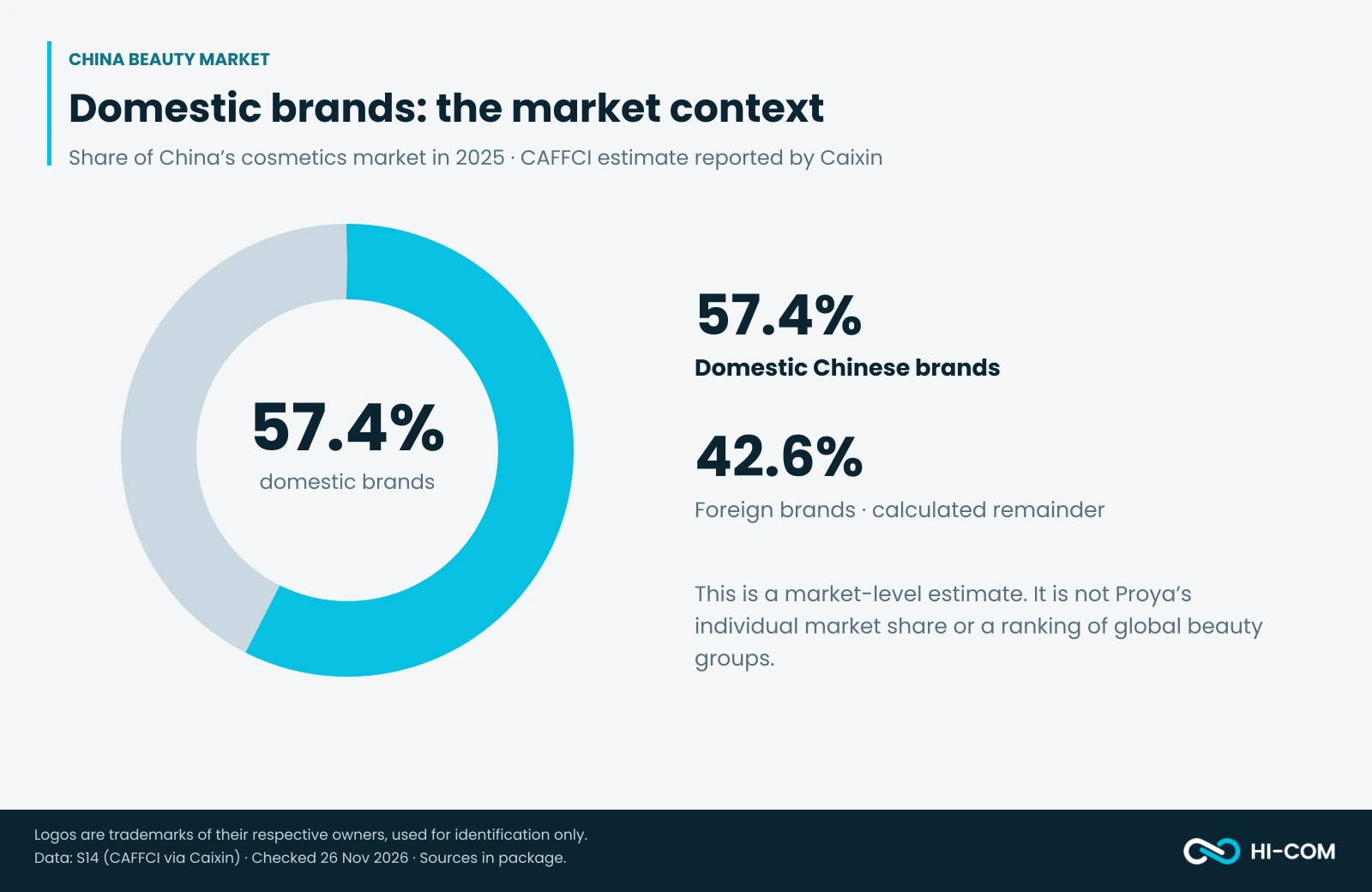
| Proya | L’Oréal, Estée Lauder | No. 1 on Tmall Beauty in 2025; Chinese brands 57.4% of the market | Hero products, Douyin |
| DJI | GoPro, Canon, Sony | 10.4M cameras shipped in 2025 vs 9.44M for all CIPA makers | R&D, product ecosystem |
| Xiaomi | Apple, Samsung | No. 3 in global smartphone shipments in 2025 (13.1%) | Value pricing, device ecosystem |
| SHEIN | Zara, H&M | US$41.8 billion revenue in 2025; Europe 35.4% of sales | Test-and-repeat, data |
| TikTok | YouTube, Instagram | No. 1 in Kantar BrandZ 2026 Chinese Global Brand Builders | Algorithmic short video |
How Chinese brands went from copycats to category leaders (2010–2027)
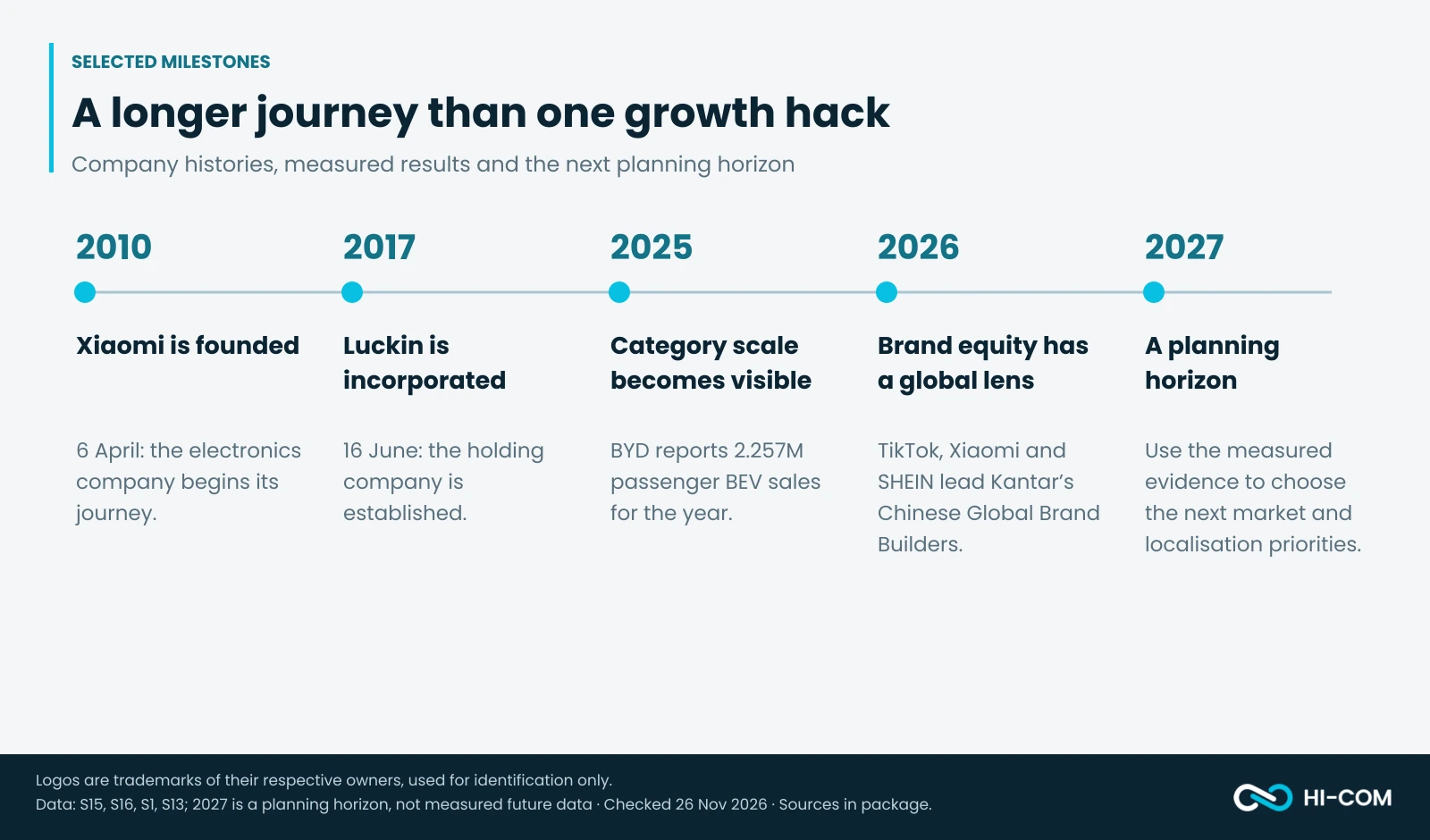
The shift did not happen in one product cycle. It came from four forces that reinforced each other:
- Speed. Chinese brands launch, test and adjust products in weeks, not seasons, because design, factories and suppliers often sit in the same city.
- Supply-chain control. BYD makes its own batteries; Mixue produces much of what its outlets sell. Owning the chain lets them cut prices and still grow.
- Digital-first customers. Brands grew up on apps, mini programs and social commerce on Douyin and Xiaohongshu, where a product can sell out after one livestream.
- National pride in design. The guochao (国潮, “national trend”) movement made Chinese aesthetics fashionable with young consumers, who now choose local brands on merit, not only on price.
The Kantar BrandZ view in 2026
Most valuable Chinese brands: Tencent leads the Kantar BrandZ 2026 ranking at US$210 billion, ahead of Alibaba (US$112 billion), Douyin (US$98 billion) and Moutai (US$82 billion). The top 100 are worth US$1.4 trillion together, up 13%.
Chinese Global Brand Builders 2026 (brands building equity abroad): 1. TikTok, 2. Xiaomi, 3. SHEIN, 4. Lenovo, 5. Huawei, 6. Haier.
The 10 match-ups, one by one
Each match-up follows the same pattern: where the brand started, where it stands now, how it got there, and the lesson for your own brand.
1. BYD vs Tesla: the electric-car race
Then: BYD started in Shenzhen in 1995 as a battery maker and only moved into cars in 2003.
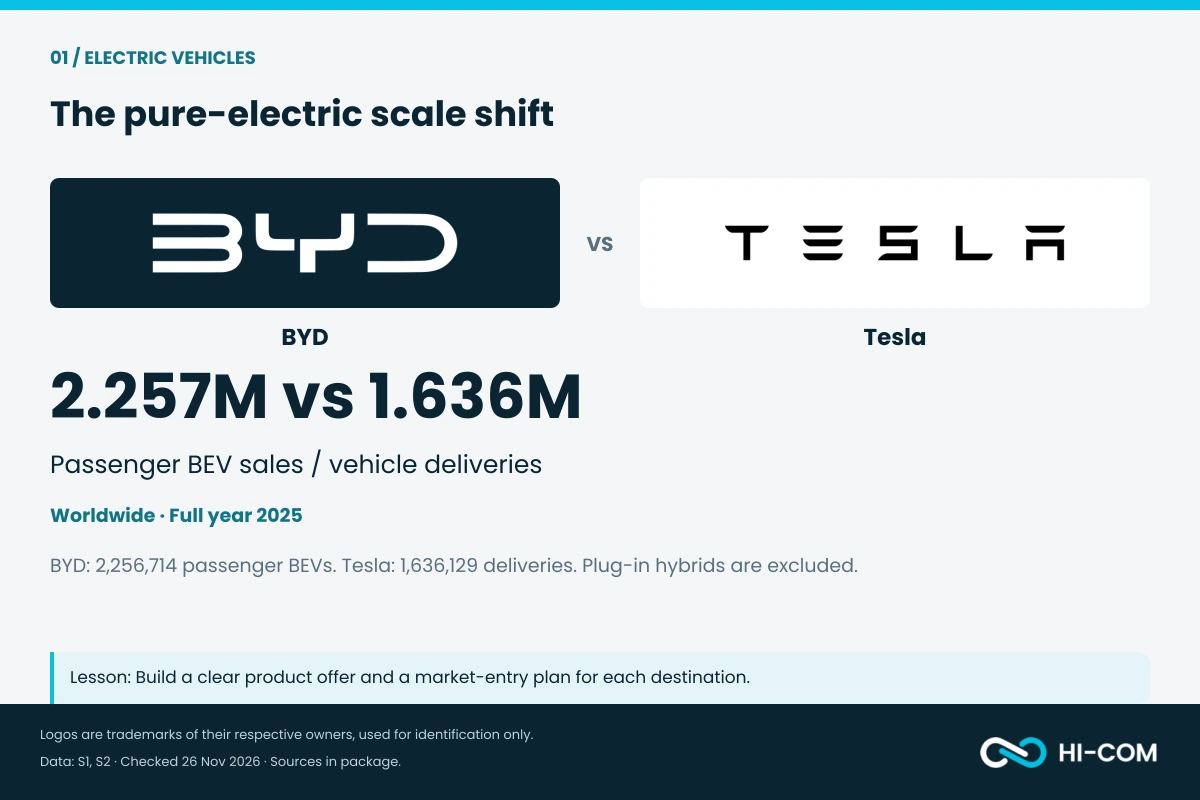
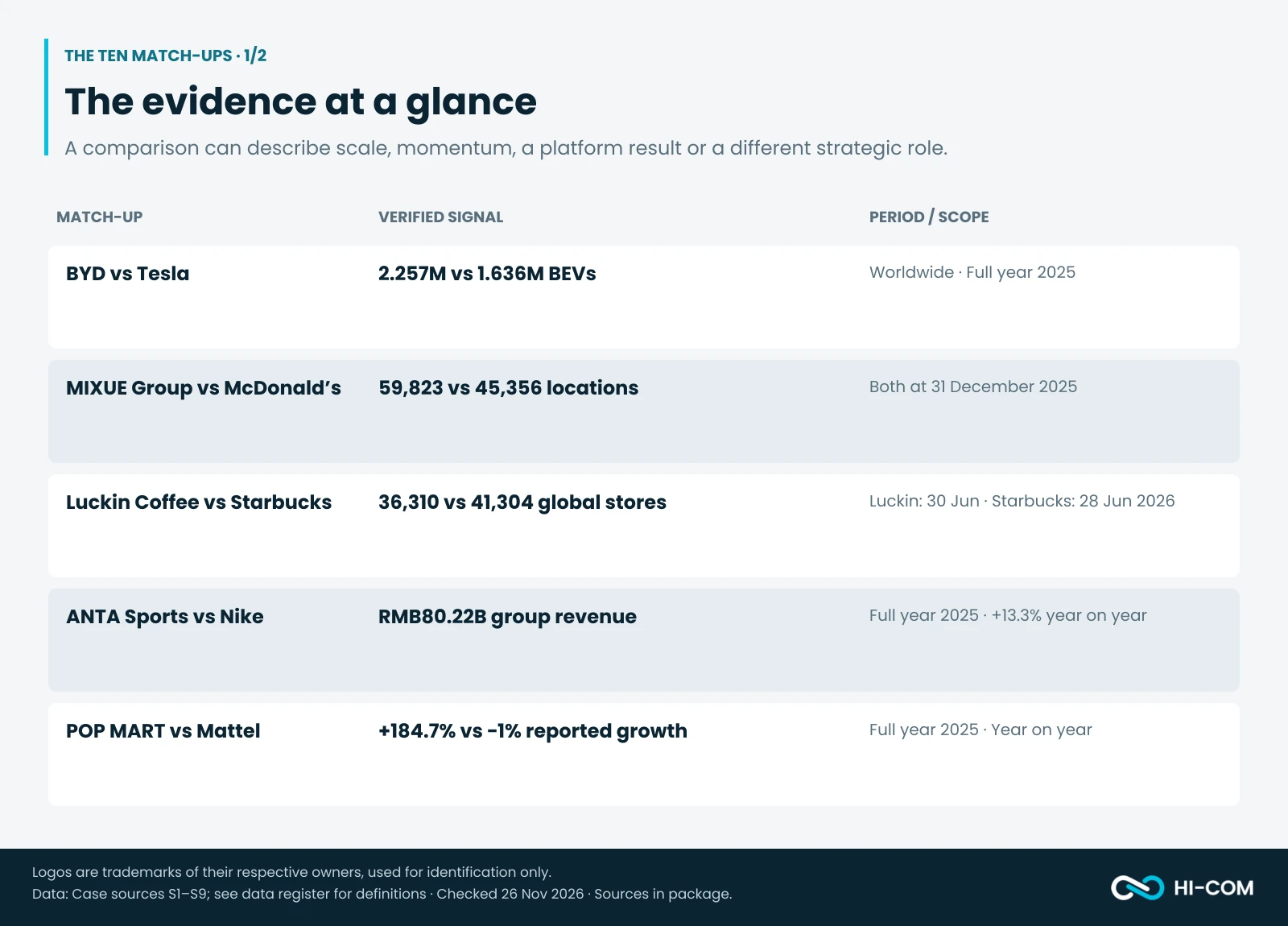
Now: in 2025, BYD sold about 2.26 million battery-electric passenger cars, against 1.64 million vehicles delivered by Tesla. Counting plug-in hybrids, BYD sold more than 4.5 million vehicles, and its sales outside China passed one million, up about 150%.
How: BYD controls its batteries and much of its supply chain, and it covers every price point, from small city cars to premium models.
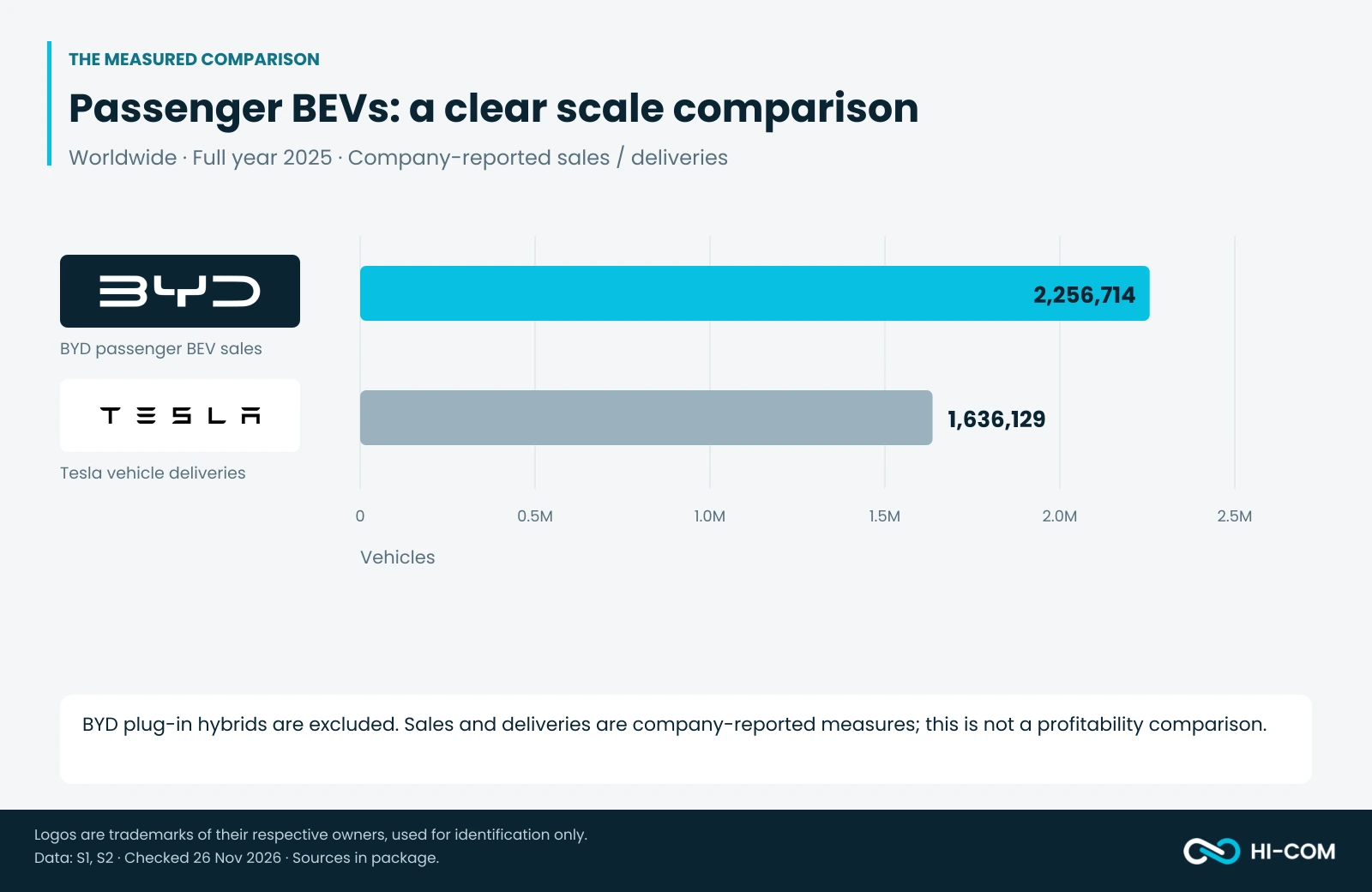
Lesson for your brand: in China, competitors move fast and cover the whole range. Map them before you set your China market entry strategy.
2. Mixue vs McDonald’s: the biggest food chain in the world
Then: Mixue (蜜雪冰城) began as a small shaved-ice stall in Zhengzhou in the late 1990s.
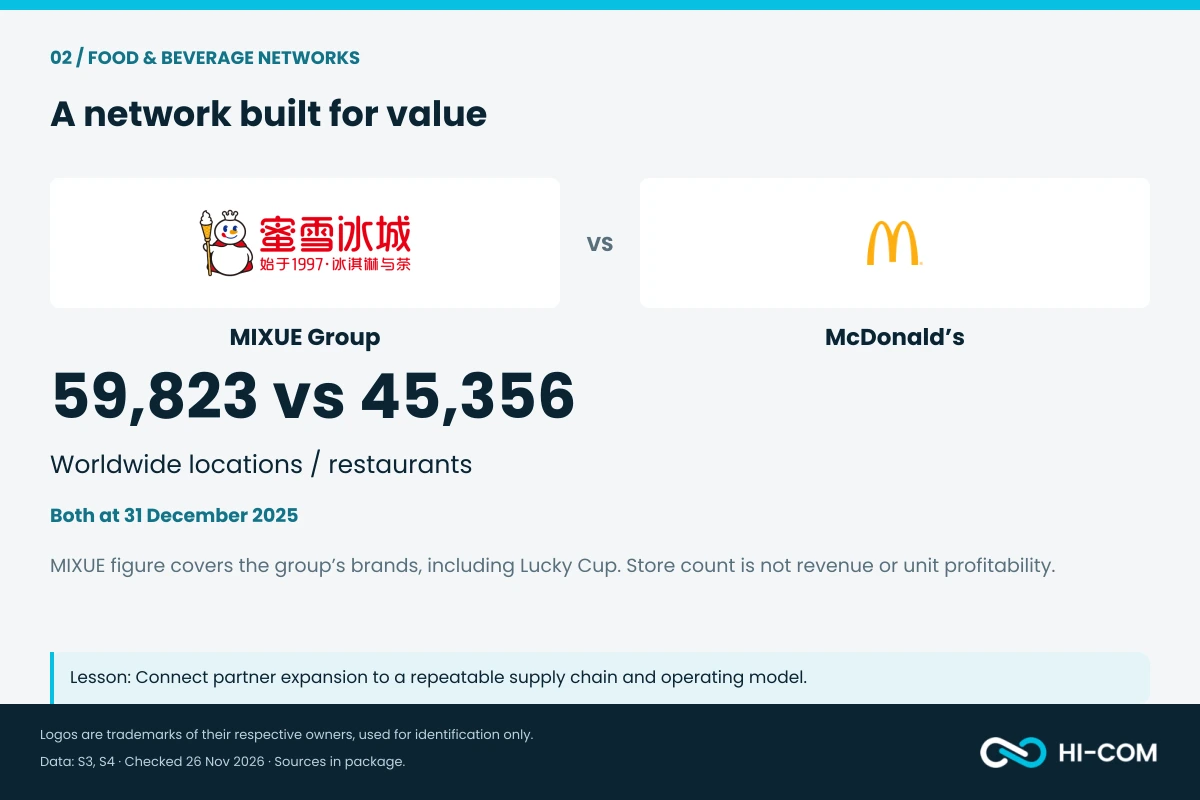
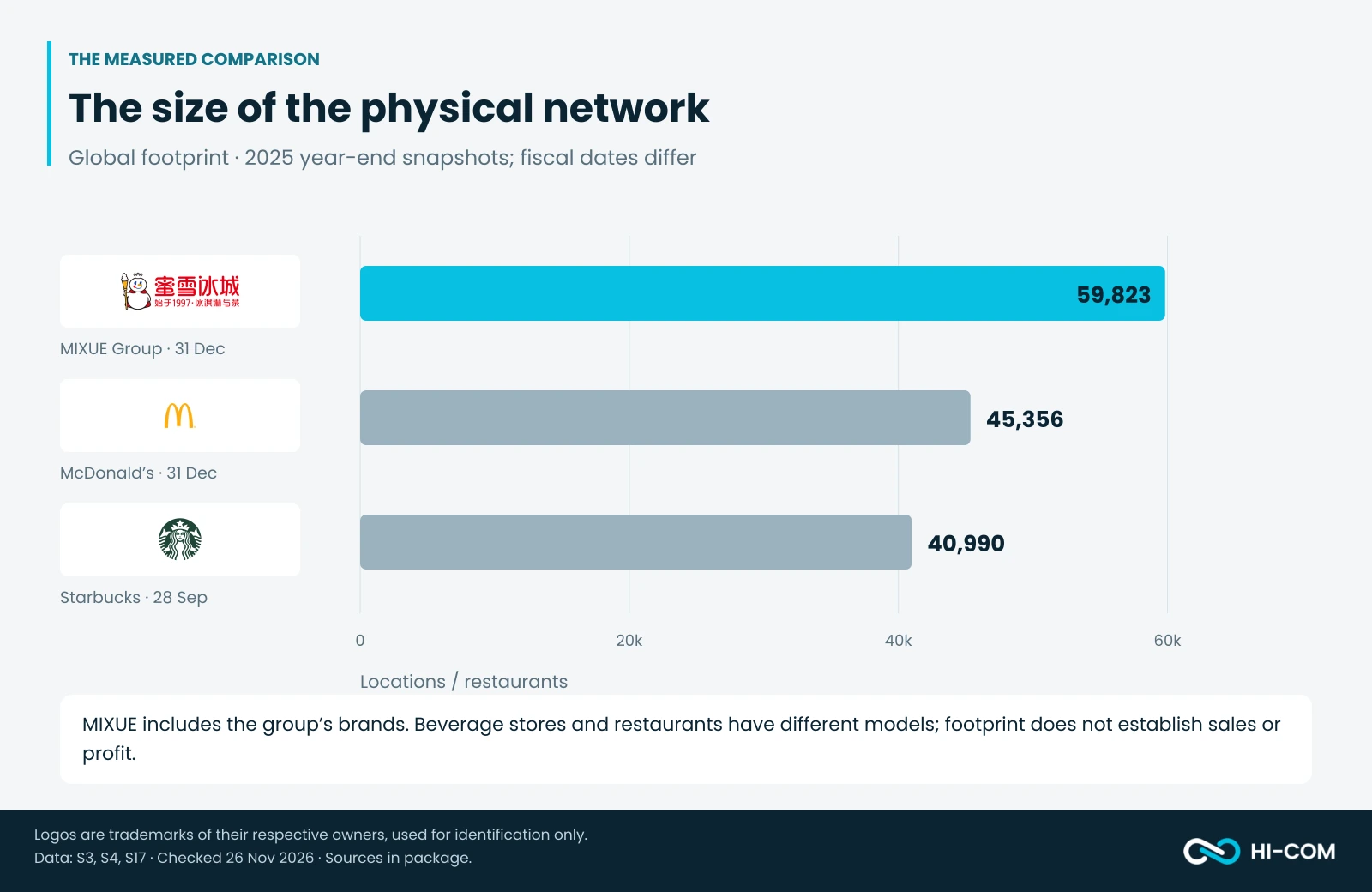
Now: at the end of 2025, Mixue Group had 59,823 outlets worldwide, more than McDonald’s (45,356 restaurants) and Starbucks (40,990 stores). Its 2025 revenue reached RMB 33.56 billion, up 35%.
How: very low prices, a franchise model and its own production and logistics, which keep costs down as the network grows across Southeast Asia and beyond.
Lesson for your brand: scale in China comes through partners. The right franchisees, distributors and suppliers matter as much as the product: see our partner and distributor search in China.
3. Luckin Coffee vs Starbucks: the coffee war
Then: Luckin was incorporated in June 2017 and went through an accounting scandal and a Nasdaq delisting in 2020.
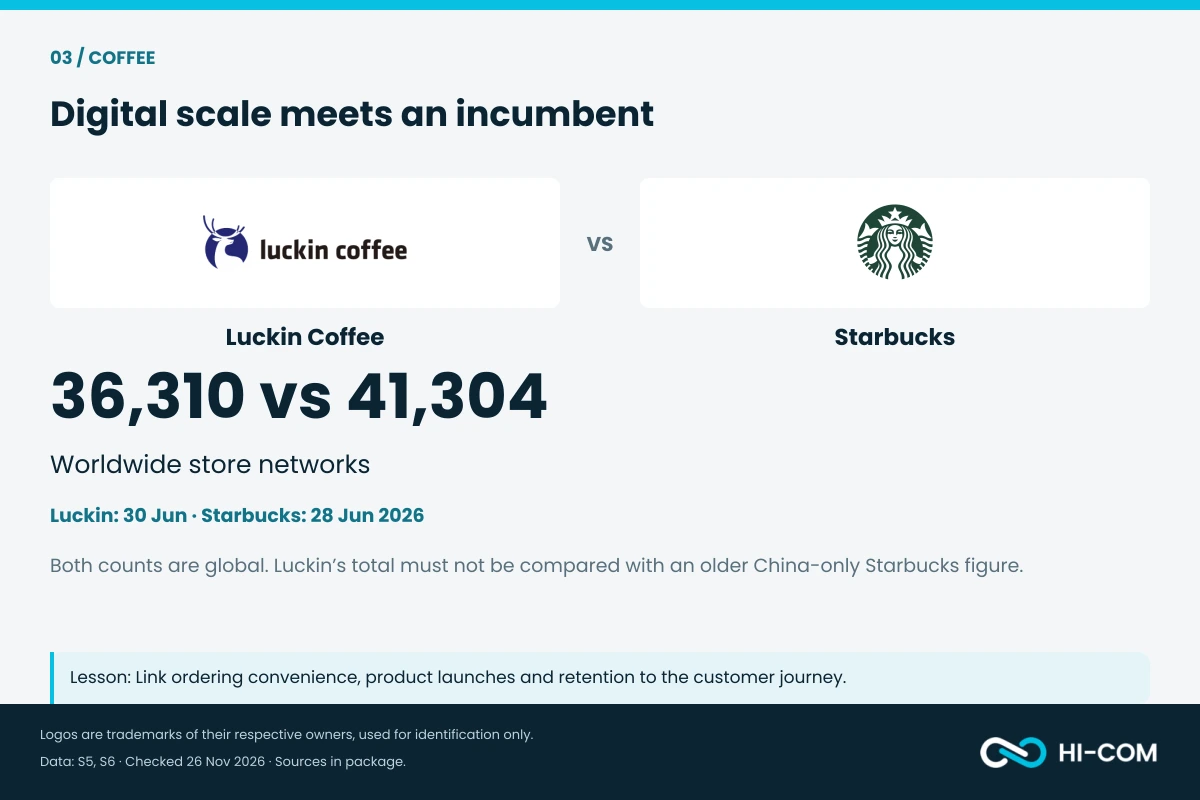
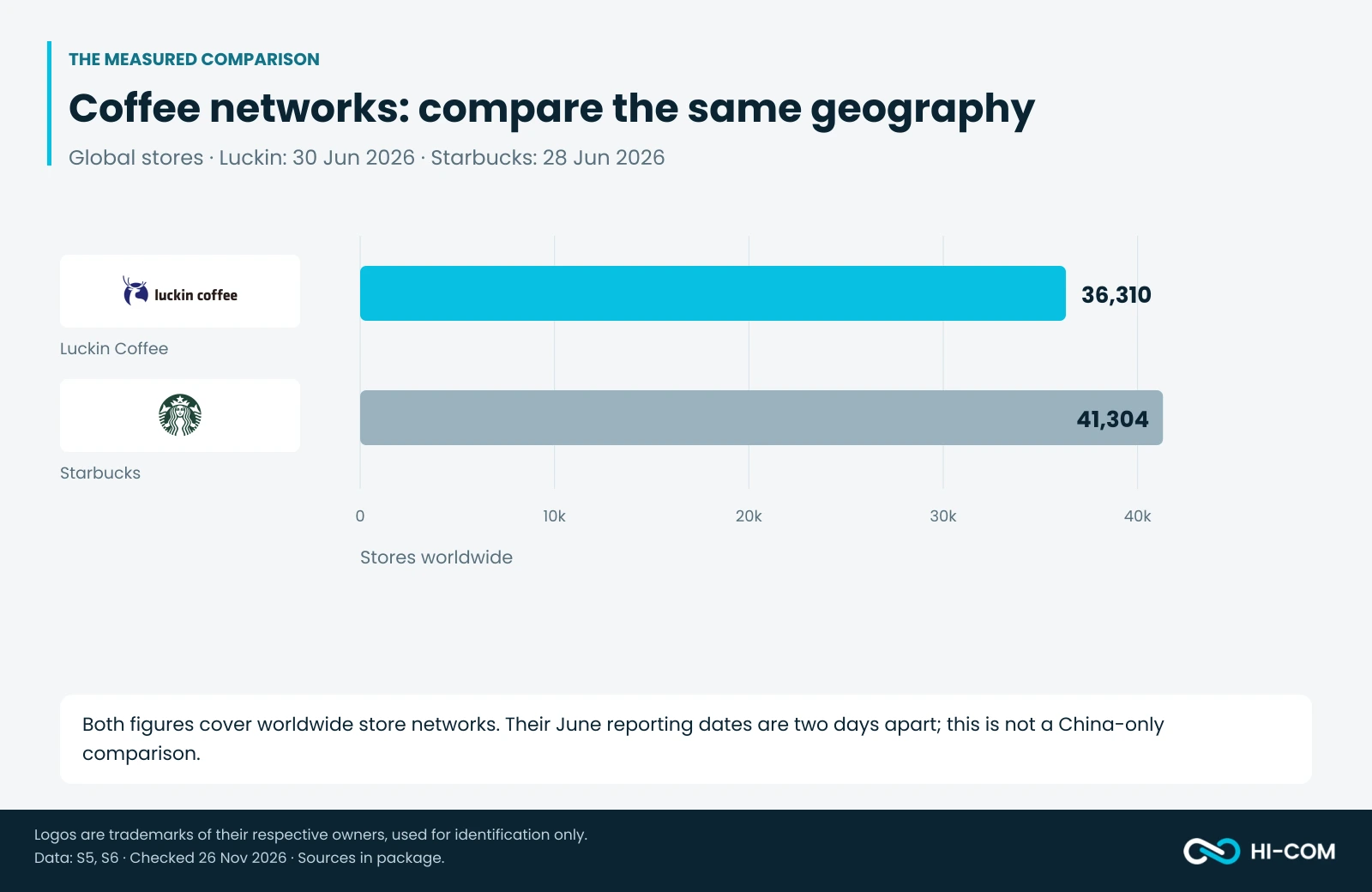
Now: Luckin had 36,310 stores worldwide at 30 June 2026, close to Starbucks’ 41,304. In China, the gap is the other way round: Starbucks, present since 1999, had about 8,011 stores when it handed 60% of its China business to Boyu Capital in a joint venture finalised in April 2026.
How: app-only ordering, small pick-up stores, daily promotions driven by data, and viral collaborations such as its 2023 latte with Moutai.
Lesson for your brand: Chinese consumers expect to order, pay and come back through their phone. Build that journey on WeChat and mini programs from day one.
4. Anta vs Nike and Adidas: sportswear
Then: Anta was a shoemaker from Jinjiang, in Fujian province, in the early 1990s.
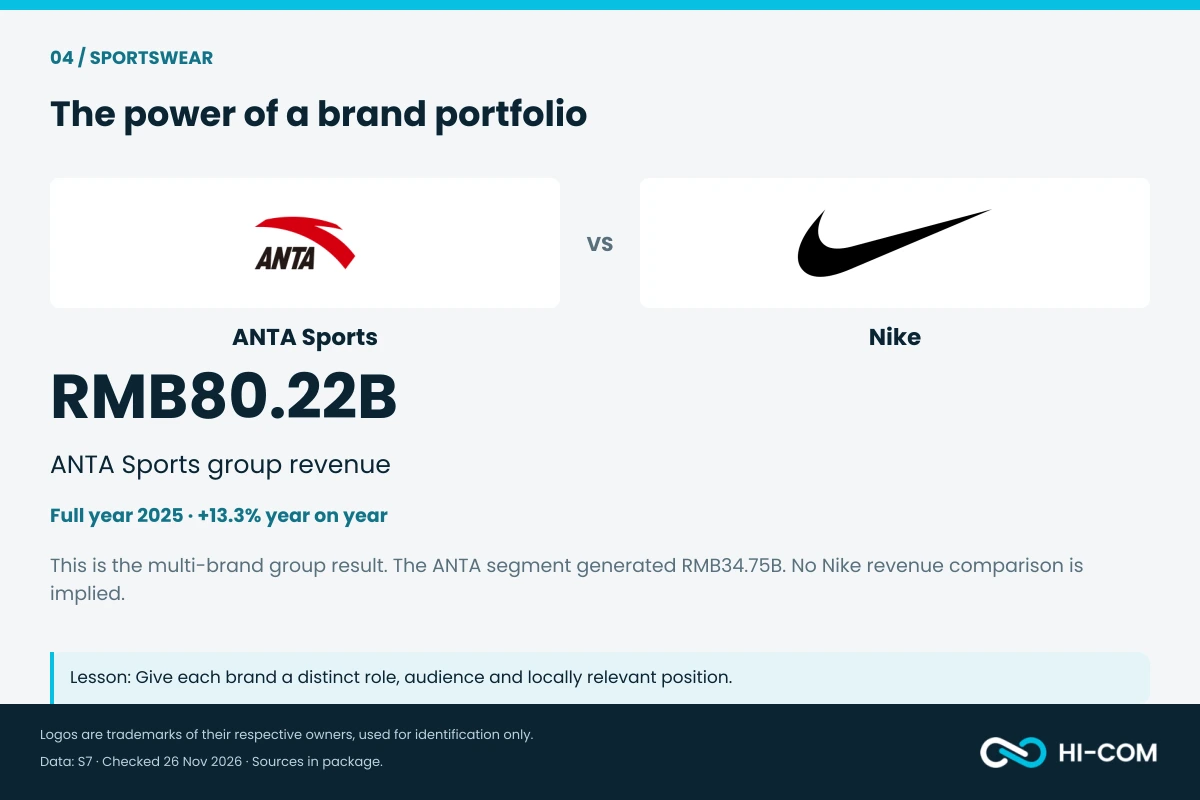
Now: the group reported RMB 80.22 billion in revenue for 2025, up 13.3%, and an estimated 21.8% share of China’s sportswear market, ahead of Nike and Adidas.
How: a portfolio of brands from mass market to premium: Anta, Fila in China, and outdoor and sports brands such as Arc’teryx and Salomon through Amer Sports.
Lesson for your brand: “foreign” is no longer a positioning on its own. Define who you are against local leaders with our China consulting team.
5. Pop Mart vs Mattel: the toy business
Then: Pop Mart opened its first store in Beijing in 2010, selling trendy gifts.
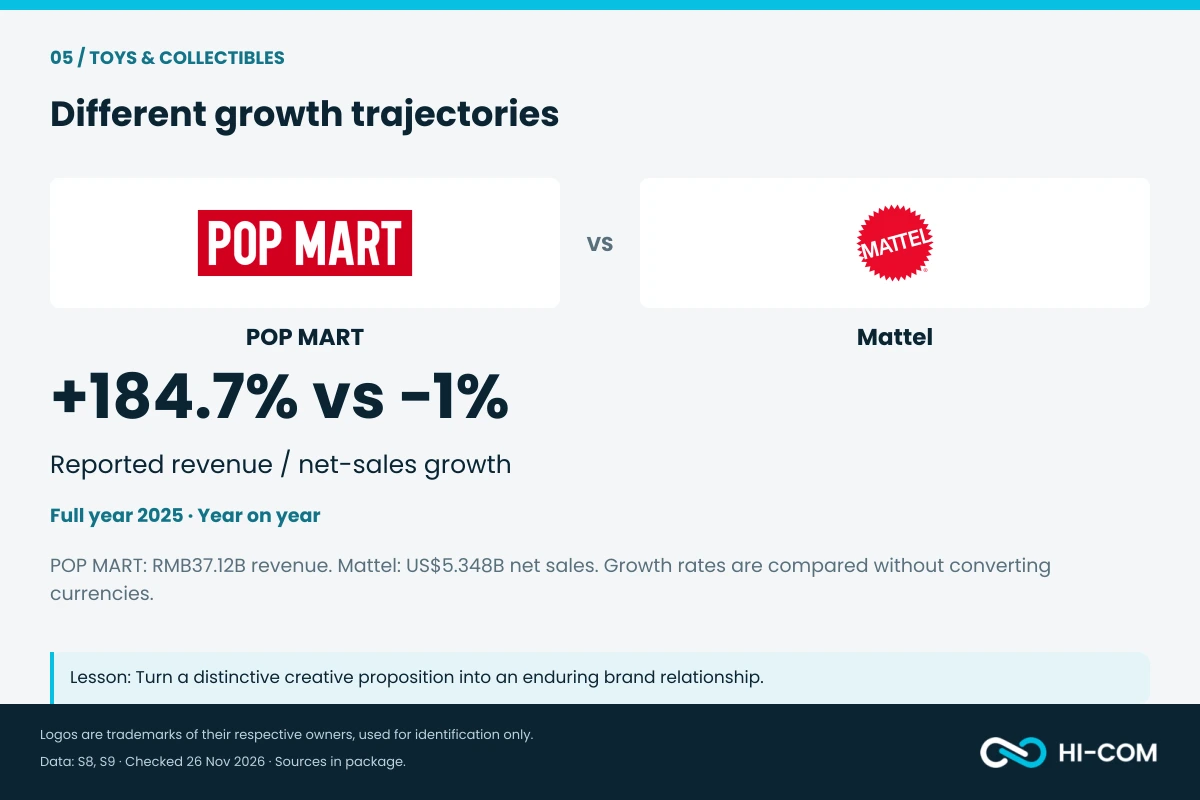
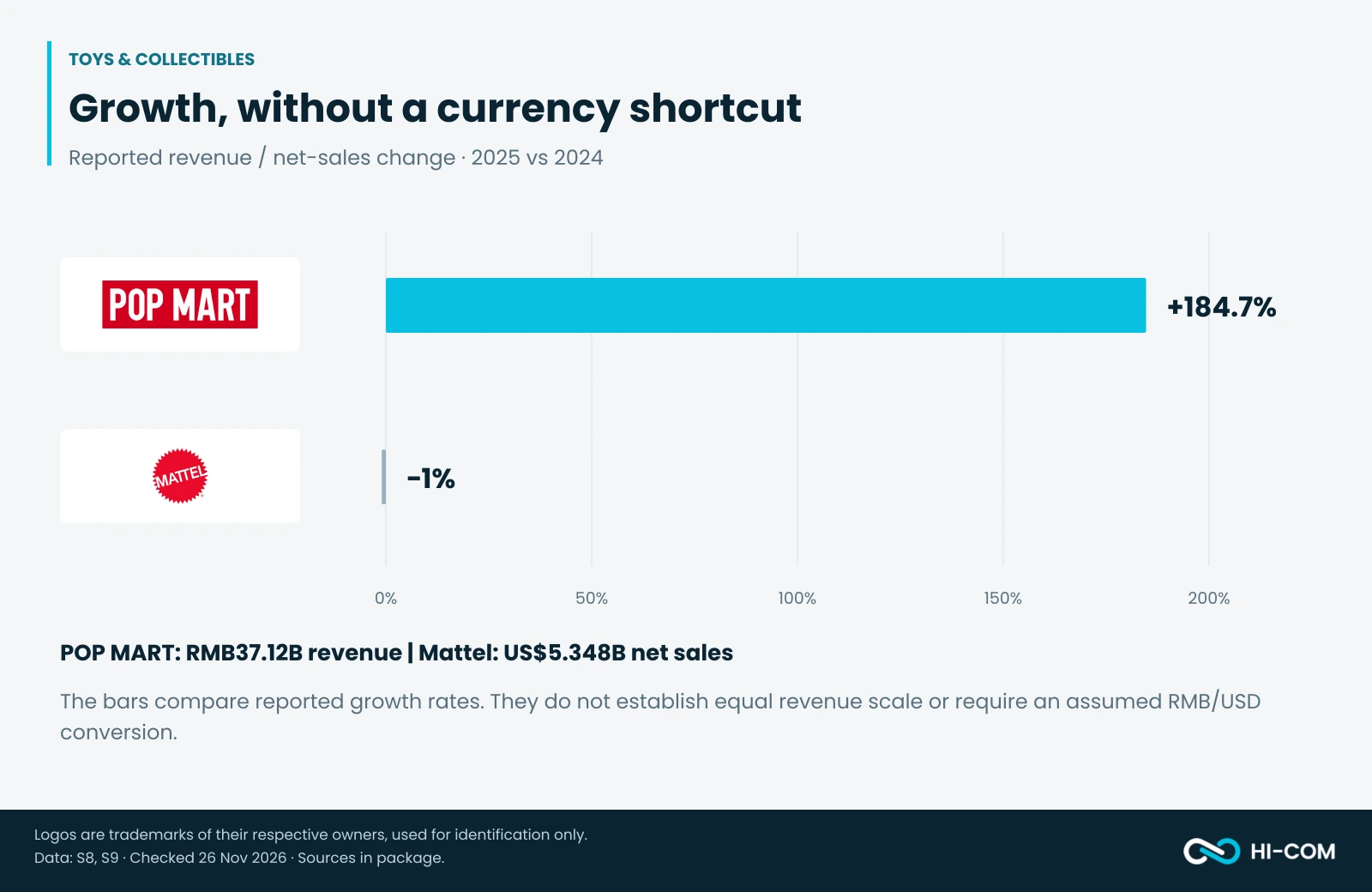
Now: its 2025 revenue rose 184.7% to RMB 37.12 billion, about US$5.2 billion at 2025’s average exchange rate, close to Mattel’s US$5.35 billion (down 1%). About 44% of Pop Mart’s revenue now comes from outside mainland China, and Labubu alone brought in RMB 14.16 billion.
How: characters it owns, blind boxes that create scarcity, and collector communities. Our Labubu marketing case study explains the playbook.
Lesson for your brand: characters, collectibles and fan communities sell in China. KOL and influencer campaigns are how they spread.
6. Proya vs L’Oréal: beauty
Then: Proya (珀莱雅) was founded in Hangzhou in 2003 and sold mainly through specialist shops.
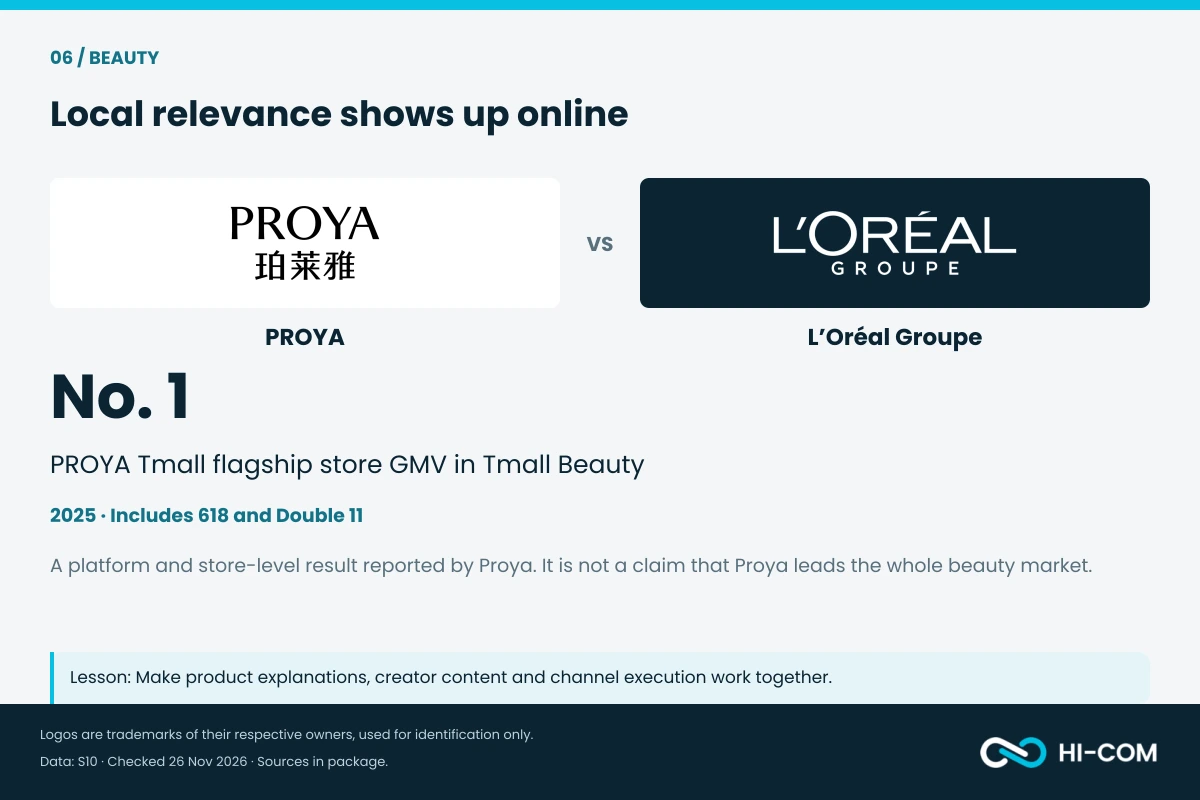
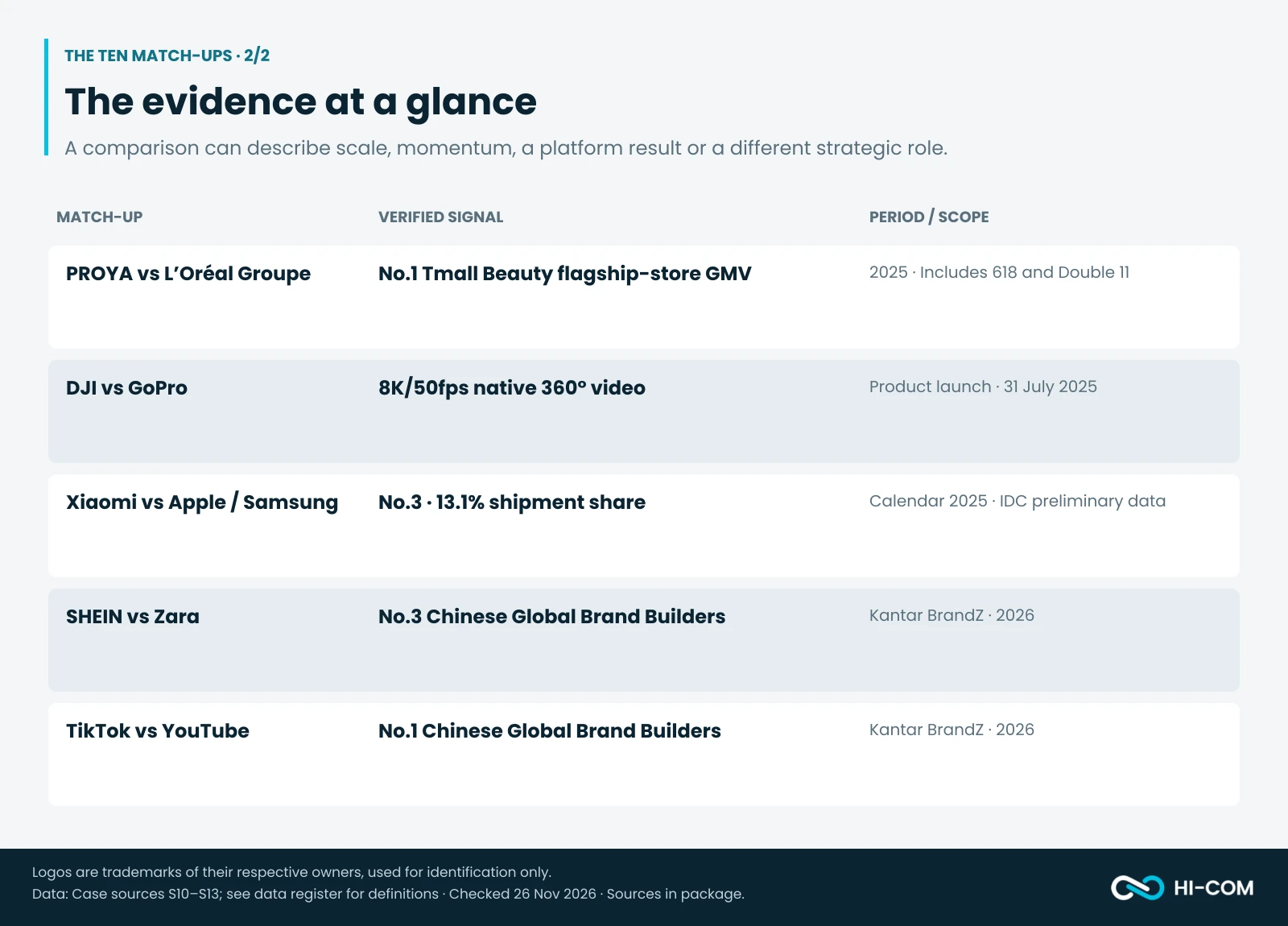
Now: in 2025 its flagship store ranked first by sales value on Tmall Beauty, and it topped Tmall’s Double 11 beauty ranking in 2023, 2024 and 2025. More broadly, Chinese brands held 57.4% of China’s cosmetics market in 2025, a market of about RMB 1.1 trillion.
How: hero serums, ingredient storytelling and heavy investment in Douyin livestreams.
Lesson for your brand: in beauty, Chinese consumers research on Xiaohongshu before they buy. Build proof there with Xiaohongshu marketing, and meet distributors at the beauty trade shows in China in 2027.
7. DJI vs GoPro, Canon and Sony: cameras
Then: DJI was founded in Shenzhen in 2006 to make flight controllers for drones.
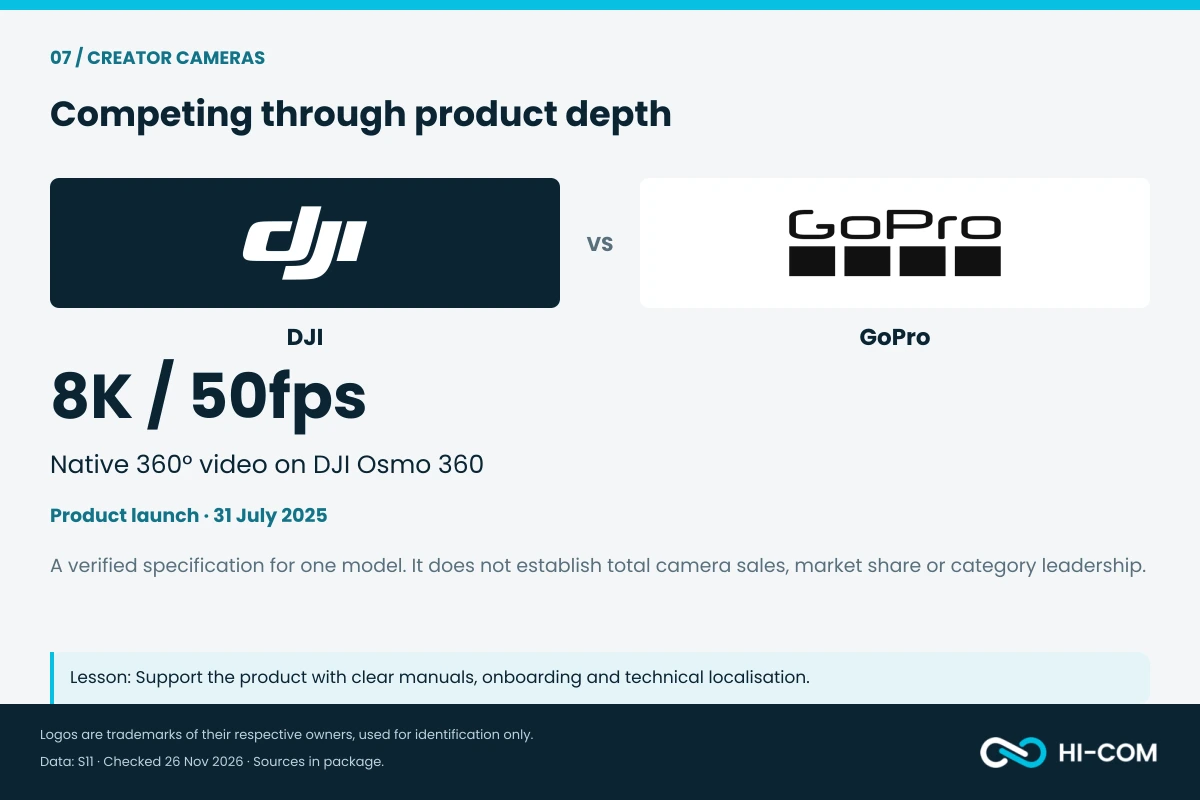
Now: DJI shipped about 10.4 million portable cameras in 2025, more than the 9.44 million cameras shipped by all members of CIPA, the Japanese camera industry association, combined. In July 2025 it launched the Osmo 360, a direct rival to GoPro and Insta360 in 360-degree video.
How: in-house R&D, and a steady move from drones to gimbals, action cameras and audio, all sold as one ecosystem.
Lesson for your brand: technical products travel with their documentation. Accurate manuals in every market language are part of the product: see our guide to user manual translation and the new EU rules for manuals in 2027.
8. Xiaomi vs Apple and Samsung: smartphones
Then: Xiaomi was founded in Beijing on 6 April 2010.
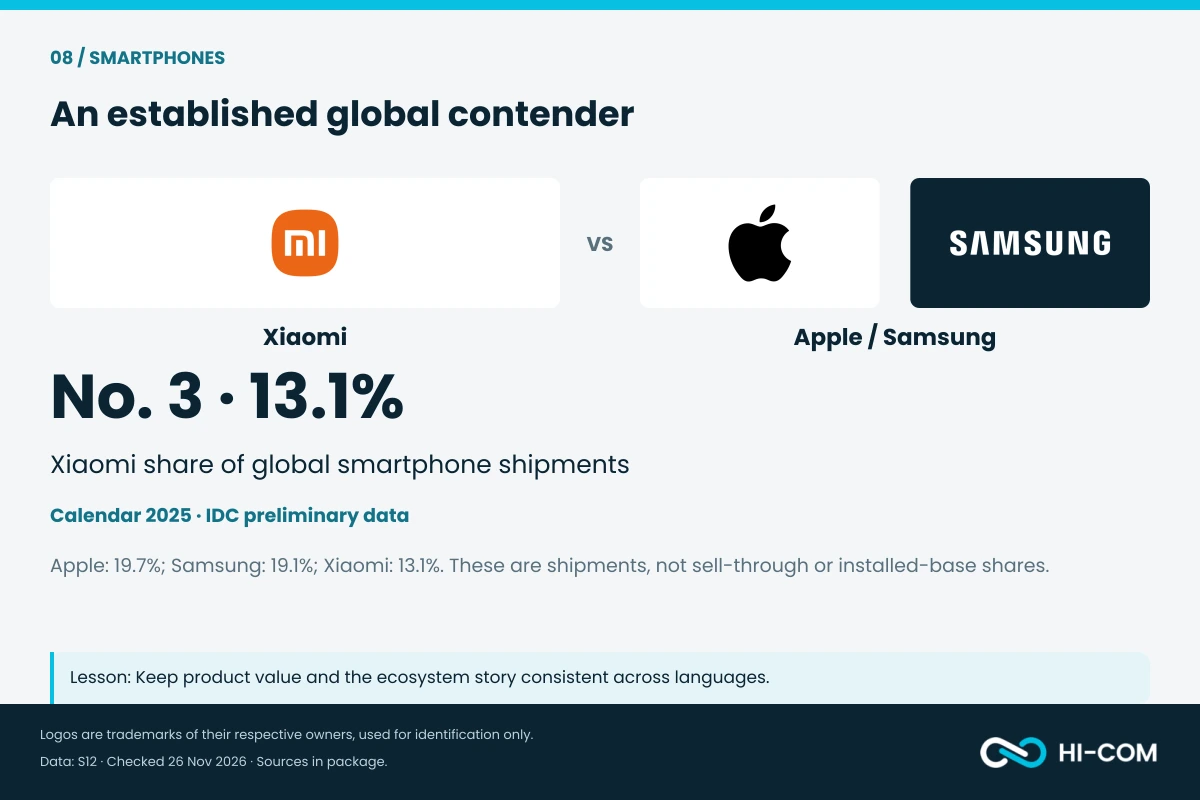
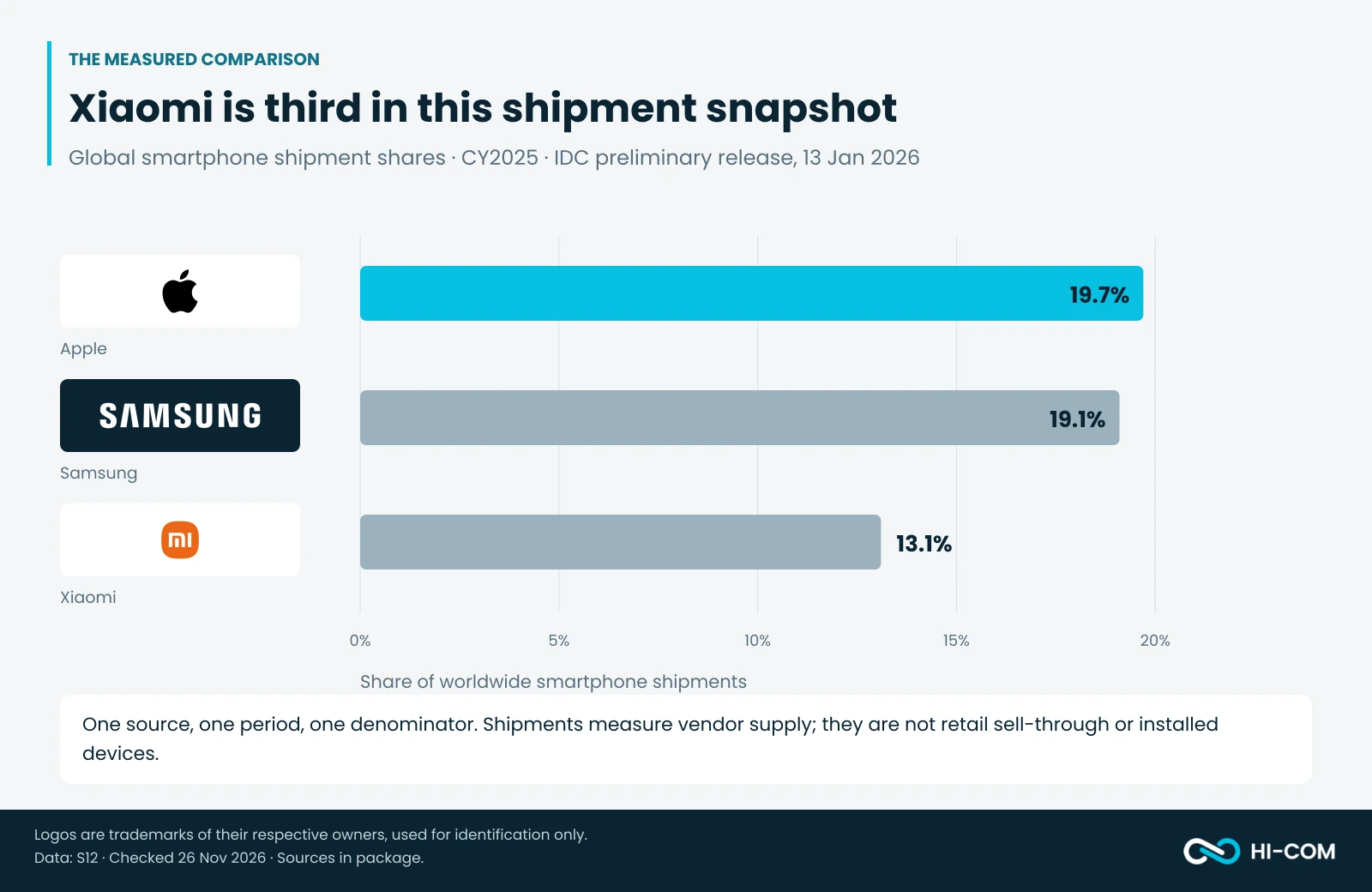
Now: it was the world’s third-largest smartphone brand in 2025, with 13.1% of shipments, behind Apple (19.7%) and Samsung (19.1%), according to IDC’s preliminary data. It ranks second among Kantar’s 2026 Chinese Global Brand Builders and has moved into electric cars.
How: strong specifications at fair prices, a fan community, and an ecosystem of connected devices around the phone.
Lesson for your brand: a global brand speaks every market’s language. Slogans, product names and campaigns need transcreation, not word-for-word translation.
9. SHEIN vs Zara and H&M: fashion
Then: SHEIN started selling clothes online in 2008.
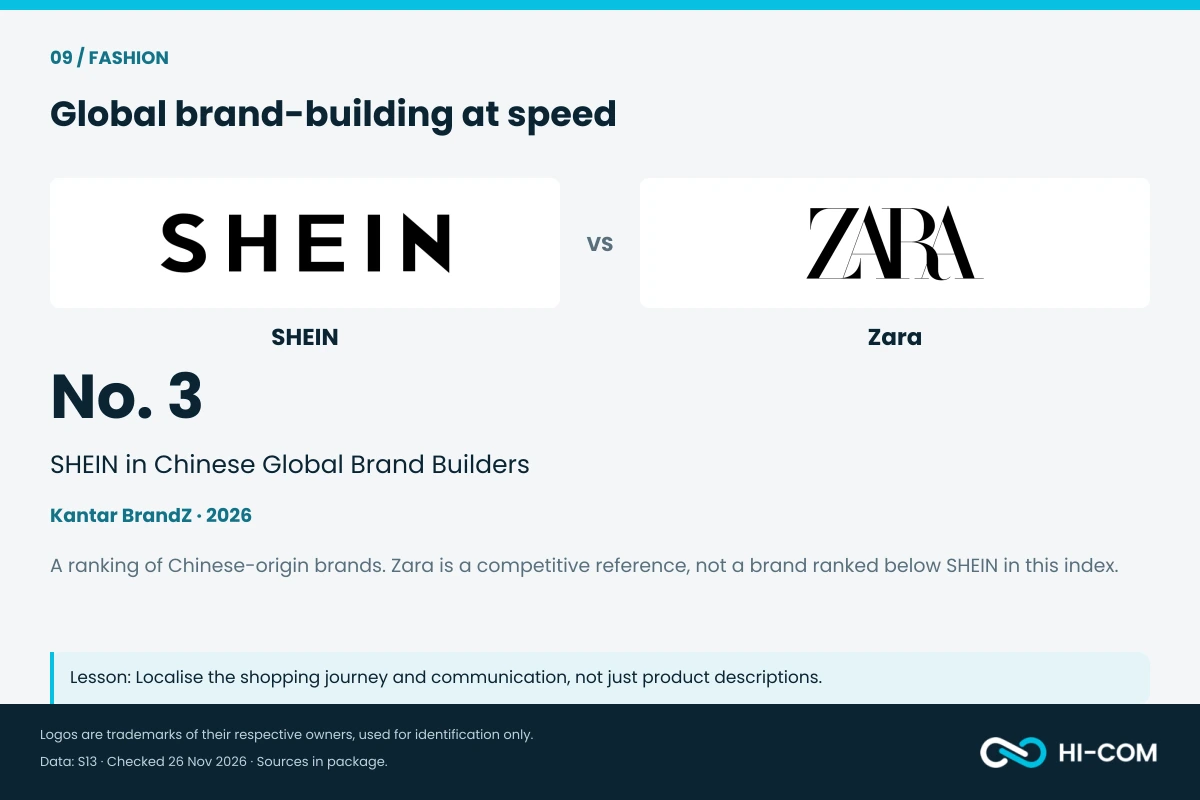
Now: it reported US$41.8 billion in revenue for 2025 (up 8%) and 273 million active customers. Europe is now its largest market, with 35.4% of revenue, ahead of the United States (24.1%). It ranks third among Kantar’s 2026 Chinese Global Brand Builders.
How: very small first production runs, real-time sales data and fast re-orders: designs that sell are produced again, the rest are dropped.
Lesson for your brand: data decides what scales. Compare the Chinese cross-border e-commerce platforms before you choose where to test.
10. TikTok vs YouTube and Instagram: social media
Then: ByteDance launched Douyin in China in 2016 and TikTok for international markets in 2017.
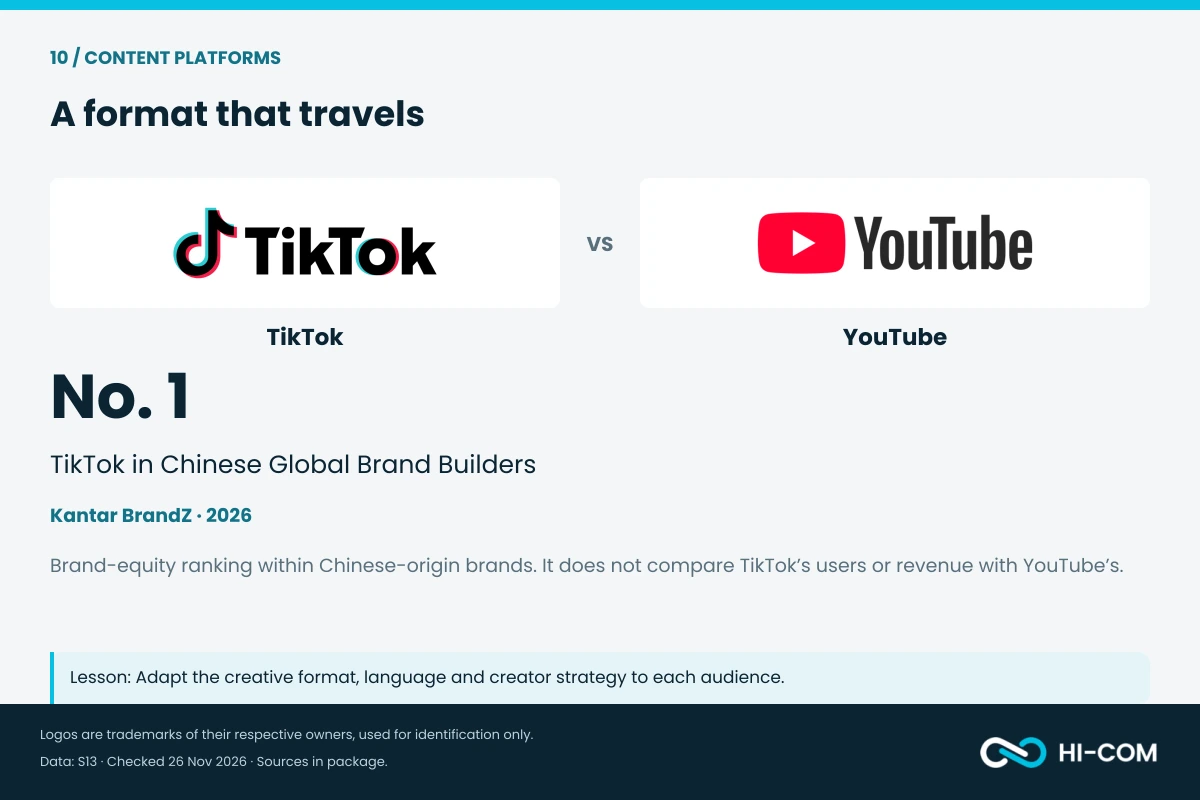
Now: TikTok ranks first among Kantar’s 2026 Chinese Global Brand Builders, and Douyin is China’s third most valuable brand at US$98 billion.
How: an algorithm that recommends videos from anyone, not only from people you follow, which made short video the default format for a generation.
Lesson for your brand: in China, the same format runs on Douyin, not TikTok. See our guide to Chinese social media platforms.
The evidence at a glance
What the 10 brands have in common
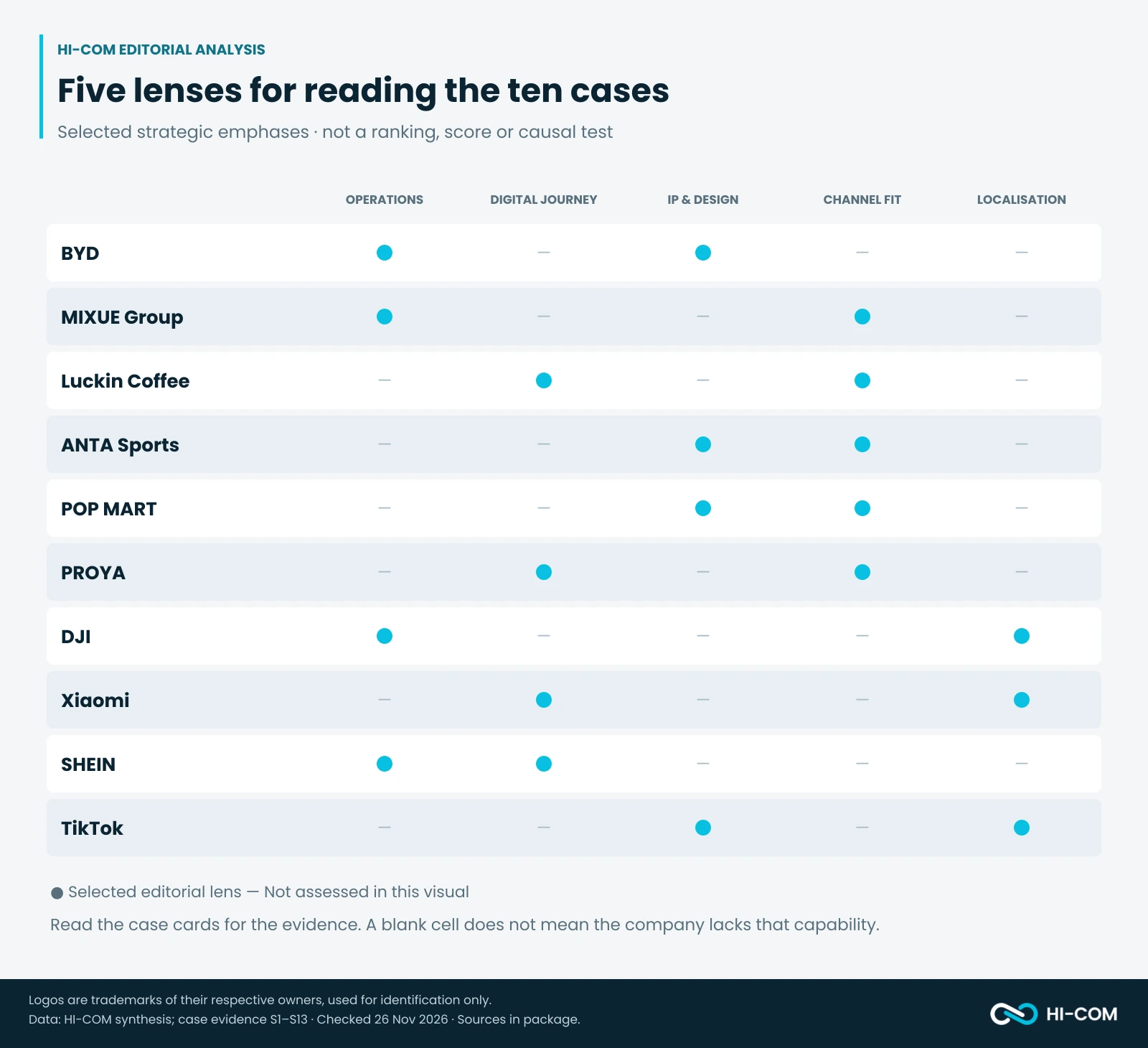
Different categories, same five levers:
- Operations: owning or tightly controlling the supply chain (BYD, Mixue, SHEIN).
- Digital journey: the app, the mini program or the feed is the store (Luckin, TikTok).
- IP and design: characters, products and aesthetics that people want to own and share (Pop Mart, DJI).
- Channel fit: being first on the channel where customers actually buy, from Tmall to Douyin livestreams (Proya, Anta).
- Localisation: adapting product, price and message to each new market (Xiaomi, Mixue, SHEIN).
None of these levers is uniquely Chinese. What is different is the speed at which they are combined.
Honourable mentions: 9 more Chinese brands to watch
- Chagee (霸王茶姬): often called the “Starbucks of tea”, it had 7,453 teahouses at the end of 2025, including 345 outside China, and RMB 31.58 billion in gross merchandise value.
- Miniso: the lifestyle retailer had 8,485 stores at the end of 2025, 3,583 of them outside China, and record revenue of RMB 21.44 billion (+26.2%).
- Bambu Lab: a Shenzhen 3D-printer maker founded by former DJI engineers, now a favourite of makers worldwide.
- Insta360: the Shenzhen 360-degree camera brand that DJI now challenges head-on.
- Anker: the charging and power brand from Changsha, a best-seller on international marketplaces.
- Haidilao: the hotpot chain known worldwide for its service rituals.
- Florasis (花西子): a make-up brand built on traditional Chinese aesthetics.
- Li-Ning: the sportswear brand that became a symbol of guochao on international catwalks.
- Songmont (山下有松): a leather-goods label leading the new wave of Chinese premium brands.
What this means for Western brands in China

Being “imported” or “European” is no longer enough to justify a higher price. Chinese consumers compare you with local brands that are fast, digital and often well designed. To compete:
- Find a real difference (heritage, expertise, quality proof) and say it in Chinese, in the formats people use. Our marketing team in Shanghai builds that strategy with you.
- Earn trust on social platforms with creators: KOL and KOC campaigns on Douyin and Xiaohongshu.
- Get your Chinese name right before you launch: it is often the first thing people see. Our brand naming service and our guide on how to choose a Chinese brand name explain the method.
- Look at what works for others: see which British brands are popular in China and why.
What this means for Chinese brands going global
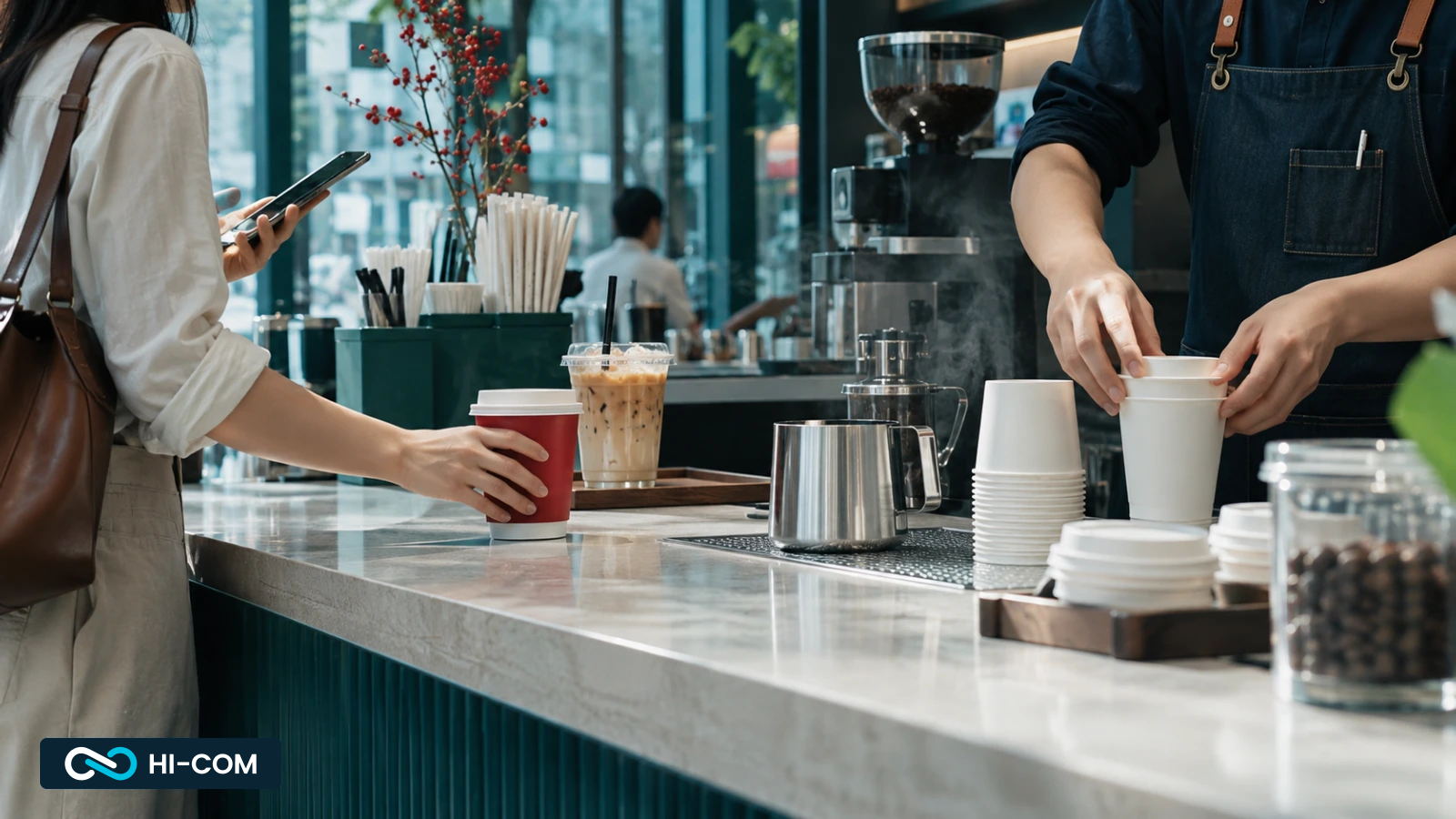
The brands above show that “Made in China” can become “loved worldwide”. The ones that succeed abroad treat localisation as part of the product, not as a last step:
- Adapt the message, not only the words: names, slogans and campaigns need transcreation. HI-COM translates from Chinese into more than 40 languages, including for Chinese game studios and authors going global.
- Get the documents right: manuals, labels, contracts and product sheets through our translation services, in the formats each market requires.
- Meet buyers and distributors in person: our interpreters support negotiations, and our China trade fairs 2027 calendar helps you plan where to meet international buyers.
FAQ
What are the most famous Chinese brands?
By brand value, the best-known are Tencent, Alibaba, Douyin and Moutai, the top four in Kantar BrandZ’s 2026 ranking. Outside China, the most visible are TikTok, Xiaomi, SHEIN, Lenovo, Huawei and Haier, the leaders of Kantar’s 2026 Chinese Global Brand Builders, along with BYD, DJI and Pop Mart.
Which Chinese brands are popular in Europe and the US?
TikTok, SHEIN, Xiaomi, DJI, Lenovo, Anker and Pop Mart (Labubu) are among the most widely used. SHEIN now earns more in Europe (35.4% of its 2025 revenue) than in the United States (24.1%).
What is the most valuable Chinese brand?
Tencent, valued at US$210 billion in the Kantar BrandZ 2026 ranking of the most valuable Chinese brands, ahead of Alibaba (US$112 billion) and Douyin (US$98 billion).
Is BYD bigger than Tesla?
In battery-electric cars, yes: in 2025 BYD sold about 2.26 million, against 1.64 million vehicles delivered by Tesla. Including plug-in hybrids, BYD sold more than 4.5 million vehicles in 2025.
What is guochao?
Guochao (国潮, “national trend” or “China chic”) is the preference of young Chinese consumers for local brands that use Chinese culture and design. Read more in our article What is guochao?
Why are Chinese brands growing so fast?
Four reasons come up again and again: speed from design to shelf, control of the supply chain, digital-first sales on apps and social commerce, and a young domestic market that is proud to buy Chinese. Together they let brands test at home, then scale abroad.
Competing with Chinese brands, or becoming one abroad?
Our Shanghai team helps Western brands stand out in China, and Chinese brands localise for new markets: strategy, marketing, KOLs, naming, translation and interpreting. Free quote within a few hours, 24 h at the latest.
Sources: Electrek (BYD and Tesla, 2025); EqualOcean (Mixue 2025 results); McDonald’s restaurants by market 2025; Starbucks Q3 FY2026 results; CKGSB (Luckin vs Starbucks); Jing Daily (Starbucks and Boyu); Anta Sports annual report 2025; Footwear Magazine (Anta market share); China Daily (Pop Mart 2025); Mattel 2025 results; Caixin Global (China beauty market 2025); People’s Daily (Proya, Double 11 2025); PetaPixel (DJI and CIPA); IDC (smartphones 2025); KrASIA (SHEIN prospectus); Modaes (SHEIN by region); Kantar BrandZ Chinese Global Brand Builders 2026; Kantar BrandZ most valuable Chinese brands 2026; Chagee 2025 results; Miniso 2025 results. Checked 26 November 2026.
All brand names and logos are the property of their owners and are used for identification only. HI-COM is not affiliated with the brands mentioned.
HI-COM Asia is a Shanghai-based consulting, marketing and translation company (ISO 17100, TAC member), with offices in Hong Kong and France, that helps Western brands compete in China and Chinese brands localise abroad.