How to Read a Chinese Company Name: Suffixes and Legal Forms
Quick answer
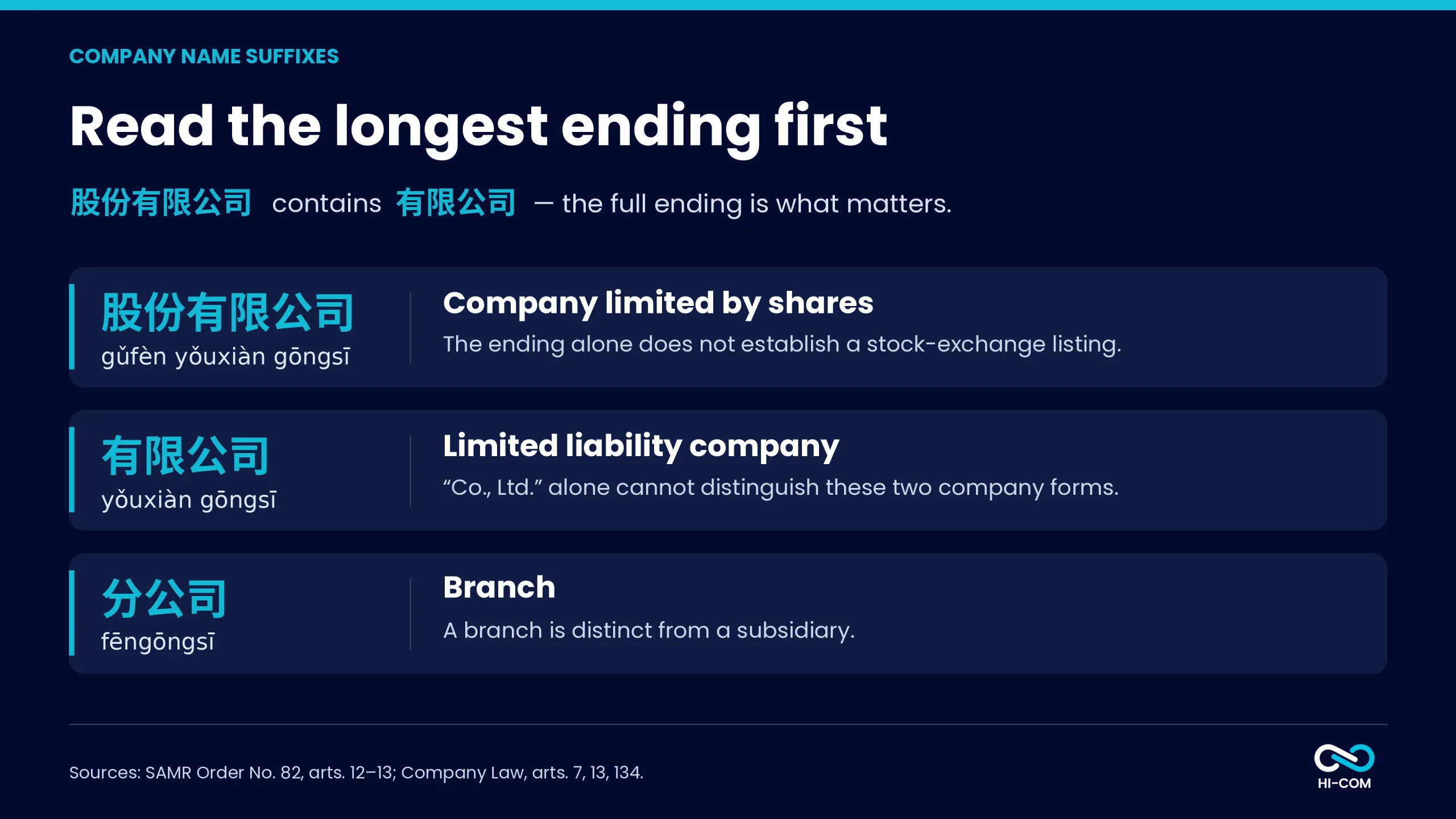
A registered Chinese enterprise name typically combines a place name, a distinctive business name, an industry descriptor and an organisational form. 有限公司 identifies a limited liability company; 股份有限公司 identifies a company limited by shares; 分公司 identifies a branch. Read the longest ending first: 股份有限公司 contains 有限公司, but the full ending is what matters.[1][2]
The name gives you a useful starting point. It cannot tell you whether a company is active, operates a factory, holds a particular licence or is the entity you are about to pay.
This guide explains names under China’s enterprise registration rules. Hong Kong has a separate naming and registration regime, discussed below.
Written by the HI-COM Asia team.
Sources checked: 4 November 2026
The Four Parts of a Chinese Company Name
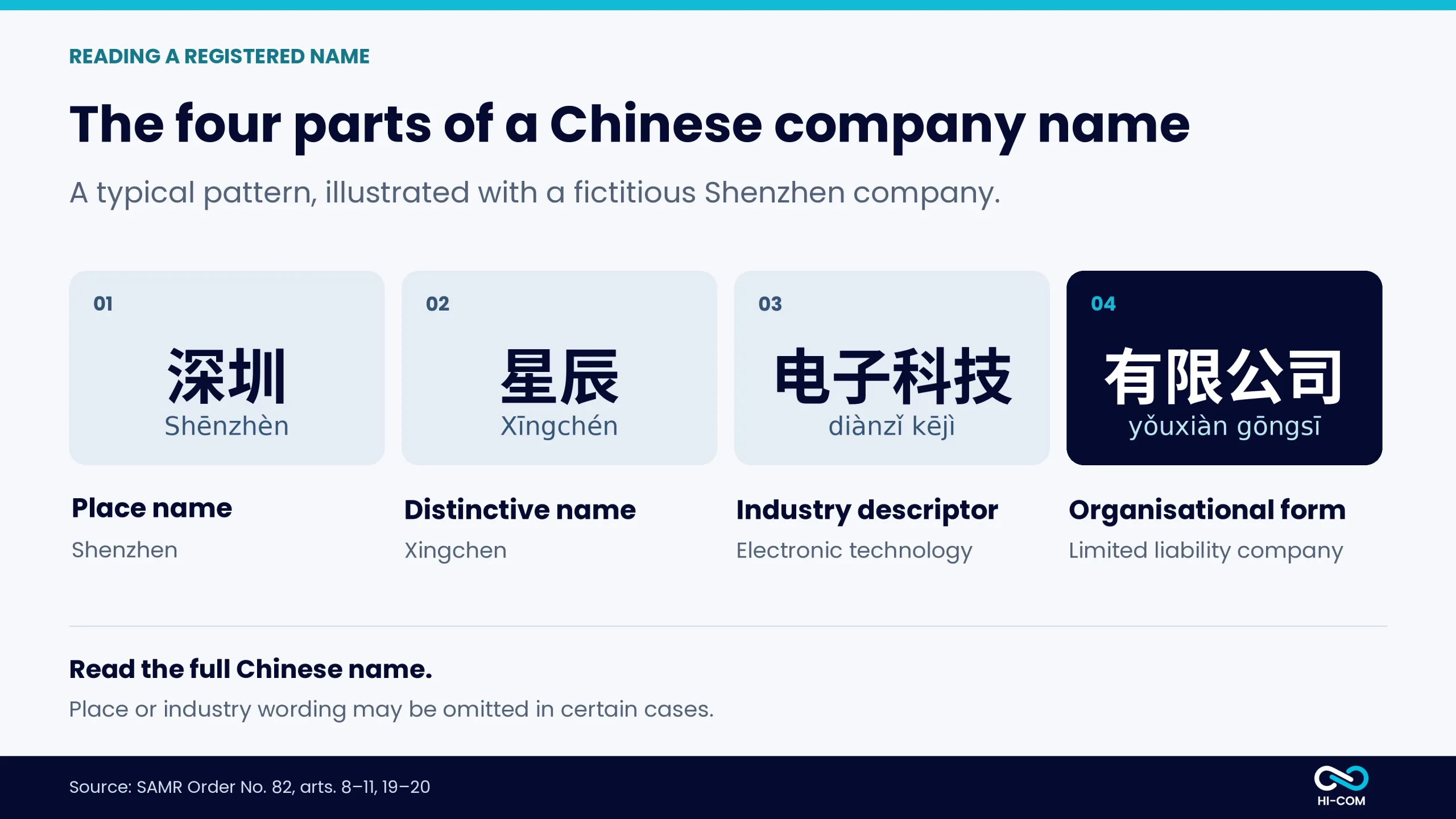
Take the constructed example 深圳星辰电子科技有限公司. It illustrates the naming pattern; it is not a claim about a particular registered business.
| Part | In the example | How to read it |
|---|---|---|
| Administrative division (行政区划) | 深圳 | Shenzhen. A location reference in the name. |
| Distinctive name (字号, zìhào) | 星辰 | Xingchen. This is the distinctive name element, which may differ from the public-facing brand. |
| Industry or business descriptor (行业或经营特点) | 电子科技 | Electronic technology. It describes the line of business at a broad level. |
| Organisational form (组织形式) | 有限公司 | Limited liability company. “Co., Ltd.” is one possible English rendering. |
An illustrative English rendering is “Shenzhen Xingchen Electronic Technology Co., Ltd.” Use the Chinese text to compare records; another English rendering could spell the same name differently.
The four-part sequence is the usual pattern. Under the SAMR measures, a place name can appear in parentheses after the distinctive name, and eligible enterprises can omit the place or industry descriptor under specified conditions. A missing city name is therefore a reason to consult the record, not a fraud indicator by itself.[1, arts. 8–11, 19–20]

Chinese Company Suffixes and Related Name Markers
The English labels are explanatory equivalents. They do not automatically map to a legal form in another jurisdiction.
| Chinese marker | Pinyin | English reading |
|---|---|---|
| 有限公司 / 有限责任公司 | yǒuxiàn gōngsī / yǒuxiàn zérèn gōngsī | Limited liability company |
| 股份有限公司 / 股份公司 | gǔfèn yǒuxiàn gōngsī / gǔfèn gōngsī | Company limited by shares |
| (普通合伙) | pǔtōng héhuǒ | General partnership |
| (特殊普通合伙) | tèshū pǔtōng héhuǒ | Special general partnership |
| (有限合伙) | yǒuxiàn héhuǒ | Limited partnership |
| (个人独资) | gèrén dúzī | Sole proprietorship |
| (个体工商户) | gètǐ gōngshānghù | Individual business household |
| 分公司 / 分厂 / 分店 | fēngōngsī / fēnchǎng / fēndiàn | Branch / branch factory / branch store |
| 集团 | jítuán | Group marker, used with an organisational form |
| 代表处 | dàibiǎochù | Representative office |
The partnership and sole-proprietorship markers are prescribed in parenthetical form. For an individual business household, Article 53 applies the marker rule when it uses a name. If a quotation or profile omits the marker, check the complete registered details rather than classifying the business from the shortened label.[1, arts. 12, 53]
有限公司 vs 股份有限公司: can “Co., Ltd.” distinguish them?
No. The two Chinese endings identify different forms under Article 7 of China’s Company Law. An English label such as “Co., Ltd.” does not reliably distinguish them. A company limited by shares may be unlisted, so 股份有限公司 alone is not evidence of a stock-exchange listing.[2, arts. 7, 134]
What does (有限合伙) mean for liability?
A limited partnership has general and limited partners. General partners bear unlimited joint and several liability for partnership debts; limited partners generally bear liability up to their subscribed contributions. Ordinary general partners generally bear unlimited joint and several liability. The special general partnership has a distinct regime for debts arising from intentional misconduct or gross negligence in professional practice. Check the entity’s form and the relevant facts before drawing conclusions about recourse.[3, arts. 2, 55–57, 61]
Branch, Subsidiary, Group and Representative Office: Four Different Readings
分公司: a branch
Compare these constructed names:
- 深圳星辰电子科技有限公司: a limited liability company.
- 深圳星辰电子科技有限公司广州分公司: the Guangzhou branch of that company.
- 广州星辰电子科技有限公司: a company-form name. Shared wording alone does not establish any relationship with the Shenzhen company.
A branch name incorporates the name of the enterprise it belongs to and a branch marker. Location or industry wording can be omitted where it matches the enterprise. Under the Company Law, a branch lacks separate legal personality and the company bears its civil liabilities. A subsidiary, by contrast, has its own legal personality. For a proposed deal, establish which unit is identified in the documents and how its authority is documented.[1, art. 13][2, art. 13]
集团: a group marker
For a registered enterprise legal person using 集团 or (集团) in its own name under Article 17, the rule refers to controlling shareholdings in at least three enterprise legal persons. Article 18 separately allows authorised subsidiaries or investee companies to prefix their names with the group name. The group parent must disclose the group name and member information through NECIPS.[1, arts. 17–18, 52]
Read the full legal name: 集团 neither tells you the size of the business nor establishes that the group parent has guaranteed the obligations of the entity named in your contract.
代表处: a representative office
A registered foreign enterprise representative office’s name identifies the foreign enterprise’s nationality, Chinese name, host city and office designation. The office has no separate legal personality. Its permitted activities include research, promotion and liaison; profit-making activity is generally prohibited, subject to the treaty exception in the regulation. If an office is arranging a sale, clarify which entity will actually contract, deliver and invoice.[4, arts. 2, 10, 13–14]
What Industry Words Tell You About a Supplier
| Chinese | Pinyin | Typical reading |
|---|---|---|
| 贸易 / 商贸 | màoyì / shāngmào | Trading / commerce |
| 进出口 | jìnchūkǒu | Import and export |
| 制造 | zhìzào | Manufacturing |
| 科技 | kējì | Technology |
| 实业 | shíyè | Industrial or commercial enterprise wording |
| 供应链 | gōngyìngliàn | Supply chain |
| 咨询 | zīxún | Consulting |
Suppose a seller with 贸易 in its name says it runs a factory. Ask for the full registered name of the factory operator and how it relates to the seller. Ask the same question if the seller uses 制造 in its name. A registered business scope (经营范围) helps explain what is recorded, but does not demonstrate production capacity, current permissions or that a particular site belongs to the seller. Our guide to legal safeguards when working with Chinese suppliers covers the wider checks.
Is the English Name the Registered Name?
An English name can be the company’s chosen translation or commercial label. For an enterprise under the rules described here, use the name as printed on its Chinese business licence when identifying it in legal documents, as explained in our guide on how to sign a contract with a Chinese company. If English wording is needed, keep it alongside the exact registered Chinese text. For a bank transfer, confirm the actual beneficiary name and payment instructions separately; do not substitute a name you have translated yourself.[1]
Hong Kong is a separate register. A Hong Kong company may register an English name, a Chinese name or both, and 有限公司 also appears in Hong Kong company names. Establish the jurisdiction before deciding which registry to search.[5]
From Reading the Name to Checking the Record
Ask for the full Chinese name under 名称 and the Unified Social Credit Code on the business licence. Compare both against the current public record using the HI-COM guide to looking up a company in NECIPS. If two documents name different entities, ask how each one fits the transaction. A shared brand or similar English spelling cannot resolve that mismatch.
If you are comparing prospective suppliers or distributors, HI-COM’s Shanghai team can help with partner search and screening in China.
Received a company name, invoice or bank details from a Chinese partner?
HI-COM Partner Insight compares the details you supply and flags inconsistencies before you pay. Official registration status and background records require a separate lookup or review.
Add HI-COM as a preferred source on Google
Sources
- State Administration for Market Regulation (SAMR), Implementing Measures for the Administration of Enterprise Name Registration, Order No. 82, effective 1 October 2023. Arts. 8–13, 17–20, 52–53 and provisions on enterprise name use.
- Company Law of the People’s Republic of China, 2023 revision, effective 1 July 2024. Arts. 7, 13 and 134.
- Partnership Enterprise Law of the People’s Republic of China. Arts. 2, 55–57 and 61.
- Regulations on the Administration of Registration of Resident Representative Offices of Foreign Enterprises. Arts. 2, 10, 13–14.
- Hong Kong Companies Registry, Guideline on Registration of Company Names for Hong Kong Companies.
Cover and infographics: original HI-COM illustrations. Company names in this guide are constructed examples, not registered businesses. English equivalents are editorial explanations, not certified translations.