


Ensuring Trust and Accuracy in Today’s Globalized Age of Automated Translation
As individuals relocate around the world for employment, education, family, retirement, or simply for a change of scenery, it’s essential that their administrative documents fit with where they plan to go, and what they plan to do. Accurate and well-presented translations, whether they be certified, sworn, or notarized, are crucial for having passports, diplomas, medical files, and legal agreements processed and validated in other countries. Such requirements are currently creating a large demand, and contrary to what some may believe about the industry, recent data indicates that translation is actually one of the fastest-growing professional service sectors worldwide.

Last year, leading international market research, consulting, and advisory firm Nimdzi Insights performed a major market analysis, reporting that the global language services industry is currently valued at 65 billion Dollars, and that it will continue to grow steadily in the years to come. A large part of this growth can be attributed to international migration, the ability to work remotely while traveling to different countries, and the ever-growing activity of cross-border ecommerce. Therefore, as people relocate in greater numbers, more companies expand, and governments become more stringent on their entry requirements, the need for certified translations is constantly increasing.
Translation is not just about words; it’s about trust. When you submit an official document to an immigration office or court, the accuracy of a single word can drastically change the outcome. That’s why certified human translation is essential, even today when machine translation tools are widely available.
Why Certified Human Translation Still Matters
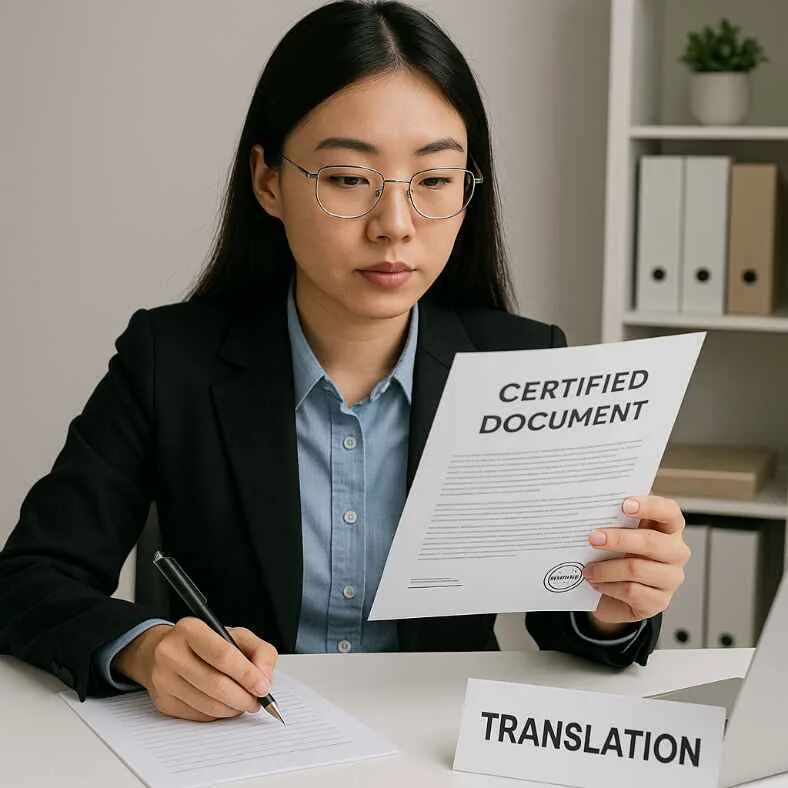
There is no denying that machine translation is extremely useful. Using tools such as Google Translate or AI tools to understand menus in other languages, browse articles, or chat with people around the world, has become commonplace. However, when documents are used for legal purposes, personal identity, or business risk, automatic translations are still some way away from offering a complete solution.
Let’s look at the examples below:
- For immigration applications, a sworn or notarized translation of birth certificates, marriage licenses, or police clearances is often required.
- Schools, universities and workplaces often demand precise translations of diplomas and transcripts before considering candidates from other countries.
- Courts and notaries may only accept certified or sworn translators for legal documents.
- Healthcare systems need accurate patient records to prevent serious misunderstandings.
Studies in the US and in Europe in 2022 and 2023 respectively revealed that over 72% of government agencies in the U.S. require sworn translations for official documents, and that the European Union reported that requests for certified translations related to migration had doubled in the previous five years.
The Growing Needs of Expats and International Students

An often-overlooked group driving the demand for professional translation services is expats. In 2023, the United Nations estimated that 281 million people live outside their country of origin. Whether relocating for work, education, or family reunion, these individuals often need translations for visa applications, rental agreements, job contracts, and financial documents.
For example, in China, there are approximately 845,000 foreign nationals holding valid residence permits on the mainland. Many need certified translations for residence permits, health records, or local business registrations. International students account for 2% of total university enrollment, and while that percentage may not seem very high, that’s still 492,000 students, making diploma and transcript translation requirements very common.
As one China-based relocation consultant said in a recent industry survey:
“Every expat family that comes to us has a folder full of documentation that needs to be translated by a certified professional. Sometimes, it’s not even possible to open a Chinese bank account without the translation of certain documents.”
Professional online translation services have come to the rescue on many occasions. By digitizing the entire process (document uploads, certified translator assignments, and electronic delivery) expats no longer have to search for local translators every time they set foot inside a new country. Platforms offering verified human translations online save them time, money, and uncertainty.
Convenience and Flexibility of Online Platforms

Self-service online platforms have become the preferred choice for individuals and businesses. According to a report released by CSA Research in 2023, nearly 60% of buyers prefer ordering translation services online instead of visiting physical offices. The main reasons are as follows:
Speed: Documents can be uploaded instantly, and quotes can be generated within minutes. Also, in China, translation agency representatives are often available to chat on messaging apps such as WeChat, and you can even send your digital copies to them directly on the platform for an instant quote.
- Accessibility: You will have access to a translator wherever you may be in the world, no matter how remote your location is.
- Security: Many online platforms now use encrypted file transfers and password-protected cloud storage.
- Flexibility: Customers can request sworn, notarized, or standard translations in multiple languages through one single portal.
In one recent case, one of our clients, who is now based in France said; “I moved from China and needed sworn translations of my diplomas for a job application in France. I uploaded the files at night, and by the next morning, a legally recognized sworn translator was already assigned. The process was smoother than I ever expected.”
Increasing Business and Legal Demands
And it’s not just individuals requiring such services. Companies expanding internationally, particularly those setting up companies in China are also driving demand. Contracts, compliance documents, financial statements, and intellectual property filings require accurate and professional translation. A small mistake in wording can lead to disputes worth millions.
According to Slator’s 2024 market report, corporate legal and financial translation is among the fastest-growing segments of the industry, accounting for nearly 30% of revenues. This growth relates to globalization, stricter regulations, and cross-border trade.
For example, as more businesses in Asia enter European markets, legal documents must be submitted in official EU languages. International arbitration cases, which are already on the rise, depend on multilingual contracts and evidence.
“Legal translation is one of the few areas where precision is non-negotiable,” notes a partner at a Shanghai law firm. “Courts and regulators do not accept machine translations, and they won’t excuse mistakes.”
Going forward
Industry analysts predict that the demand for translation will keep rising over the next decade. This will be driven by the following three key factors:
- Global Mobility: As international migration increases, the need for certified document translations will follow.
- Education and Research: Universities are expanding international programs, which raises the demand for academic translations.
- Digital Trade: As more businesses sell globally, product manuals, contracts, and terms of service require multilingual accuracy.
In this climate, professional online translation services have positioned themselves as both reliable and accessible. They combine the expertise needed for accuracy with the convenience of a digital platform.
At HI-COM, we believe that technology’s true role in our industry is to support human translators, and not replace them. The future of translation will lie in combining speed and accessibility with professional-level quality.