

Gaokao in China: The Exam That Stops a Country
Every June, China enters a very particular kind of silence.
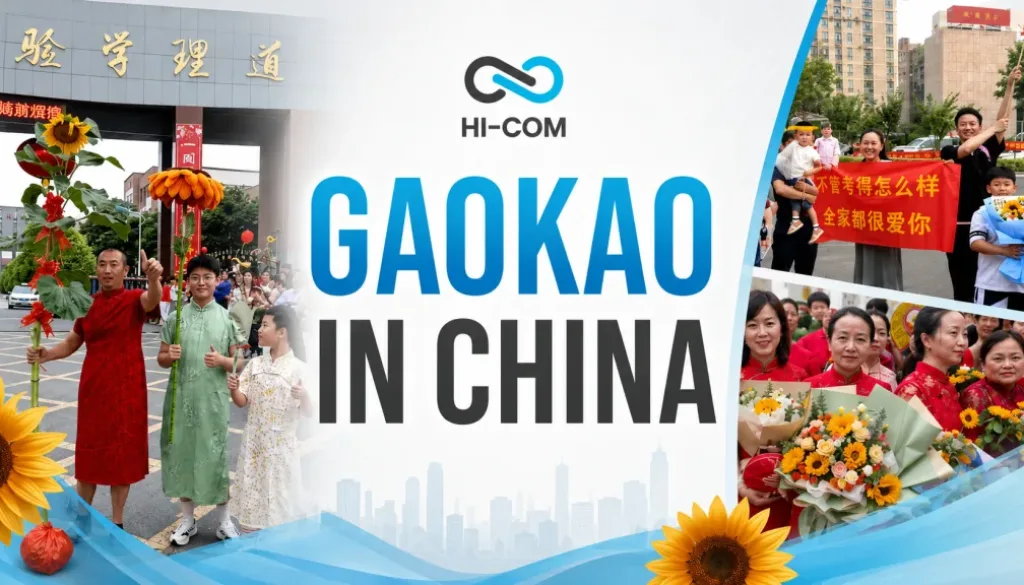
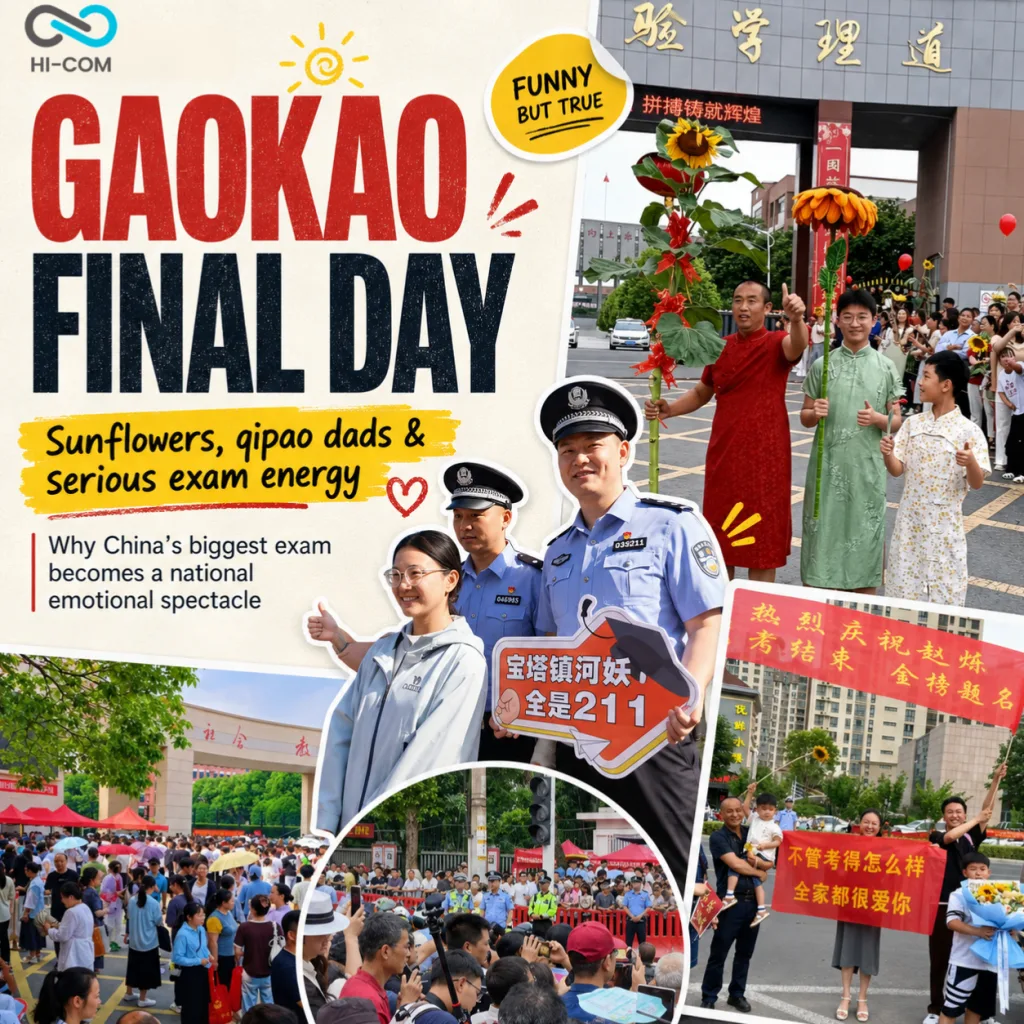
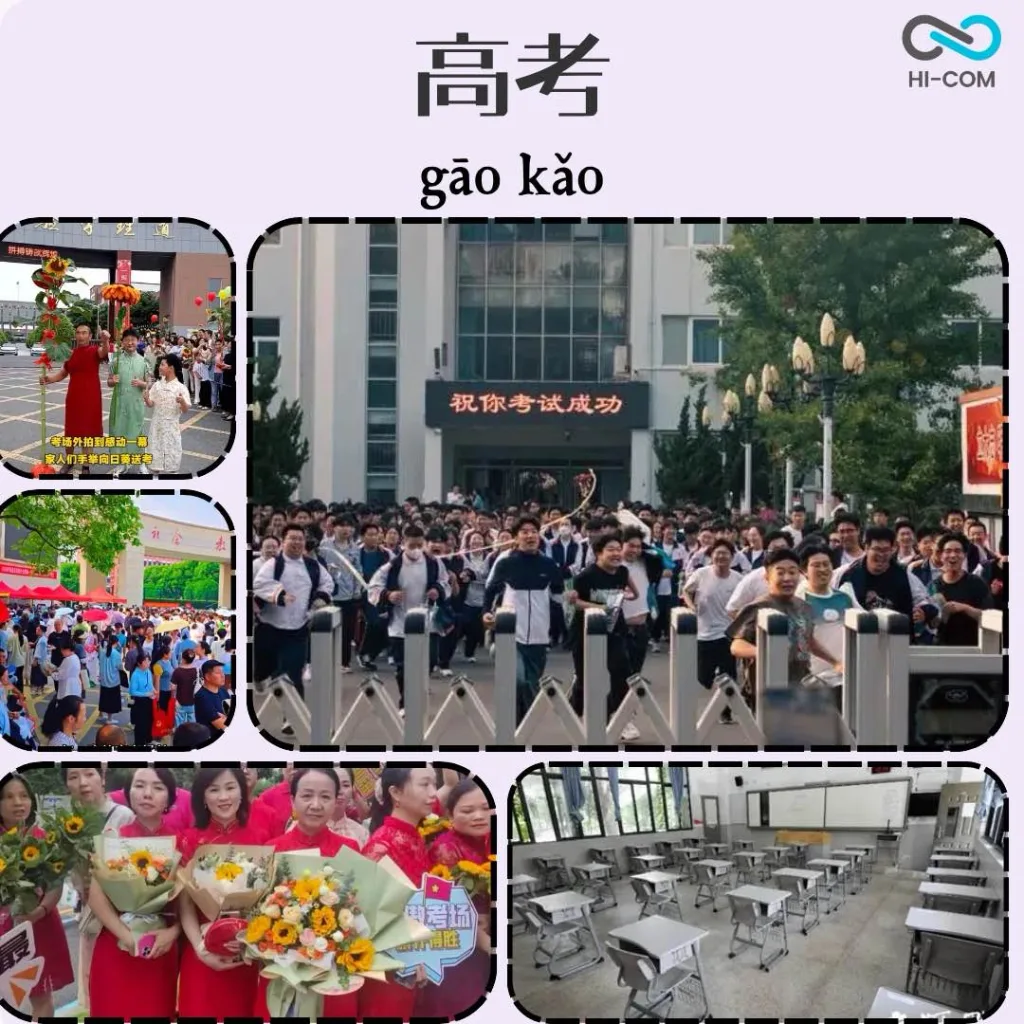
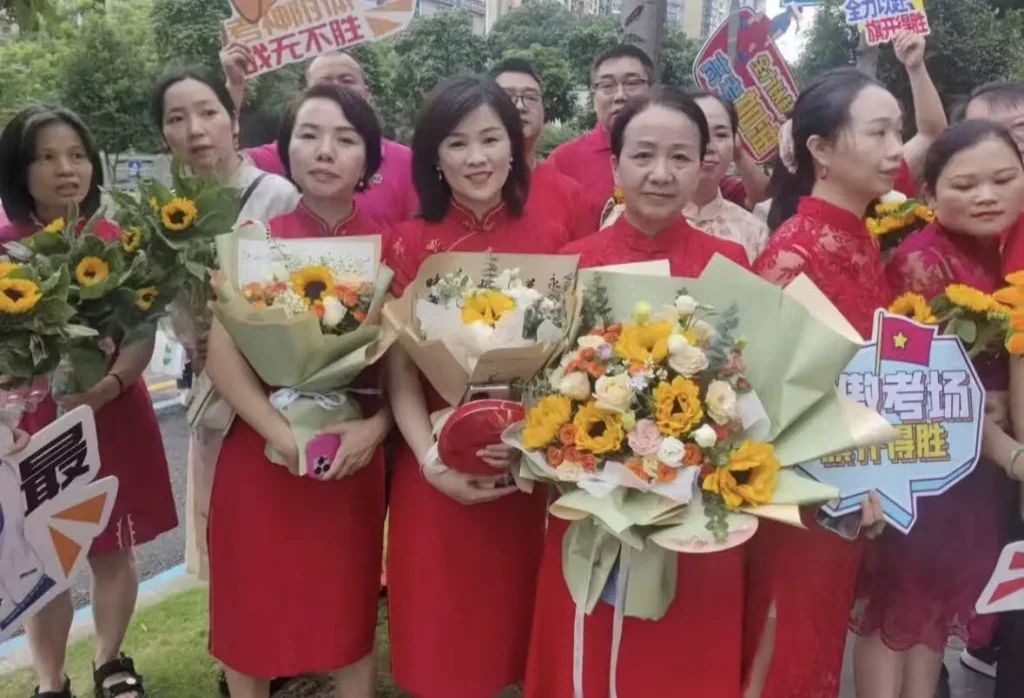
Construction is paused near exam sites. Traffic is controlled. Parents wait outside school gates with water bottles, lucky charms and nervous smiles. Some mothers wear a qipao. Others hold sunflowers. Across the country, millions of teenagers sit for the Gaokao (or 高考) China’s national college entrance examination.
For foreign audiences, the Gaokao is often described as “China’s SAT”. However, this comparison does not go far enough. The Gaokao is not just an exam. It is a national ritual, a family milestone, a social mobility mechanism and, for many students, the most important academic event of their lives.
In 2026, around 12.9 million students registered for the Gaokao, according to China’s Ministry of Education. The figure was slightly lower than the previous year, but the exam remains one of the largest and most intense standardized tests in the world.
What is the Gaokao?
The word Gaokao comes from 普通高等学校招生全国统一考试, usually translated as the National College Entrance Examination. It is the main exam used for admission to Chinese universities.
For most Chinese students, the Gaokao result plays a decisive role in determining which university they can attend. Unlike many Western admissions systems, which may consider essays, interviews, recommendation letters, extracurricular activities and school grades, the Chinese system is still highly exam-centered.
This is why the Gaokao carries so much emotional weight. One score can influence a student’s university, city, network, career path and family expectations.
How does the Gaokao work?
The exact format can vary by province, but the core structure usually includes Chinese, mathematics and a foreign language, often English. Students then take additional subjects depending on their track, such as physics, chemistry and biology, or history, geography and politics.
In many systems, the total score is based on 750 points, with core subjects such as Chinese, mathematics and foreign language carrying 150 points each. Other selected subjects make up the remaining score, depending on the province and exam model.
The exam usually takes place over two to four days, depending on local arrangements and subject choices. In 2026, it was reported that the test would last two to four days depending on the subjects chosen.
After the exam, students enter the next stressful stage: 志愿填报 (zhìyuàn tiánbào), the process of submitting university preferences. Admission is based on the score, provincial quotas, university requirements and the student’s ranked choices.
Why one point can change everything
One of the most important things to understand about the Gaokao is that it is not only about difficulty. It is about ranking.
Student voice: “Gaokao isn’t inherently difficult. I would say it’s hyper competitive and excruciatingly stressful. Even one or two points could mean drastically different placements for a student.”
Another student voice: “The actual difficulty of Gaokao is not so relevant because it is all about percentile. Even one extra point can make a difference.”
These comments capture the real pressure of the exam. A student is not simply trying to “pass”. They are competing inside a huge ranking system where small score differences can decide access to better universities, stronger majors and more attractive cities.
The regional pressure behind the exam
The Gaokao is national in spirit, but local in practice. Exams, score lines and admission competition can vary by province.
Students from heavily populated provinces such as Henan, Shandong, Hebei and Hunan are often seen as facing especially strong competition. These provinces have large student populations, and university admission quotas can make the path to top institutions feel much narrower.
This is one reason the Gaokao is often discussed as both a meritocratic tool and a system shaped by regional inequality. In theory, an anonymous exam gives students from different backgrounds the same chance to compete. In practice, where a student is registered can still affect how intense the competition feels.
985 and 211: the dream behind the score
To understand why families care so much about the Gaokao, it helps to know two numbers: 985 and 211.
The 211 Project was created to strengthen around 100 key universities and disciplines for the 21st century. The 985 Project focused on building world-class Chinese universities.
Today, people still use “985” and “211” as shorthand for elite higher education in China. A place at a top 985 university such as Peking University or Tsinghua University can carry huge social value. It can shape job prospects, family pride and long-term opportunity.
This is why a high Gaokao score is not only seen as academic success. It is often treated as a life-changing result.
The culture around Gaokao: qipao, sunflowers and lucky wishes
The Gaokao is surrounded by small rituals, symbols and emotional gestures.
One of the most visible is the qipao. Many mothers or fathers wear this traditional dress outside exam centers because qipao sounds close to 旗开得胜 (qí kāi dé shèng), an expression meaning “victory from the start”.
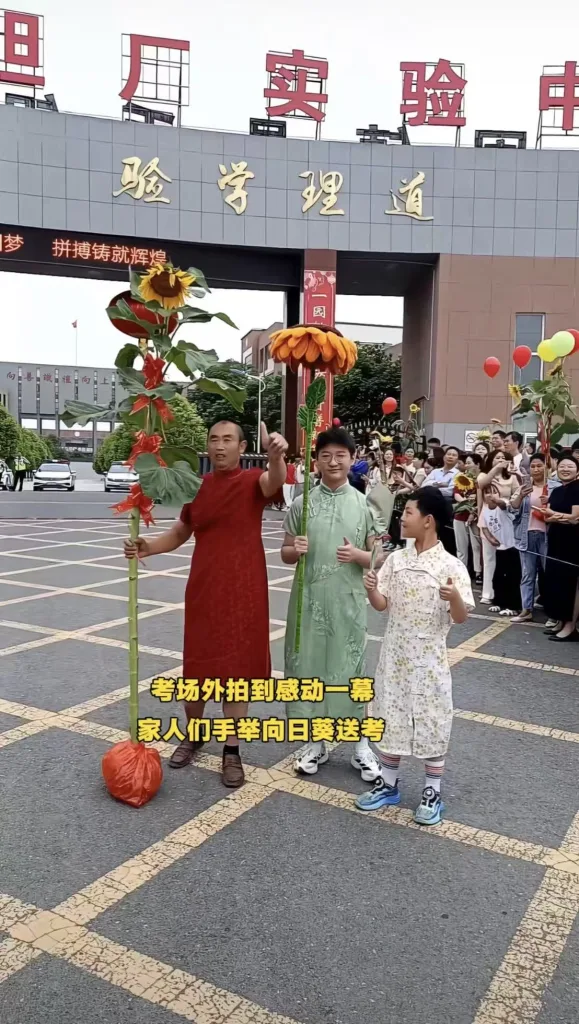
Another popular symbol is the sunflower — 向日葵 (xiàngrìkuí). The flower turns toward the sun, so it suggests ambition, brightness and determination. It also connects with the idea of 一举夺魁 (yìjǔ duókuí), meaning to win first place in one attempt.
Outside exam halls, parents wait for hours. Some bring lucky objects. Some stay quiet to avoid adding pressure. Others simply want to be present for one of the biggest days of their child’s life.
This parental presence is important. It is not only about control or expectation. It is also about companionship, emotional support and sharing a difficult moment together.
A national operation: silence, security and support
During Gaokao days, cities often adjust around the exam.
In 2026, it was reported that buses were rerouted and construction operations were silenced near test sites in Beijing to reduce noise. Some test sites also prepared rest areas and waiting zones for parents.
Local authorities mobilized resources such as traffic control, noise reduction, medical support, food safety inspections and anti-cheating systems. It noted that 2026 had 7,981 testing centers and around 348,000 examination rooms across China.
This is part of what makes the Gaokao so unusual for foreign observers. It is an exam, but it is treated almost like a national event.
Can students retake the Gaokao?
Yes. Students can retake the Gaokao, but the exam is only offered once per year.
In practice, retaking is a serious decision. It means spending another full year preparing, often under even greater pressure. It does not usually damage the application itself, because admission is mainly based on score and choices. However, it can carry emotional, social and practical costs.
In Chinese, repeat students are often called 复读生 (fùdúshēng). Some retake because their score was far below their usual level. Others believe that one more year could push them into a better university tier.
Why the Gaokao still matters in a changing China
The Gaokao is changing. China is trying to reduce pure rote learning and include more problem-solving, critical thinking and real-life application. Xinhua reported in 2026 that policymakers are pushing the exam toward skills such as critical thinking, problem-solving and adaptability.
At the same time, the social context is changing too. Reuters reported that 2026 registrations fell to 12.9 million, partly linked to demographic changes and a difficult job market. It also noted growing interest in vocational programs that may offer faster routes to employment.
This does not mean the Gaokao is losing its importance. Rather, it shows that Chinese families are thinking more carefully about education, employment and future security.
Using Gaokao results abroad: why translation is not enough
For students applying to foreign universities, the Gaokao can sometimes be used as part of an international application. However, one common mistake is assuming that a simple translation of a Gaokao score report is enough.
In many cases, foreign universities or credential evaluators require more than a translation. They may ask for an official verification report from Chinese education authorities.
The Center for Student Services and Development, often accessed through CHSI, provides verification services for Chinese academic records, including Gaokao scores. CHSI’s English service information states that verification can cover higher education records, high school qualifications and Gaokao scores, and reports may be issued in Chinese and English.
Depending on the country and institution, students may also need:
- the original Gaokao score report;
- a CHSI or CSSD verification report;
- a certified translation;
- a sworn translation for some European institutions;
- notarized or apostilled academic documents;
- a credential evaluation service such as WES, if required.
HI-COM provides certified translation services for official documents, including education diplomas, transcripts and administrative documents in more than 40 languages. HI-COM also explains in its guide to getting a diploma apostilled in China that Chinese diplomas are usually not apostilled directly. Instead, a Chinese notarial certificate confirming the diploma is notarized and then apostilled.
Need certified translation for Chinese academic documents?
If you studied in China and need to use your diploma, transcript, Gaokao score report or academic documents abroad, it is important to prepare the right version for the destination country.
A self-translation is often not accepted. A casual translation may also be rejected if it lacks a seal, certification statement or required formatting.
HI-COM can support students, families and institutions with certified translation of Chinese academic documents, official diploma translation, Chinese-English translation, French-English translation, notarization guidance and apostille-related document preparation.
Whether you are applying to a foreign university, preparing a credential evaluation, moving abroad or submitting Chinese academic records to an official authority, our team can help you avoid delays and document rejection.
Need help translating or preparing your Chinese academic documents? Contact HI-COM for certified translation and document support.
Conclusion: the Gaokao is more than an exam
The Gaokao is one of the best ways to understand modern China.
It reveals the value placed on education, the pressure of social mobility, the role of family, the weight of regional competition and the belief that effort can still change a life.
For students, it is a test. For parents, it is a shared emotional battle. For society, it is a yearly national moment. And for foreign observers, it is a window into China’s ambition, discipline and complexity.
Understanding the Gaokao means understanding much more than education. It means understanding how millions of families imagine the future.