Languages of China: Official Language, Dialects and Writing (2026 Guide)
China’s official language is Standard Mandarin, called Putonghua 普通话. But “Chinese” is not one single language: it is a family of language groups, from Mandarin and Cantonese to Wu, Min and Hakka, with hundreds of local dialects, plus the languages of China’s ethnic minorities. Here is a clear guide to the languages of China: the official language, the main dialect groups, how old Chinese is, and how it is written.
Last updated: October 2026 · HI-COM Translation Team, Shanghai
Languages of China in brief
- Official language: Standard Mandarin (Putonghua), defined by the 2000 Law on the Standard Spoken and Written Chinese Language as the “national common language”.
- Official script: Simplified Chinese characters in mainland China; Traditional characters in Hong Kong, Macau and Taiwan.
- Main Chinese language groups: Mandarin, Wu, Yue (Cantonese), Min, Hakka, Xiang and Gan, often extended to ten with Jin, Huizhou and Pinghua.
- Minority languages: China officially recognises 56 ethnic groups. Their languages include Zhuang, Uyghur, Tibetan, Mongolian, Yi and Miao.
- Mandarin speakers: 80.72% of China’s population could speak Putonghua in 2020, up from 53.06% in 2000 (Ministry of Education), with a target of 85% by 2025.
TABLE OF CONTENTS:
I – What is the official language of China?
II – Is Chinese one language or many?
III – The main Chinese language groups
IV – Wenzhounese and the dialects of Zhejiang
V – How old is the Chinese language?
VI – Chinese writing: Simplified, Traditional and Pinyin
VII – What is happening to Chinese dialects today?
VIII – FAQ
What Is the Official Language of China?
The official language of the People’s Republic of China is Standard Mandarin, known in China as Putonghua 普通话, “the common speech”. It is based on the pronunciation of Beijing and the grammar of northern Mandarin dialects. China’s Constitution states that the country promotes Putonghua nationwide, and the 2000 Law on the Standard Spoken and Written Chinese Language makes Putonghua and standard Chinese characters the national common language and script (国家通用语言文字). It is the language of government, schools, national media and business.
Several names are used for the same standard language:
- Putonghua 普通话 (“common speech”), in mainland China;
- Guoyu 国语 (“national language”), in Taiwan;
- Huayu 华语 (“language of the Chinese people”), in Singapore and Malaysia;
- Hanyu 汉语 (“language of the Han”) and Zhongwen 中文 (“Chinese”), the general terms for the Chinese language.
Mandarin Chinese is also one of the six official languages of the United Nations. In Hong Kong, the official languages are Chinese and English, and Cantonese is the main spoken language; in Macau, they are Chinese and Portuguese.
Is Chinese One Language or Many?
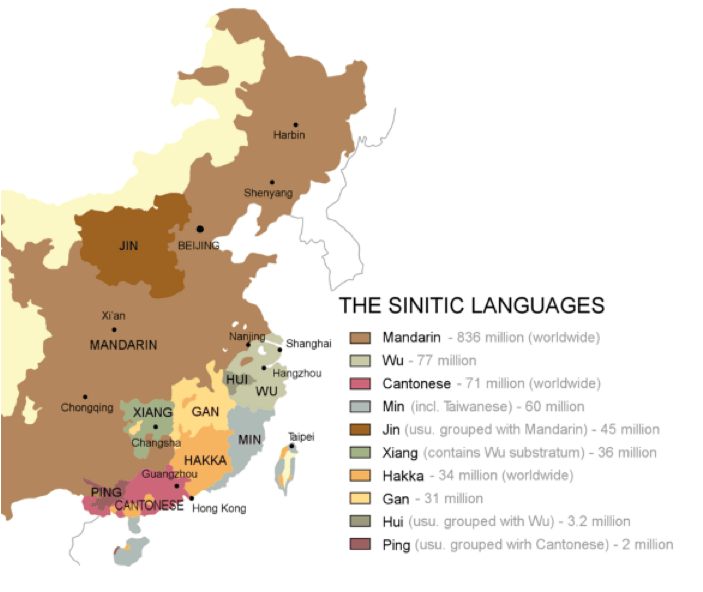
When we talk about ‘Chinese’, and how there are more than one billion Chinese speakers in the world, one might imagine one monolithic, universally understood language. However, this couldn’t be further from the truth. ‘Chinese’ in fact refers to a family of languages that comprises at least seven different linguistic groups, each with various dialects and sub-dialects sitting under them.
In China, these varieties are traditionally called dialects (fangyan 方言, literally ‘place speech’), because they share the same written language and cultural history. Linguists, however, often describe them as separate languages: a speaker of Cantonese and a speaker of Mandarin cannot understand each other when they speak, much like a Spanish speaker and an Italian speaker. To non-Chinese, this may be surprising. We know that English with an American, British or Australian accent remains mutually understandable. In China, you could come across two places within a few miles of each other where the locals speak different dialects and cannot understand each other at all.

Why so many dialects? China’s mountain ranges, rivers and deserts acted for centuries as natural boundaries between regions, valleys and villages. Before modern roads and railways, each region developed its own culture, traditions and speech. This is why the greatest linguistic diversity is found in the mountainous south-east of China, while the northern plains share relatively similar Mandarin dialects.
The Main Chinese Language Groups
The generally accepted classification divides the Chinese languages into seven main groups. The Language Atlas of China adds three more: Jin, Huizhou and Pinghua.
| Language group | Main regions | Well-known varieties |
|---|---|---|
| Mandarin 官话 Guanhua | Northern, central and south-western China | Beijing dialect (basis of Putonghua), Nanjing, Sichuanese |
| Wu 吴语 | Shanghai, Zhejiang, southern Jiangsu | Shanghainese, Suzhounese, Wenzhounese |
| Yue 粤语 | Guangdong, Guangxi, Hong Kong, Macau | Cantonese, Taishanese |
| Min 闽语 | Fujian, eastern Guangdong, Hainan, Taiwan | Hokkien (Taiwanese), Teochew, Fuzhounese |
| Hakka 客家话 | Guangdong, Fujian, Jiangxi, Taiwan | Meixian Hakka |
| Xiang 湘语 | Hunan | Changsha dialect |
| Gan 赣语 | Jiangxi | Nanchang dialect |
| Jin 晋语 | Shanxi, parts of Inner Mongolia, Shaanxi and Hebei | Taiyuan dialect |
| Huizhou 徽语 | Southern Anhui | Shexian dialect |
| Pinghua 平话 | Guangxi | Nanning Pinghua |
Mandarin and Cantonese: the two best-known Chinese languages
Mandarin is by far the largest group. Standard Mandarin (Putonghua) is a standardised form of northern Mandarin, sponsored by the government, taught in schools and universities throughout China, and used as the lingua franca of the country. Within Mandarin itself there are many regional varieties.
Cantonese, from the Yue group, is the main language of Guangdong, Guangxi, Hong Kong and Macau, and of many overseas Chinese communities. It differs from Mandarin in several ways:
- Number of tones: Mandarin has four basic tones and a fifth neutral tone. Cantonese is often said to have nine tones, including the so-called “checked tones”, although six are generally counted in Hong Kong.
- Initial consonants: Cantonese has fewer initial consonants than Mandarin.
- Final consonants: Cantonese keeps final -p, -t and -k sounds that Mandarin lost centuries ago, which makes it closer to Middle Chinese in some respects.
The other southern groups
The Min group, spoken in China’s southern coastal province of Fujian, is the most diverse: even within the group, many varieties are not mutually understandable. Hokkien, one of its branches, is spoken across Taiwan, Malaysia, Singapore, Indonesia and the Philippines, reflecting the history of the Chinese diaspora. Hakka (Kejia) is the language of the Hakka people, spread across pockets of Guangdong, Fujian, Jiangxi, Taiwan and Southeast Asia. Xiang is spoken in Hunan and Gan in Jiangxi.
Any province, district, town or city can have its own hua 话 (speech). For example, Shanghaihua 上海话, the local dialect of Shanghai, shares some words with Putonghua but sounds very different and is very much its own variety.

Minority languages of China
Beyond the Chinese languages, China is home to many non-Chinese languages spoken by its 55 officially recognised ethnic minorities. They belong to several language families: Tibetan and Yi (Sino-Tibetan), Zhuang (Tai-Kadai), Uyghur and Kazakh (Turkic), Mongolian, Korean, and Miao (Hmong-Mien). The Zhuang are China’s largest ethnic minority, with about 19.6 million people in the 2020 census. In regions such as Tibet, Xinjiang and Inner Mongolia, local languages are used alongside Mandarin, including on road signs and banknotes.
Wenzhounese and the Dialects of Zhejiang
A case in point is Wenzhouhua 温州话 (Wenzhounese), the dialect of Wenzhou, a prefecture-level city in Zhejiang province. Due to its location in a mountainous region, Wenzhou remained isolated from neighbouring areas for centuries. This made Wenzhou’s local culture and language very distinct from other Chinese dialects.
Wenzhounese belongs to the Wu group, like Shanghainese, but speakers of the two cannot easily understand each other. It is often described as one of the hardest Chinese dialects to understand, even for other Chinese people, because of its unusual pronunciation, tones and vocabulary. According to popular accounts, it was even used to pass messages during wartime because outsiders could not understand it.
Zhejiang province as a whole illustrates China’s linguistic diversity: Hangzhou, Ningbo, Shaoxing and Wenzhou all speak Wu varieties, yet each has its own distinct dialect. Wenzhou is also known for its large business diaspora in Europe, especially in Italy and France, where Wenzhounese is still widely spoken in the community.
How Old Is the Chinese Language?
Chinese is one of the oldest written languages in the world still in use. Chinese belongs to the Sino-Tibetan language family. Its history is usually divided into three main stages:
- Old Chinese (上古汉语): the language of the oldest Chinese texts. The earliest attested Chinese writing appears on the oracle bones of the Shang dynasty, around 1250 BC, followed by bronze inscriptions and the classics of the Zhou dynasty, such as the Book of Songs.
- Middle Chinese (中古汉语): the language of the Sui and Tang dynasties, documented by the Qieyun rhyme dictionary published in 601 AD. Many readings of Chinese characters in Japanese, Korean and Vietnamese come from this period.
- Modern Chinese: the spoken varieties of today. Standard Mandarin was defined in the 1950s, based on the Beijing dialect.
For most of Chinese history, the written language was Classical Chinese (文言文 wenyanwen), a literary style based on ancient texts and very different from everyday speech. In the early 20th century, the New Culture Movement promoted writing in the vernacular (白话文 baihuawen), close to spoken Mandarin. This is the basis of written Chinese today.
Chinese Writing: Simplified, Traditional and Pinyin
The basic unit of Chinese writing is the character, or sinogram. Each Chinese character corresponds to one syllable, and most words are made of one or two syllables. Because all Chinese varieties share the same written language, a Cantonese speaker and a Mandarin speaker who cannot understand each other’s speech can read the same newspaper.
Simplified vs Traditional Chinese
| Simplified Chinese | Traditional Chinese | |
|---|---|---|
| Where | Mainland China, Singapore, Malaysia | Hong Kong, Macau, Taiwan, many overseas communities |
| Since | Official simplification scheme of 1956, completed in 1964 | The historical form of the characters |
| Strokes | Fewer strokes, faster to write | More strokes, closer to the original forms |
| Example | 语言 (language) | 語言 (language) |
Simplified characters were introduced to make reading and writing easier and to reduce illiteracy. Traditional characters are still used in Hong Kong, Macau and Taiwan, as well as in calligraphy and classical texts. The differences go beyond the characters: vocabulary and expressions also vary between Hong Kong, Taiwan and the mainland. Read more about the language differences between Hong Kong and Taiwan.

Pinyin: Chinese in the Latin alphabet
Chinese has no alphabet: characters are learned one by one, with their strokes and components. To help with pronunciation, China created Hanyu Pinyin (拼音, “spelling sounds”), a system that writes the sounds of Mandarin in Latin letters. It was approved in 1958 and became the international standard (ISO 7098) in 1982. Chinese children learn Pinyin at school before characters, and most people use it to type Chinese characters on computers and smartphones, which is why Chinese keyboards use the standard QWERTY layout.
The tones
Chinese is a tonal language: the pitch of a syllable changes its meaning. Standard Mandarin has four tones plus a neutral tone. The syllable ma, for example, can mean “mother” (妈), “hemp” (麻), “horse” (马) or “to scold” (骂), or be a question particle (吗), depending on its tone.
What Is Happening to Chinese Dialects Today?
China’s rapid urbanisation means that hundreds of millions of people now live far from their hometowns, and Putonghua is taught in every school from an early age. In 2020, 80.72% of the population could speak Putonghua, compared with 53.06% in 2000, according to China’s Ministry of Education. Many young people in cities now understand their local dialect but speak it less than their parents did.
However, dialects are far from gone. Cantonese remains the everyday language of Hong Kong and much of Guangdong, local dialects thrive in family life, opera and comedy, and voice messages on WeChat or videos on Douyin help keep them alive. As linguist Zhu Zhenmiao of Shanghai University told the Global Times: “China’s dialects are a crucial part of our national heritage”.
What this means for translation and business
For companies working with China, the language question is practical:
- Written content: use Simplified Chinese for mainland China and Traditional Chinese for Hong Kong, Macau and Taiwan, with local vocabulary.
- Spoken content: Mandarin works across mainland China; Cantonese is often preferred for audiences in Hong Kong and Guangdong (video voice-overs, events, customer service).
- Official documents: authorities expect a certified translation in the right script for the country where it will be used.
HI-COM’s team in Shanghai and Hong Kong translates into Simplified and Traditional Chinese from English and 40+ languages. See our professional translation to Chinese and certified Chinese translation services.
FAQ: Languages of China
What is the official language of China?
Standard Mandarin, called Putonghua (普通话), is the official language of the People’s Republic of China. The 2000 Law on the Standard Spoken and Written Chinese Language makes Putonghua and standard Chinese characters the national common language and script.
What is the national language of China?
In mainland China, the law uses the term “national common language” (国家通用语言) for Putonghua, Standard Mandarin. In Taiwan, the same standard language is called Guoyu (国语), which literally means “national language”.
How many languages are spoken in China?
Chinese itself includes seven to ten major language groups, such as Mandarin, Wu, Cantonese, Min and Hakka, with hundreds of local dialects. China also has around 300 living languages in total when minority languages are included, according to Ethnologue.
Is Cantonese a language or a dialect?
In China, Cantonese is traditionally called a dialect (方言), because it shares the Chinese writing system and culture. Linguists often consider it a separate language, because Cantonese and Mandarin speakers cannot understand each other’s speech.
How old is the Chinese language?
The oldest attested Chinese writing dates from around 1250 BC, on the oracle bones of the Shang dynasty. This makes Chinese one of the oldest written languages still in use today.
Do Hong Kong and Taiwan use the same Chinese as mainland China?
They use Traditional characters instead of Simplified characters, and some vocabulary differs. Taiwan speaks Mandarin (Guoyu), while Hong Kong mainly speaks Cantonese.