

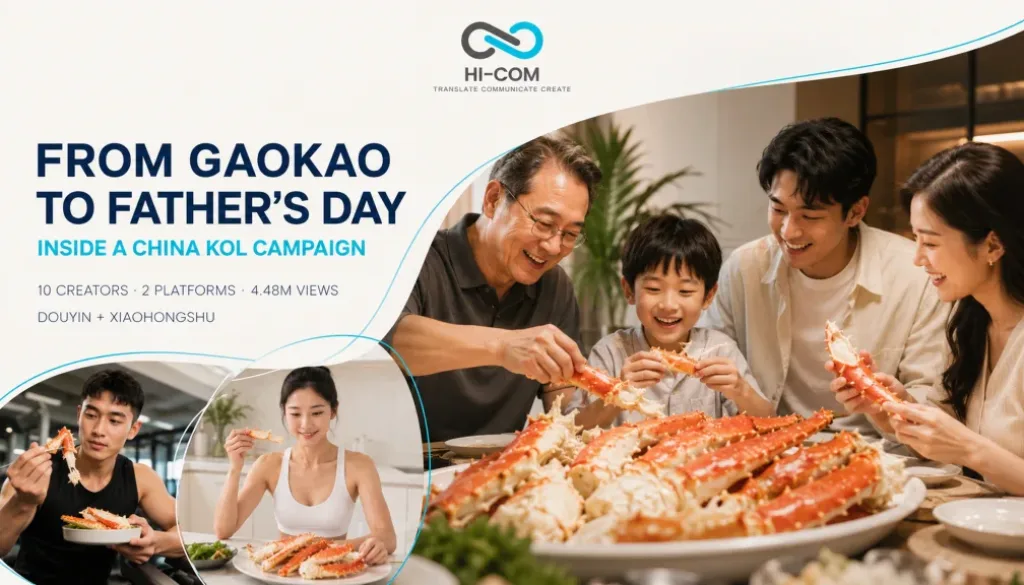
From Gaokao to Father’s Day: Inside a 4.48M-View KOL Campaign in China
Published by the HI-COM Marketing Team | 27 July 2026
One family creator filmed the days after her son’s Gaokao. Another prepared a surprise dinner for Father’s Day. A fitness creator turned premium seafood into a post-workout reward, while nutrition specialists answered the practical questions people ask before trying a new food.
The product range remained consistent across the campaign: Russian King Crab and Snow Crab. The reason to care was different each time.
The campaign challenge: building King Crab demand beyond the peak season
In China, the peak sales season for King Crab is typically concentrated between late September and the New Year period. The client’s challenge was how to maintain consumer interest during the quieter months, when the product had fewer established reasons to appear on the table.
Our first task was therefore to identify another period with strong consumption potential. June brought several relevant moments together: the end of Gaokao, the Dragon Boat Festival, Father’s Day and the beginning of summer fitness and nutrition routines.
Rather than connecting King Crab with a single occasion, the campaign was designed to reach different audiences through several eating occasions. A coordinated wave of creator content gave these individual stories greater visibility and aimed to build a recognisable conversation around King Crab outside its traditional peak season.
That was the idea behind HI-COM’s June 2026 KOL campaign in China. Instead of relying on one celebrity account or repeating a single product message, we worked with 10 creators across Douyin and Xiaohongshu, also known as RED. The campaign connected premium seafood with four recognisable moments: the end of Gaokao, the Dragon Boat Festival, Father’s Day and everyday nutrition or fitness routines.
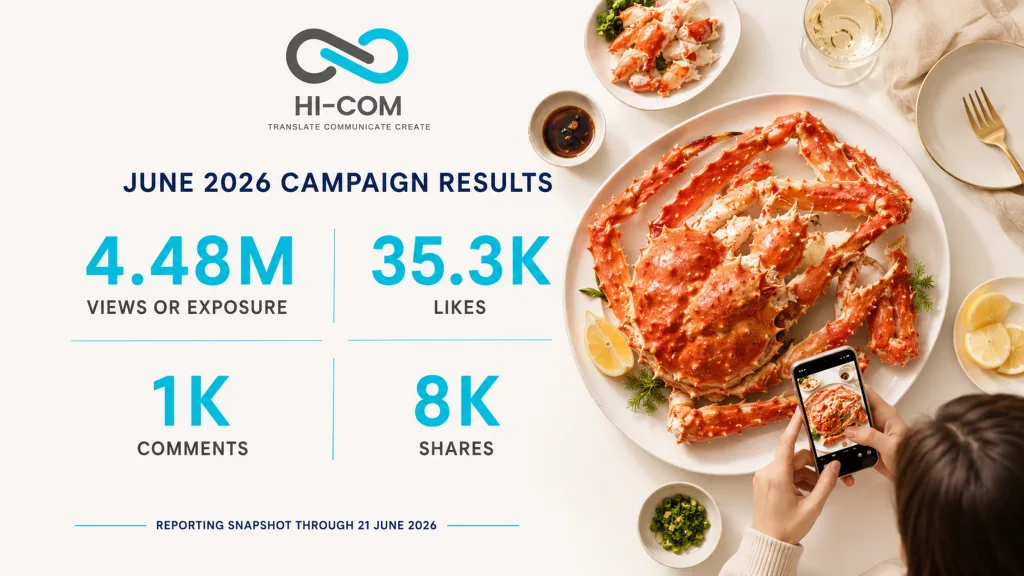
By 21 June, the campaign report recorded 4.48 million platform-reported views or exposure, 35,300 likes, 1,000 comments and 8,000 shares. The initial planning estimate had been two million views. The final result was more than double that forecast.
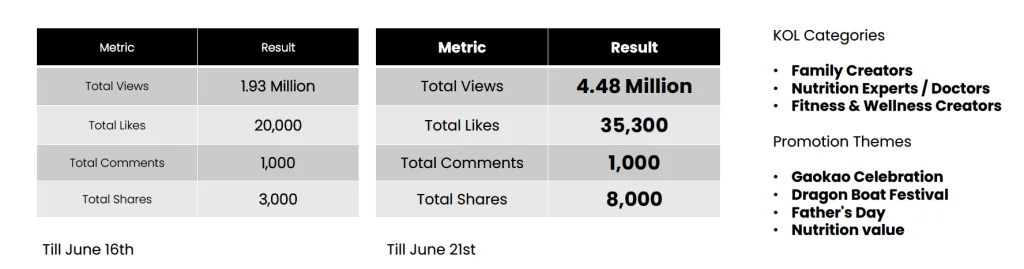
Key results from the June KOL campaign
- 10 participating creators
- 7 Douyin creators
- 3 Xiaohongshu creators
- 4 family lifestyle creators
- 3 fitness and wellness creators
- 2 nutrition creators
- 1 doctor
- 4.48 million reported views or exposure
- 35,300 likes
- 1,000 comments
- 8,000 shares
- More than twice the original two-million-view estimate
The numbers matter, but the campaign’s real value was broader. It tested how one imported food product could move between celebration, family life, fitness and practical nutrition without losing its premium positioning.
From one successful Mother’s Day story to a wider occasion strategy
The June campaign did not begin from zero.
For Mother’s Day 2026, HI-COM had already developed a Douyin campaign that placed Russian King Crab and Snow Crab inside a family gifting story. One major lifestyle creator presented the seafood as a thoughtful gift for her mother. Within 48 hours, that video recorded 4.65 million views and 152,000 likes.
The creative lesson was clear: premium seafood becomes more relatable when it has a role in a real family moment. The product should not interrupt the story. It should help complete it.
The June campaign asked a different question. Could that association extend beyond one holiday and one major creator?
This time, the objective was not to recreate a single viral peak. It was to build a portfolio of stories around the working idea:
Special Moments Deserve Better Food.
Russian King Crab was positioned as a premium centrepiece for meaningful occasions. Snow Crab offered a more accessible route into everyday, protein-focused meals. Together, the products could move from celebration to routine without being presented as interchangeable.
One product, four reasons to care
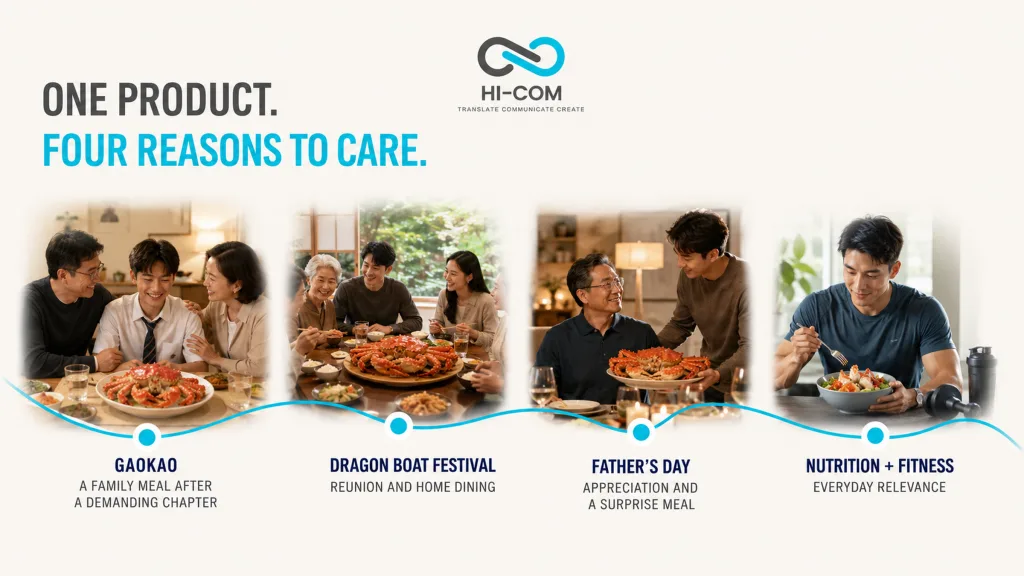
The campaign calendar followed several moments that were already present in people’s lives. Each gave creators a different way to introduce the product naturally.
1. Gaokao: a family meal after a demanding chapter
The campaign was timed around Gaokao, China’s national college entrance examination, beginning on 7 June. In 2026, the national unified subjects ran on 7 and 8 June, while some provinces scheduled additional subjects on 9 or 10 June. For families with students, the end of the examination period can bring relief after months of pressure.
The brief did not ask creators to claim that seafood could improve examination performance. Instead, it treated the first family meal after Gaokao as a transition: time to come home, sit together and recognise the effort that had been made.
One family storyline followed a son completing Gaokao before the content moved towards a Father’s Day surprise. This gave the creator room to connect several events through one family narrative rather than producing separate, unrelated advertisements.
2. Dragon Boat Festival: bringing something special home
The Dragon Boat Festival created a natural setting for reunion meals, home cooking and multi-generational gatherings.
Here, King Crab worked as a visible centrepiece. Its size and preparation gave the videos an immediate visual hook, while the family table made the product easier to imagine in a real home.
The occasion also supported a useful message for imported food brands: premium does not have to mean distant or ceremonial. A high-value ingredient can still belong inside a warm, familiar meal.
3. Father’s Day: appreciation without a hard sell
Father’s Day content focused on surprise meals and the idea that fathers, who may not spend much on themselves, also deserve something special.
The product reveal worked best when it followed the emotion. The creator first established the relationship, the preparation or the surprise. The seafood then became part of the gesture.
This approach gave viewers a reason to care before asking them to notice the product.
4. Nutrition and fitness: extending relevance beyond holidays
The fitness and nutrition creators had a different job. They explored whether crab could appear in regular meal planning, active lifestyles or a satisfying meal after exercise.
This was especially important for Snow Crab. A product cannot build year-round relevance if consumers only associate it with major celebrations. Fitness vlogs and practical nutrition content introduced another use case without removing the premium cues around quality and origin.
Any nutrition-led campaign still needs careful claim review. A creator’s authority should not be used to imply medical benefits, disease prevention or guaranteed health outcomes. The strongest content stayed close to preparation, protein-focused meal choices and real consumption situations.
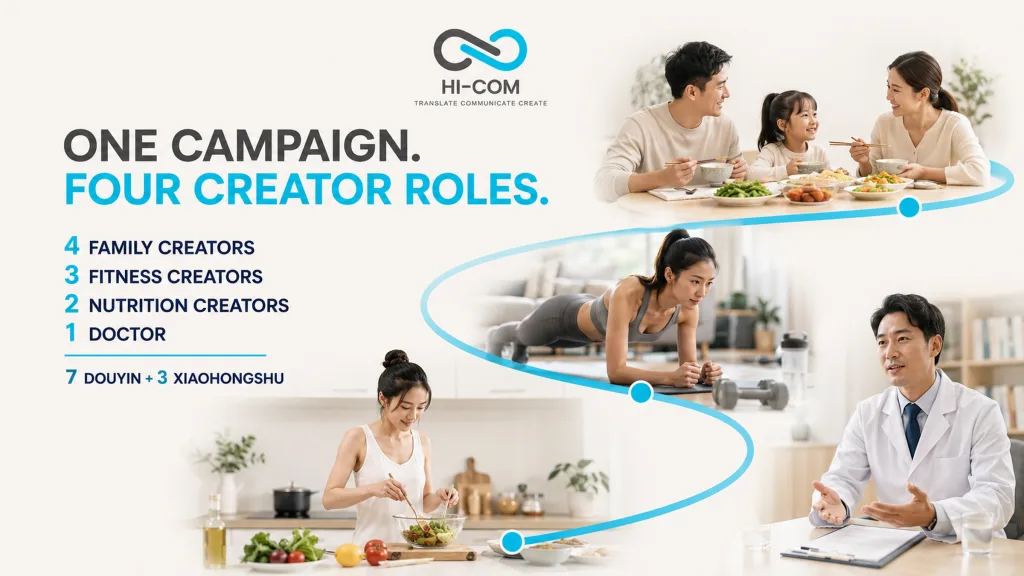
Why HI-COM used a 10-creator matrix
A single large KOL can deliver exceptional reach. HI-COM’s Mother’s Day campaign demonstrated that. A broader creator matrix serves a different purpose.
The June campaign combined four family creators, three fitness creators, two nutrition specialists and one doctor. Collectively, the candidates represented approximately one million followers at the planning stage.
This structure created four advantages:
- More situations: the product appeared in family kitchens, celebration meals, fitness routines and educational content. No single creator had to carry every message.
- More audience entry points: parents, younger fitness audiences, urban lifestyle users and people actively seeking nutrition information encountered the product through creators they already understood.
- Less dependence on one post: performance did not rely on one video becoming viral. Stronger posts could compensate for weaker ones while still producing useful learning.
- Better comparative data: the campaign could compare which themes created reach, shares, saves, comments or purchase-related questions.
In this article, KOL
is used as an umbrella term for the creator group. The matrix included established creators and more community-oriented voices whose value came from everyday credibility rather than celebrity status alone.
Meet the 10 KOLs behind the campaign
To make the creator strategy more concrete, here are the 10 profiles selected for the campaign and the audience angle each one contributed.
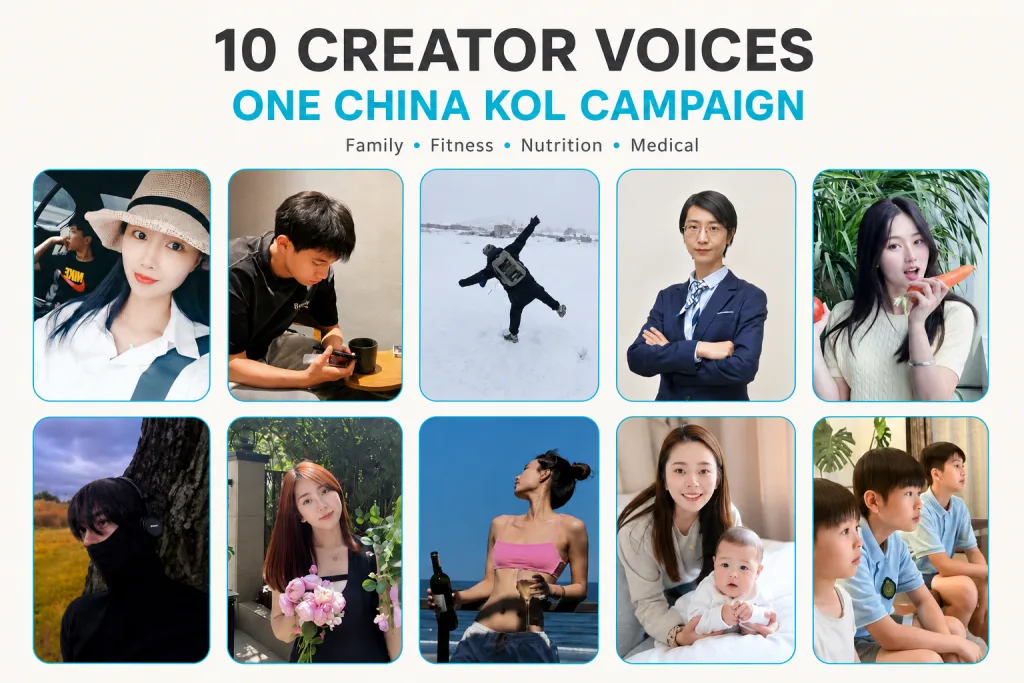
Douyin family and lifestyle KOLs
- Huma – family lifestyle: 631,000 reported views. Her main audience was women over 40, with strong representation in Jiangsu, Zhejiang and Guangdong.
- Chenmo – family lifestyle: 579,000 reported views. His content mainly reached women aged 34 to 40 in Jiangsu, Zhejiang and Guangdong.
- Lemon Mom – family lifestyle: 537,000 reported views. Her main audience was women aged 18 to 23 in Jiangsu, Guangdong and Zhejiang.
Douyin fitness, nutrition and medical KOLs
- Fitness Zhou: 256,000 reported views. The profile mainly reached users aged 24 to 30 in Guangdong and Zhejiang, and the post generated particularly strong sharing and saving behaviour.
- Fitness Gangan: 33,000 reported views. The audience extended from approximately 18 to 40, with a nearly even gender split and strong representation in Guangdong, Jiangsu and Zhejiang.
- Nutritionist Zhuzi: 530,000 reported views. Her core audience was women aged 24 to 30, particularly white-collar users in Guangdong, Shandong and Jiangsu.
- Doctor Sun: 47,126 reported views. Her main audience was women over 40. The limited interaction on this post also gave the campaign a useful lesson about the need to place expert content inside a natural consumption story.
Xiaohongshu family, fitness and nutrition KOLs
- Fitness Abby: 284,126 reported exposure. Her main audience was women aged 25 to 34 in Beijing, Shanghai, Guangzhou and Shenzhen.
- Nutritionist Grace: 337,786 reported views or impressions. Her content mainly reached women aged 25 to 44 in Xi’an and other northern locations.
- Yiyi and Son – family lifestyle: 183,874 reported views or impressions. The profile reached users aged 25 to 34, with a nearly even gender split across Shanghai, Guangzhou, Beijing, Shenzhen, Hangzhou and Chengdu.
Together, these profiles gave the campaign access to parents, younger lifestyle audiences, fitness communities, nutrition-focused users and older consumers. The point was not to make every creator deliver the same message. It was to give each audience a credible way into the story.
Why Douyin and Xiaohongshu played different roles
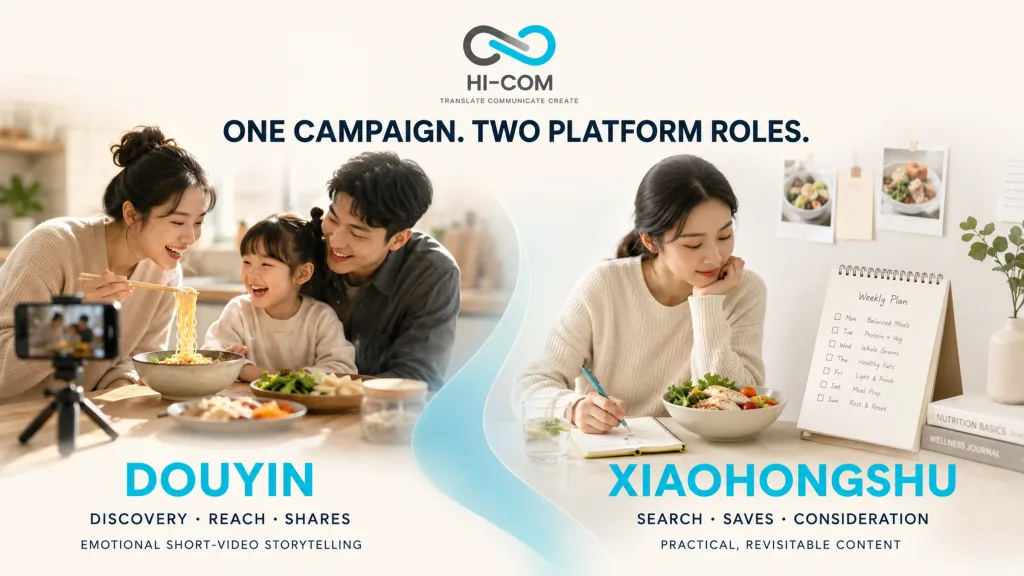
China’s social media ecosystem is highly segmented. The most useful lesson from HI-COM’s existing guides to Chinese social media platforms is not that every brand needs more accounts. It is that each platform should have a defined job.
For this campaign, Douyin and Xiaohongshu were not duplicate distribution channels. They created different kinds of value.
Douyin: reach, pace and shareable storytelling

Douyin is built around fast video discovery. A viewer does not need to search for a creator or follow a brand before encountering a post.
That made it suitable for family reveals, fitness reward vlogs and visually strong cooking scenes. The report found that Douyin was particularly effective for broad visibility and sharing.
The Douyin creative pattern that worked
The stronger videos generally followed a recognisable sequence:
- Open inside a real situation rather than with a brand message
- Establish a person, goal or family moment
- Introduce the crab as part of the action
- Show preparation, texture or serving
- End with a reaction, shared meal or useful takeaway
This gave viewers an immediate human hook and a reason to continue watching after the product appeared.
Xiaohongshu: consideration, saves and practical value

Xiaohongshu, also called RED, plays a strong role in product discovery and decision-making. Users often save useful posts, compare recommendations and return to content later.
In the June campaign, the nutrition-led Xiaohongshu content showed stronger collection potential than broad entertainment content. This is commercially important. A save does not prove a purchase, but it can signal that the viewer considers the information useful enough to revisit.
Why saves mattered on RED
For an unfamiliar or premium food product, consumers may want to check:
- How it is prepared
- Whether it suits their meal routine
- What the texture or portion looks like
- Where it can be purchased
- Whether the product feels suitable for a family occasion
Structured creator content can answer these questions more effectively than a short product slogan.
What performed best – and what did not
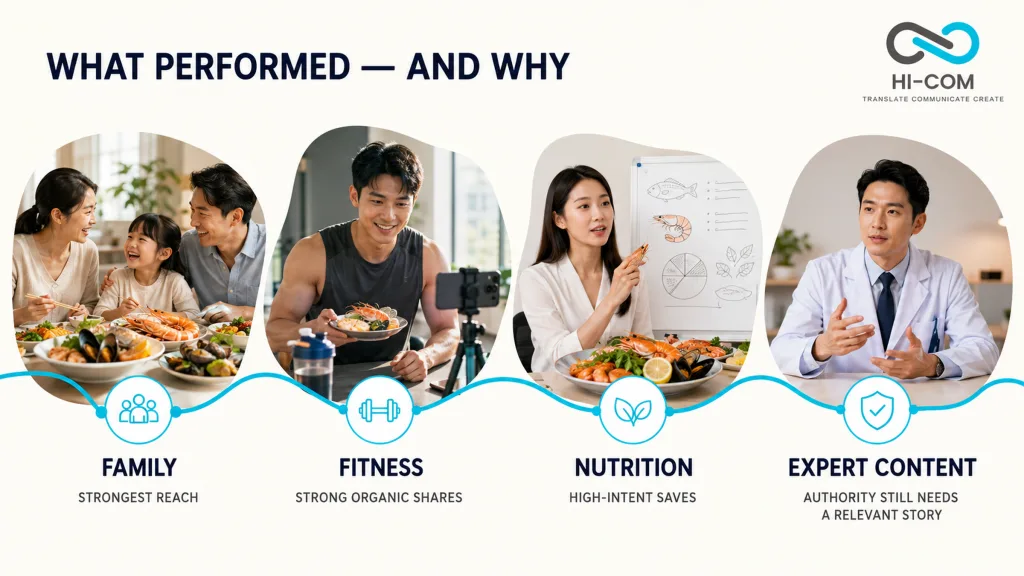
The creator mix produced different forms of performance. Treating every post by view count alone would hide the most useful findings.
Family creators produced the strongest reach
Family lifestyle videos gave the product a clear role and an easy-to-understand setting.
One family creator recorded 631,000 views, approximately 13,000 likes, 387 comments and 598 shares. Another family creator reached 537,000 views and generated 1,064 shares.
These posts did not require viewers to understand technical nutrition information. The meaning was immediate: a family had reached an important moment and was sharing a special meal.
Fitness creators generated strong sharing behaviour
Fitness content gave the product a self-reward and active-lifestyle angle.
One fitness video recorded 256,000 views, 1,310 shares and 453 saves. Another produced 1,678 shares. These results suggest that fitness reward stories travelled well between users, even when they did not always produce the campaign’s highest overall reach.
The distinction matters. A creator can be valuable because the content is passed on, not only because it accumulates impressions.
Nutrition creators generated higher-intent actions
Nutrition content helped explain how the product could fit into everyday choices.
One Douyin nutrition creator recorded 530,000 views, with a core audience of women aged approximately 24 to 30 in Guangdong, Shandong and Jiangsu. On Xiaohongshu, one nutrition creator’s post was reported as outperforming 96% of comparable creator content, and the campaign report listed 2,252 collections for the post.
This supports the platform-level finding: practical nutrition content may not always look as viral as an emotional family video, but it can create stronger consideration signals.
The doctor-led content underperformed
The doctor-led video recorded approximately 47,000 views and almost no interaction.
This was one of the campaign’s most useful findings. Professional authority alone does not guarantee engagement. The content was less connected to a natural meal, family occasion or daily consumption scene, so viewers had fewer reasons to react or share.
The lesson is not to avoid experts. It is to give expertise a practical context. A doctor, nutritionist or specialist still needs a story that belongs on the platform.
What 1,000 comments revealed about consumer interest
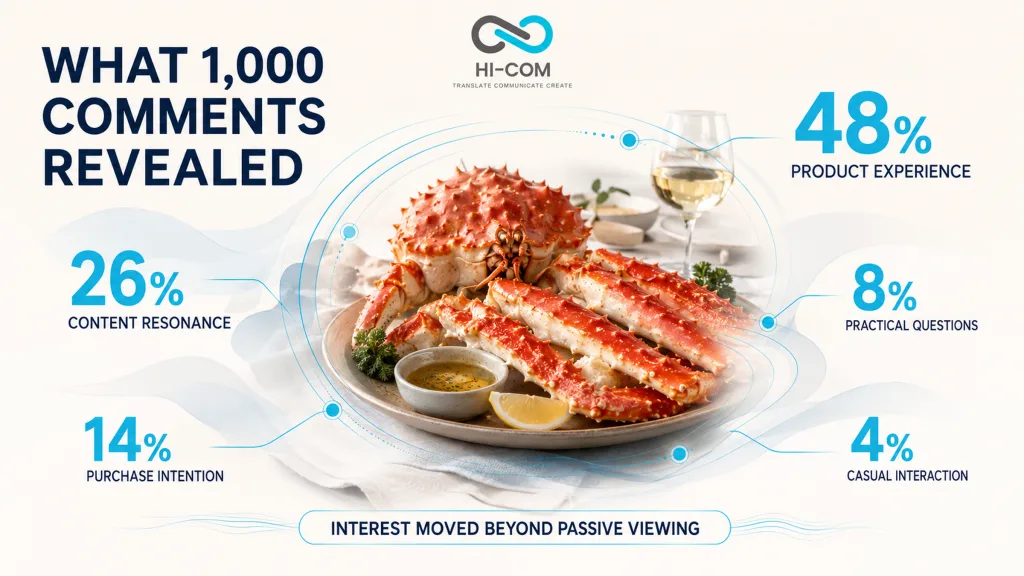
The campaign team grouped valid comments into five categories:
- 48% product experience
- 26% content resonance
- 14% purchase intention
- 8% professional consultation
- 4% casual interaction
Almost half of the analysed comments focused on the product itself: taste, texture, freshness and perceived imported quality. This indicates that the videos succeeded in making sensory qualities visible, even though viewers could not physically try the product through the screen.
Another 26% responded to the content setting and creative style. Viewers recognised the family atmosphere, everyday scenes and fitness vlogs. This matters because positive reactions to the story can reduce the distance between an imported premium product and ordinary life.
Fourteen percent of comments expressed purchase-related interest, including questions about price, specifications and where to buy. In Chinese marketing, this kind of recommendation-led interest is often described as grass-planting
or zhongcao (种草): content gives a consumer the desire to consider or try a product.
Eight percent asked practical questions about cooking, nutrition or dietary suitability. These questions can inform future content, product pages and customer service materials.
The comment analysis did not prove completed purchases. It did, however, show where curiosity moved beyond passive viewing.
Who engaged with the campaign?
Women dominated interaction across the family, fitness and nutrition verticals.
The most responsive age groups generally sat between the mid-20s and 40s, although each creator attracted a different profile. Family content reached parents and household decision-makers, while fitness and nutrition creators brought in younger audiences interested in active routines and practical food choices.
Geographically, Jiangsu, Guangdong and Zhejiang appeared repeatedly among the strongest audience locations on Douyin. Xiaohongshu content also reached users in major cities including Shanghai, Beijing, Guangzhou, Shenzhen, Hangzhou and Chengdu, while one nutrition creator performed strongly across Xi’an and other northern locations.
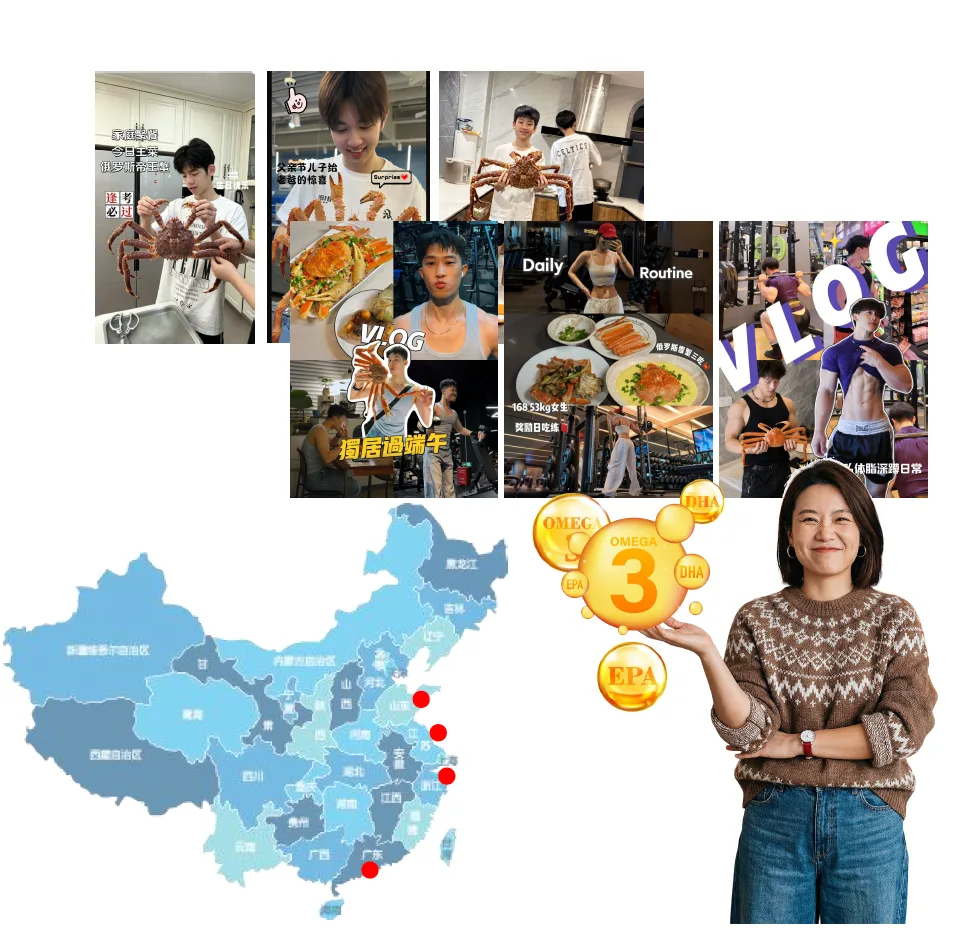
These patterns should not be turned into a universal profile for every seafood campaign. They show why brands need creator-level audience data. The right audience may differ by storyline, platform and intended consumption moment.
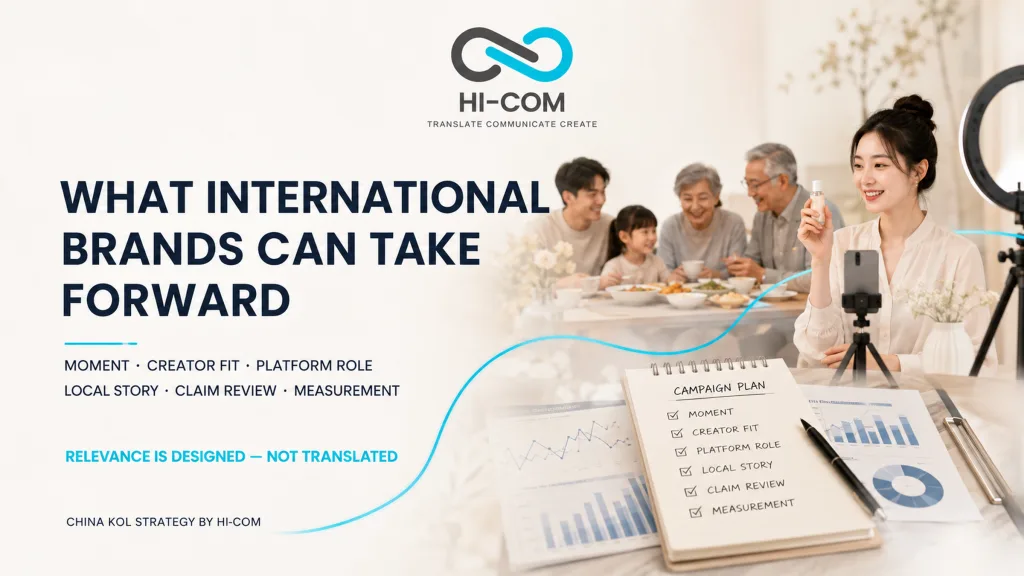
Seven practical lessons for planning a KOL campaign in China
1. Start with the product’s role in life
Premium
, imported
and high quality
describe a product. They do not explain when someone should want it.
The June campaign gave King Crab a role in celebrations and family gatherings, while Snow Crab could enter more regular, protein-focused meal routines.
2. Build around moments that already matter
Gaokao, Dragon Boat Festival and Father’s Day did not need to be invented by the brand. They already carried emotion, family behaviour and search interest.
The creative work was to enter those moments naturally.
3. Choose creators by function, not follower count alone
A family creator can deliver reach. A fitness creator can encourage sharing. A nutrition creator can generate saves and questions.
The best creator is the one whose normal content can carry the message without changing personality.
4. Give each platform a specific task
Douyin and Xiaohongshu should not receive the same edit, caption and success metric by default.
For this campaign, Douyin was stronger for broad discovery and sharing. Xiaohongshu offered stronger potential for saves, practical consideration and searchable lifestyle content.
5. Leave room for the creator’s real life
The brief established the product position, mandatory information and campaign moments. It also allowed creators to adapt the idea to their own family, routine and tone.
That flexibility made it possible for one story to move from Gaokao to Father’s Day without feeling like two unrelated placements.
6. Review nutrition and medical claims carefully
Expert-led content can build trust, but it also creates responsibility.
Brands should verify product facts, avoid unsupported health promises and distinguish ordinary nutrition communication from medical advice. Compliance review should happen before filming, not after publication.
7. Measure what happened after the view
Views are useful, but they are not a complete result.
Shares can indicate social relevance. Saves can indicate future consideration. Comments can reveal questions, objections and purchase interest. Sales, coupon use, store visits or tracked conversions require separate measurement.
A clear reporting framework should define these metrics before the campaign begins.
What this campaign adds to HI-COM’s earlier China social media research
HI-COM’s existing guides to Chinese social media platforms explain which platforms matter and what each one does.
This case study answers the next question: what happens when a brand uses those platforms in a real campaign?
Three ideas from the platform guides remained especially relevant:
- Chinese social media is segmented; platform choice must follow audience behaviour and content purpose.
- Consumers use creator content for entertainment, advice and product discovery.
- A brand should not open or use an account without offering clear value.
The June campaign translated those principles into practice. Douyin delivered fast discovery and shareable storytelling. Xiaohongshu supported useful, saveable content. The KOL matrix gave each creator a reason to speak, rather than asking 10 people to repeat the same advertisement.
For international teams working on food marketing in China, that distinction is essential. Platform presence alone does not create relevance; the product still needs a credible moment, creator and reason to be remembered.
Frequently asked questions
What results did the June KOL campaign in China achieve?
The final reporting snapshot through 21 June recorded 4.48 million views or exposure, 35,300 likes, 1,000 comments and 8,000 shares across 10 creators on Douyin and Xiaohongshu.
How many KOLs participated in the campaign?
The campaign used 10 creators: four family lifestyle creators, three fitness and wellness creators, two nutrition creators and one doctor. Seven posted on Douyin and three posted on Xiaohongshu.
Why did the campaign use both Douyin and Xiaohongshu?
The platforms served different purposes. Douyin supported broad short-video discovery and sharing. Xiaohongshu supported more structured, searchable and saveable lifestyle or nutrition content.
What is the difference between a KOL and a KOC in China?
A KOL, or key opinion leader, usually has recognised influence, expertise or a substantial audience. A KOC, or key opinion consumer, tends to have a smaller community and a more everyday consumer voice. In practice, many campaigns use a mixed creator matrix rather than relying on labels alone.
Did 4.48 million views mean 4.48 million potential buyers?
No. Views or exposure measure visibility, not unique qualified buyers or completed purchases. The campaign also tracked likes, comments and shares, while final sales attribution would require separate e-commerce, coupon, CRM or retail data.
Which creator category performed best?
It depends on the objective. Family creators generated the strongest reach, fitness creators produced strong sharing behaviour, and nutrition creators generated higher-intent saves and practical questions. The doctor-led execution underperformed because it lacked a sufficiently natural consumption scenario.
What should an international brand prepare before launching a China KOL campaign?
The brand should define its target audience, product role, campaign moments, platform mix, creator criteria, claim boundaries, content approvals and measurement plan. Contracts, usage rights, disclosure requirements, product logistics and comment monitoring should also be agreed before posting.
Plan a KOL campaign in China with HI-COM
The June campaign did not depend on one message being repeated 10 times. It worked by giving different creators different reasons to make the product relevant.
HI-COM supports international brands with China KOL strategy, creator selection, localised campaign concepts, content coordination, platform execution and performance analysis.
If your brand is preparing a food, lifestyle or consumer campaign in China, contact the HI-COM team to discuss the audience, platforms and story your product needs.