

Double 11 2026 in China: Dates, New Pricing Rules and What International Brands Should Prepare Now
Double 11 used to be a date. In 2026 it is closer to a season.
This year’s campaigns open on 12 October on JD.com and, for the first time, on WeChat Shop. Tmall starts taking presale deposits on 15 October, and in-stock sales on Tmall run until 13 November. For international brands, though, the calendar is not the biggest change. The platforms have dropped most of the old coupon maths in favour of plain price cuts, and China’s pricing rules now make the old habit of raising a price in October to discount it in November a real legal risk. If your prices, stock and content are settled before the National Day holiday ends on 8 October, you are in a good position.

We wrote this for brand, e-commerce and marketing teams outside China who are deciding what to do with Double 11 this year: whether to take part at all, and if so, how to do it without teaching Chinese shoppers to wait for your next discount.
Dates and rules were checked against platform announcements and official sources on 30 September 2026.
Double 11 2026 at a glance
- 12 October: JD.com and WeChat Shop open.
- 15 October: Tmall presale deposits open.
- 20 October, 20:00: Tmall balance payments and in-stock sales start.
- 11 November: Double 11 itself, and the reported end of Douyin’s campaign.
- 13 to 15 November: Tmall in-stock sales end on 13 November; Kuaishou and WeChat Shop on 15 November.
All times are China time (UTC+8).
Double 11 2026 Dates, Platform by Platform
Tmall and Taobao
JD.com
WeChat Shop
Kuaishou
Douyin
Pinduoduo and Xiaohongshu
If you sell on Tmall and Douyin, run a WeChat Shop, or have a distributor handling JD.com, the “same” festival now opens and peaks on different days in each place. It sounds obvious, but one shared calendar for your team and your partners avoids a lot of last-minute confusion.
What Is Different About Double 11 This Year
It lasts five weeks, and nobody publishes the real total
Nobody outside the platforms knows exactly how big Double 11 is any more. Alibaba and JD.com stopped publishing official totals in 2022. The most quoted estimate for 2025 comes from the data firm Syntun: RMB 1.695 trillion across all platforms, measured over 37 days from 7 October to 11 November. Treat that as an indication of scale, not a benchmark for your brand. The more useful point is the length. Budget, stock and content now have to last for weeks rather than peak on one night.
The coupon maths has (mostly) gone
For years, taking part in Double 11 meant cross-store “spend X, save Y” offers that were famously hard to work out. In 2026, Tmall’s headline mechanic is the official price cut (官方立减) on a single item, and JD.com is promoting direct price cuts with no need to add items to a basket. Shoppers will like it. For brands it cuts both ways: your discount is now completely visible, and very easy to compare with what the same product costs elsewhere. WeChat Shop is the exception, with shared vouchers and cross-shop offers still part of its mix.
WeChat has joined in
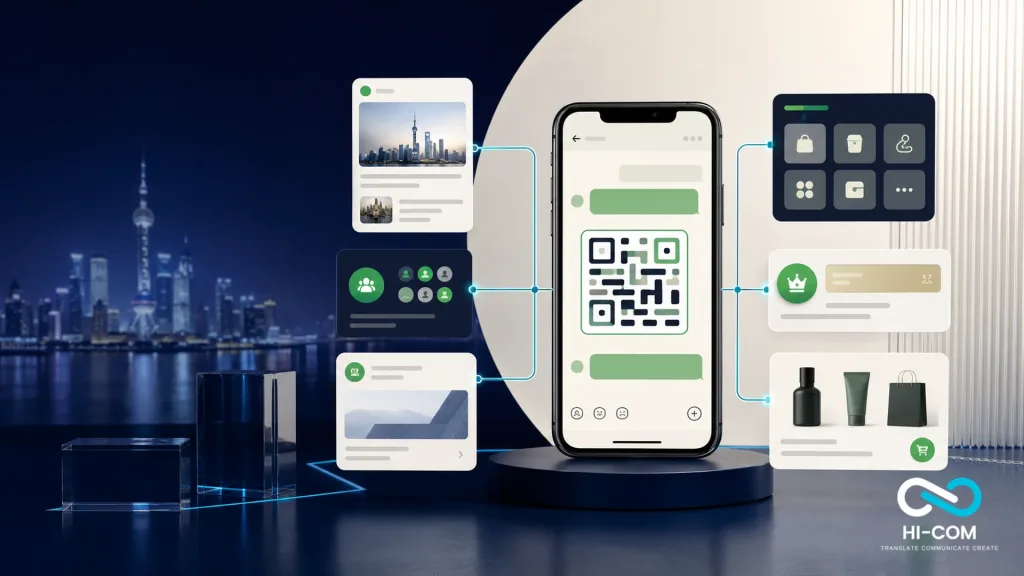
This is the change we find most interesting. WeChat Shop is running its first official Double 11, from 12 October to 15 November. Selling happens inside WeChat itself: through chats and groups, Official Accounts, Channels livestreams and search. Coupons are designed to be passed between friends, and a “send a gift” feature lets shoppers buy something for someone else directly in the app. For international brands that have spent years building a WeChat Official Account without quite knowing how to turn followers into buyers, Double 11 now offers a reason to try.
Our WeChat marketing services cover Official Accounts, content and community management if you want help setting that up.
Faster delivery and AI shopping assistants
Double 11 is no longer only about parcels arriving a few days later. Syntun counted RMB 67 billion of 2025 Double 11 sales on instant-delivery platforms, where orders can arrive within the hour, and the big platforms are pushing AI search and AI shopping assistants hard this year. Both reward something unglamorous: complete, accurate product information in natural Chinese. Titles, specifications, sizes and FAQs are what shoppers and AI tools read before anything else.
Trade-in subsidies, in some categories
China’s 2026 trade-in programme subsidises eligible products bought in stores and online. Nationally it covers cars, six home appliances (refrigerators, washing machines, televisions, air conditioners, computers and water heaters) and four digital products (smartphones, tablets, smartwatches and bands, and smart glasses). For digital products and appliances the subsidy is generally 15% of the price, capped at RMB 500 per digital product and RMB 1,500 per appliance, one item per category per person. On 30 September, the final batch of this year’s RMB 250 billion budget was confirmed as allocated, so the programme is still funded going into Double 11. Local rules differ, so check them before you build an offer around the subsidy. If you do not sell in these categories, the scheme will not affect you directly, but it does shape the prices shoppers see in those aisles.
The Pricing Rules That Catch Foreign Brands Out
This is the part international brands most often underestimate, and where a Double 11 campaign can create problems that last long after November. What follows is general information, not legal advice.
The 7-day rule
Under China’s rules on price marking and price fraud, in force since 1 July 2022, a discount shown against an “original” price without further explanation must compare with a price no higher than the lowest price actually charged in the 7 days before the promotion. In plain terms, raising your price in early October so that your Double 11 discount looks bigger is exactly what these rules target. Keep your regular price stable in the weeks before the event, and keep screenshots or exports that show it.
Platform pricing rules since April 2026
The Internet Platform Price Behaviour Rules, issued by the NDRC, the State Administration for Market Regulation and the Cyberspace Administration of China, have applied since 10 April 2026. Among other things, they stop platforms from punishing a merchant’s pricing choices with extra fees, traffic limits, search demotion or delisting. They also forbid platforms and merchants from using data and algorithms to charge different prices for the same product under the same conditions without the shopper knowing.
No forced below-cost selling, and a regulator paying attention
China’s revised Anti-Unfair Competition Law, in force since 15 October 2025, bans platforms from forcing merchants to sell below cost and targets fake transactions and fake reviews. Ahead of 618 in June 2026, the market regulator also reminded platforms that it would crack down on false price cuts, misleading promotions and fake reviews, and that merchants must not be forced into price-comparison or price-matching tools as a condition of joining a promotion. We would expect a similar message before Double 11. Taken together, this gives brands firmer ground to say no to a discount that makes no commercial sense.
Watch the wording, and talk to your distributor
Double 11 copy is where absolute claims such as “the best” or “number one” tend to slip in, and they are restricted under China’s Advertising Law.
Our guide to forbidden words in Chinese advertising lists what to avoid.
If a distributor sells your products, Double 11 pricing becomes a shared decision. Agree early how discounts will work across your own store and your partner’s, bearing in mind that Chinese competition law restricts fixing a distributor’s resale price. We cover this in more detail in the 8 terms to agree before you sign a distributor in China.
Should Your Brand Take Part at All?
Not every brand should chase Double 11. A premium brand with a small following in China can lose more in price perception than it gains in volume, and once shoppers learn that you discount every November, they wait. Before you commit a budget, answer these five questions honestly.
- What is the goal? Winning new customers, clearing seasonal stock and building awareness need different offers. “Selling more” is not a goal.
- Are your prices consistent? If your Tmall store, your distributor and cross-border sellers show different prices, a direct price cut will expose the gap on day one.
- Can your margin take it? With single-item price cuts now the norm, your discount is public and comparable. Decide your floor before a platform or partner asks for it.
- Is your stock where it needs to be? In-stock sales now start in October. Stock still in transit, or held only overseas, limits what you can promise on delivery.
- Have shoppers heard of you? Double 11 converts interest that already exists. If nobody has seen your product on Xiaohongshu or Douyin before October, a discount alone rarely creates it.
Two or more “no” or “not sure” answers usually point to a smaller, targeted campaign, or to waiting for a moment that suits your category better.
Your Double 11 2026 Countdown Plan
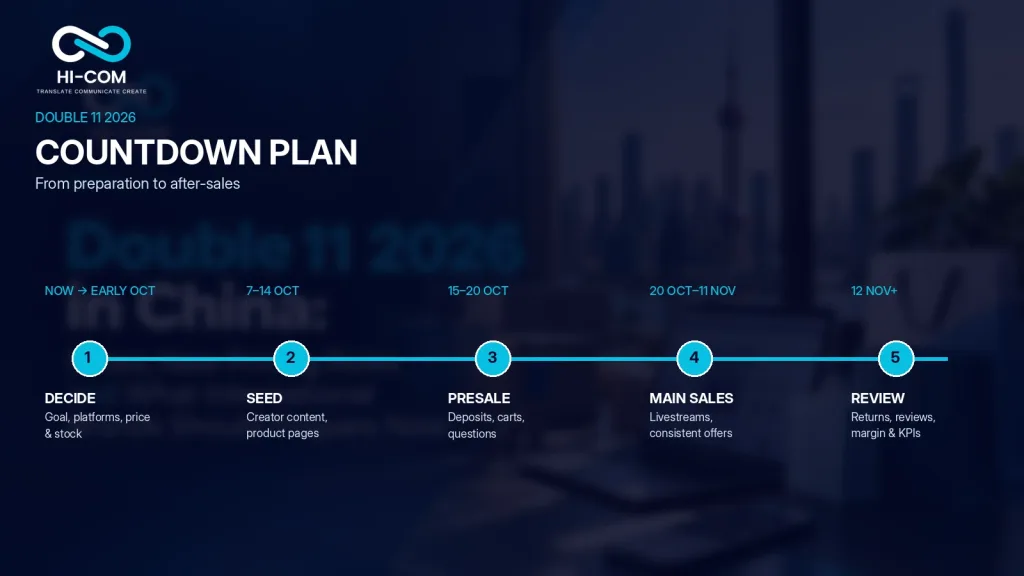
Here is how we would pace the next six weeks for a brand that decides to take part.
1. Now to 8 October: decide
2. 7 to 14 October: seed
3. 15 to 20 October: presale
4. 20 October to 11 November: main sales
5. 12 November onwards: review
Content, Creators and Livestreams: Start Before the Presale
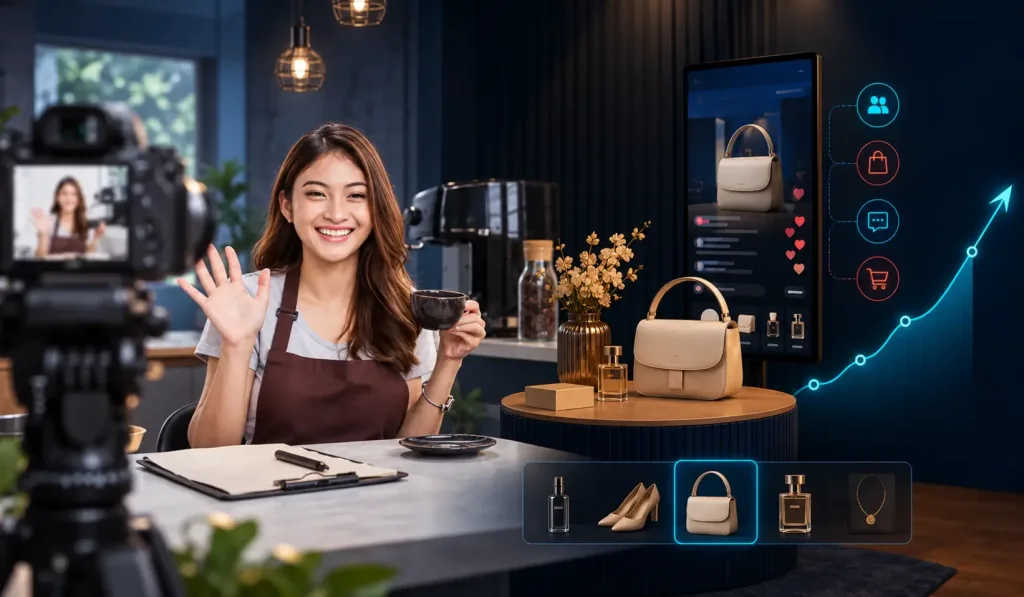
The brands that do well on Double 11 are usually the ones Chinese shoppers have already saved, searched for or talked about weeks before. Xiaohongshu is where many people research a purchase, while Douyin and Kuaishou mix short video with live selling. Three things matter most this year.
- Seed before you sell. Creator content that goes live in early October gives people a reason to add your product to their cart when the presale opens.
- Pick creators for their audience, not their follower count. A smaller creator who speaks to exactly your customer often sells more than a big generalist account.
- Treat livestreams as a series. A five-week season leaves room for several shorter sessions around different products, moments or offers, instead of betting everything on one evening.
If you are planning creator work, our KOL and influencer marketing team in China handles casting, briefs and campaign management. For a real example, see how ten creators on Douyin and Xiaohongshu generated 4.48 million views in our KOL campaign case study.
How to Measure Double 11 Without Official Totals
Market headlines will not tell you whether Double 11 worked for you. Your own numbers will. After the festival, look at:
- new customers, and how many of them buy again within three months;
- sales and return rates by platform and by channel, including distributors and livestreams;
- how content performed before the presale compared with sales during it;
- your real margin after discounts, platform fees and creator costs;
- reviews and customer-service questions, which tell you what to fix before 618 next year.
For the mid-year comparison, read our look at the 618 Shopping Festival and what foreign brands can learn from it.
How HI-COM Can Help
Our China-based marketing team plans and runs campaigns across WeChat, Douyin, Xiaohongshu and KOL partnerships, from strategy and creator casting to content, paid media and reporting. For Double 11, that means helping you decide whether and how to take part, getting seeding content live before the presale, and keeping your brand story consistent across five weeks and several platforms. You can see the full scope of our China digital marketing services here.
Planning Double 11 or Your Next China Campaign?
Tell HI-COM about your brand, your platforms and what you want this season to achieve. We will help you decide where to focus before the presale opens.
PLAN YOUR CHINA CAMPAIGN
Prefer WeChat? Scan to contact HI-COM
Frequently Asked Questions
When is Double 11 2026 in China?
Double 11 falls on 11 November, but the 2026 campaigns start much earlier. JD.com and WeChat Shop open on 12 October, Tmall presales open on 15 October, and in-stock sales on Tmall run from 20 October to 13 November. Kuaishou is reported to run from 7 October to 15 November.
When does the Tmall Double 11 2026 presale start?
Tmall opens presale deposits on 15 October 2026. Balance payments open on 20 October at 20:00 China time, the same moment in-stock sales begin, and in-stock sales continue until 13 November.
Is WeChat part of Double 11 in 2026?
Yes. WeChat Shop is running its first official Double 11 campaign from 12 October to 15 November 2026, with platform-funded vouchers for selected shops, livestream incentives and coupons that can be shared in chats and groups.
Is Double 11 still worth it for foreign brands?
It can be, if the brand has a clear goal, consistent prices across channels, stock in the right place and some existing awareness among Chinese shoppers. For premium brands with a small China presence, a focused campaign often works better than deep discounts.
Can I raise my price before Double 11 and then discount it?
It is risky. Under China’s price-marking and price-fraud rules, an unexplained “original” price must not be higher than the lowest price charged in the 7 days before the promotion. Keep your regular price stable before the event and keep a record of it.
Do trade-in subsidies apply to Double 11 purchases?
China’s 2026 trade-in programme covers eligible cars, six home appliances and four digital products, including smartphones and smart glasses, bought in stores or online. The subsidy is generally 15% with caps per item, and local rules vary. The full 2026 national budget had been allocated by 30 September.
Does Alibaba still publish Double 11 sales figures?
No. Alibaba and JD.com stopped publishing official Double 11 totals in 2022. Figures reported since then, such as Syntun’s estimate of RMB 1.695 trillion for 2025, come from third-party data firms.
This article provides general market and regulatory information and is not legal advice. Dates were checked on 30 September 2026 and may change. Prepared by HI-COM’s China-based marketing team.