





TRANSLATION HUB · AI TRANSLATION WITH HUMAN POST-EDITING
AI Translation with Human Post-Editing
HI-COM’s AI Translation with Human Post-Editing is a distinct service sized around removing obstacles on your timeline, such as a large document, a tight deadline, or both, with a qualified human editor on hand to review the AI output.

 ISO 17100-oriented process
 China-based team
 40+ languages
What is AI Translation with Human Post-Editing? It pairs fast machine translation with a qualified human editor who reviews the AI output before delivery — also known in the industry as MTPE (machine translation post-editing). It’s built for large documents and tight deadlines, not as a substitute for certified translation. See the two post-editing levels below.
Is This the Right Service for You?
This service is not valid for certified translations. It is instead built for a specific situation, such as a large document, a tight deadline, or both, where fast, accurate, and human-reviewed translation is the top priority. Therefore if your document needs official certification for a court, government body, university, or other institution, please refer to our certified translation services.
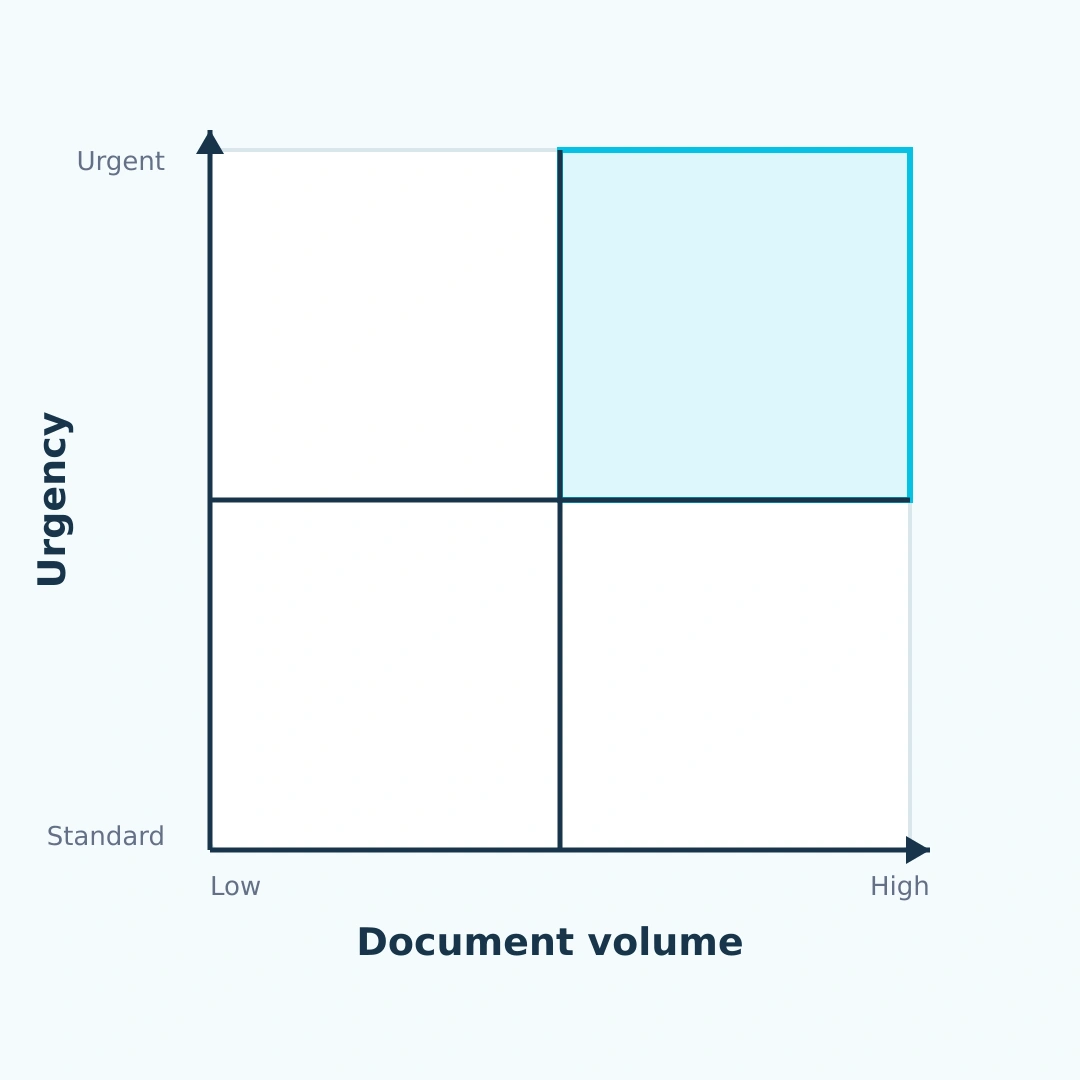
| Document Volume | Standard Timeline | Tight Deadline | Rush / Urgent |
|---|---|---|---|
| Short document | Standard Human Translation | AI Translation + Human Post-Editing | AI Translation + Human Post-Editing |
| Medium-length document | Standard Human Translation | AI Translation + Human Post-Editing | AI Translation + Human Post-Editing |
| Large document / high volume | AI Translation + Human Post-Editing | AI Translation + Human Post-Editing | AI Translation + Human Post-Editing (Priority) |
Need an official certification? Any document intended for a court, government body, university, bank, or other institution that requires certification is routed to our certified or sworn translation services instead — Certified Translation or Sworn Translation — regardless of size or deadline, since eligibility of the documents is set by the receiving authority, not by document length or speed.
Volume and deadline bands shown are illustrative. Send your document for an exact recommendation and quote.
What Does “AI Translation with Human Post-Editing” Actually Mean?
Machine translation with human post-editing follows one of two recognized levels, defined by ISO 18587, the international standard covering post-editing of AI-generated translation output.
Meaning-Level Corrections
A qualified editor corrects errors that change meaning — mistranslations, omissions, additions. Style and tone are left as the machine translation produced them. Suited to internal documents and materials where speed matters more than polish.
Publication-Ready Quality
Everything in light post-editing, plus terminology, grammar, style, tone and consistency, brought to a standard suitable for external, customer-facing or regulated use.
HI-COM offers both tiers, so your document gets the right depth of review for what it’s actually for — HI-COM will confirm which level fits your project and its intended use.
Data Privacy, PIPL, and Why Human Post-Editing Matters in China
Submitting a document containing personal information to a foreign AI translation tool can count as a cross-border data transfer under China’s Personal Information Protection Law (PIPL) — a framework, alongside the Cybersecurity Law and Data Security Law, that generally requires explicit informed consent, data minimization, and one of three compliance pathways (a CAC security assessment, CAC-approved standard contractual clauses, or third-party PIPL certification) before personal data collected in China moves outside its borders.
Most AI translation platforms don’t say where your data is processed, whether it’s retained for model training, or how it would satisfy any of these requirements. A human-in-the-loop process, run by a China-based team, keeps that handling within HI-COM’s own accountability rather than an opaque third-party pipeline — this is part of why HI-COM pairs AI speed with human post-editing rather than offering raw machine output alone.
This is operational guidance, not legal advice — consult qualified counsel for your specific situation.


What to Ask Any AI Translation Vendor About Your Data
Before sending confidential documents to any AI translation provider, it’s worth asking directly:
These are the same questions enterprise legal and IT security teams ask any vendor handling sensitive documents — a vendor that can’t answer them plainly is worth a second look regardless of price or speed.
Right Fit — Or Certified / Sworn Translation Instead?
An honest answer either way, before you send your document.
When AI Translation with Human Post-Editing Is the Right Fit
When You Need Certified or Sworn Translation Instead
If your document needs to be accepted by a court, government body, university, bank, or other institution requiring official certification or a sworn translation, that eligibility is set by the receiving authority, not by document length or deadline. AI Translation with Human Post-Editing is not a substitute for certified or sworn translation, regardless of urgency.
Frequently Asked Questions
Clear answers on AI translation with human post-editing, data privacy, and when certified or sworn translation is the right call instead.
Is AI Translation with Human Post-Editing the same as certified translation?
No. Certification and sworn-translation requirements are set by the receiving authority, not by how the translation was produced. If your document needs to be certified or sworn, Certified Translation or Sworn Translation is the right service regardless of your deadline.
Is this the same as MTPE (machine translation post-editing)?
Yes — MTPE, machine translation post-editing, is the industry term for this service. HI-COM offers both ISO 18587-defined levels, light and full post-editing, and will confirm which one fits your document.
What’s the difference between light and full post-editing?
Light post-editing fixes only errors that change meaning; full post-editing also brings the terminology, grammar, style and tone up to a standard suitable for external use. HI-COM will confirm which level fits your document and its intended use.
How fast is AI translation with human post-editing compared to standard human translation?
Turnaround depends on document volume, the post-editing level required and current workload. HI-COM doesn’t publish a fixed turnaround figure since it varies meaningfully by project — send your document details for a specific timeline.
How much does it cost?
Cost depends on document volume, the post-editing level required (light or full), language pair, and deadline. Send your document details for a specific quote.
Can I switch from AI translation to certified translation if I realize I need certification?
Yes — tell HI-COM if certification or sworn-translation requirements apply and the project will be routed to the right service instead, Certified Translation or Sworn Translation.
Is my document data safe when it’s translated using AI?
Documents are reviewed and handled by HI-COM’s China-based team throughout the process, rather than passed through an unaccountable third-party AI pipeline alone.
Does using AI translation on my documents count as a cross-border data transfer under China’s PIPL?
It can, if the document contains personal information and is processed outside China. This is why HI-COM pairs AI translation with human post-editing by a China-based team rather than offering raw machine output alone. This is general regulatory information, not legal advice — consult qualified counsel for your specific situation.
What should I ask an AI translation vendor about how they handle my data?
At minimum: where content is processed and stored and for how long, whether it’s used to train the vendor’s models, who has access, and whether a signed data processing agreement with a no-training clause is in place.
Related HI-COM Services
Ready to Send Your Document?
Send your document volume, deadline and language pair — HI-COM will confirm the right service and a clear quote.

Scan to contact us on WeChat